 Indietro
Exam 2 Study Guide: Membrane Transport, Metabolism, Cellular Respiration, and Animal Nutrition
Guida di studio - Note intelligenti
 Appunti personalizzati basati sui tuoi materiali, ampliati con definizioni chiave, esempi e contesto.
Membrane Transport & Cell Signaling
Fluid Mosaic Model of the Cell Membrane
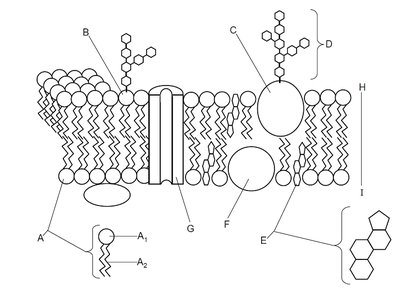
The fluid mosaic model describes the structure of the cell membrane as a dynamic combination of lipids, proteins, and carbohydrates. This model explains how membranes are flexible and selectively permeable.
Phospholipid bilayer: Provides the basic structural framework, with hydrophilic heads facing outward and hydrophobic tails inward.
Integral and peripheral proteins: Embedded or attached to the membrane, serving functions such as transport, signaling, and structural support.
Carbohydrate chains: Attached to proteins or lipids, important for cell recognition.
Cholesterol: Maintains membrane fluidity and stability.
Example: Glycoproteins act as cell surface markers for immune recognition. 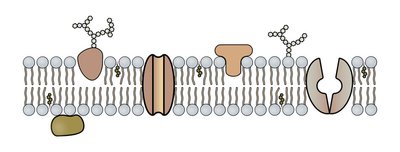
Selective Permeability
The membrane's structure allows certain molecules to pass while restricting others, based on size, charge, and solubility.
Small, nonpolar molecules (e.g., O2, CO2) diffuse freely.
Large or charged molecules require transport proteins.
Example: Water moves through aquaporins, specialized channel proteins.
Transport Mechanisms
Simple diffusion: Movement of molecules from high to low concentration without energy input.
Facilitated diffusion: Uses channel or carrier proteins for passive transport.
Osmosis: Diffusion of water across a semipermeable membrane.
Active transport: Requires energy (ATP) to move substances against their concentration gradient.
Bulk transport: Endocytosis and exocytosis move large particles or volumes.
Example: Sodium-potassium pump uses ATP to maintain ion gradients.
Signal Transduction Pathways
Signal transduction involves three key steps:
Reception: A signaling molecule binds to a receptor protein.
Transduction: The signal is relayed and amplified through a cascade of molecular events.
Response: The cell alters its activity, such as gene expression or metabolic change.
Example: Hormone binding triggers a phosphorylation cascade.
Nervous & Endocrine System Signaling
Intercellular Signaling Pathways
Animals use both nervous and endocrine systems for communication.
Nervous system: Fast, electrical signals transmitted via neurons.
Endocrine system: Slow, chemical signals (hormones) released into the bloodstream.
Comparison Table:
Feature | Nervous System | Endocrine System |
|---|---|---|
Speed | Rapid | Slow |
Signal Type | Electrical/Chemical | Chemical (Hormones) |
Target | Specific cells | Broad tissues/organs |
Hypothalamus and Pituitary: The hypothalamus links the nervous and endocrine systems, controlling the pituitary gland, which releases hormones to regulate bodily functions.
Introduction to Metabolism
Thermodynamics in Biology
1st Law: Energy cannot be created or destroyed, only transformed.
2nd Law: Energy transformations increase entropy (disorder).
Application: Cells convert chemical energy in food to ATP, releasing heat.
Free Energy (G) and Reactions
Free energy (G): The energy available to do work.
Spontaneous reactions: Occur when ΔG is negative (exergonic).
Endergonic reactions: Require input of energy (ΔG positive).
Equation:
ATP Coupling and Hydrolysis
ATP hydrolysis releases energy, which is used to drive endergonic reactions.
ATP: Adenosine triphosphate, the cell's energy currency.
Coupling: Linking ATP hydrolysis to energy-requiring processes.
Example: Muscle contraction uses ATP.
Enzymes and Metabolic Regulation
Enzymes: Biological catalysts that lower activation energy.
Regulation: Allosteric inhibition, feedback inhibition, and competitive inhibition control enzyme activity.
Example: Phosphofructokinase is regulated by ATP levels in glycolysis.
Cellular Respiration & Fermentation
Redox Reactions and Energy Yield
Catabolic pathways oxidize organic fuels, transferring electrons to generate ATP.
Oxidation: Loss of electrons.
Reduction: Gain of electrons.
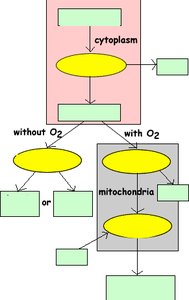
Pathway of Glucose Oxidation
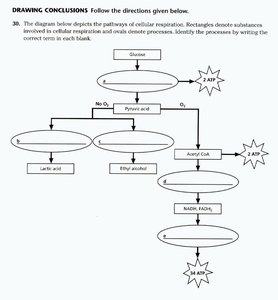
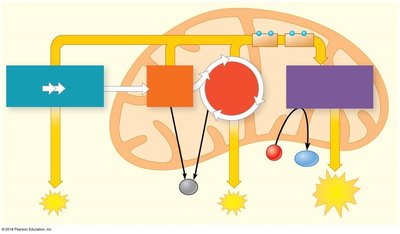
Glycolysis: Glucose is split into pyruvate, yielding 2 ATP.
Pyruvate oxidation: Pyruvate is converted to Acetyl-CoA.
Citric Acid Cycle: Acetyl-CoA is oxidized, producing NADH, FADH2, and 2 ATP.
Oxidative phosphorylation: Electron transport chain and chemiosmosis produce ~34 ATP.
Fermentation
Lactic acid fermentation: Pyruvate is reduced to lactic acid.
Alcohol fermentation: Pyruvate is converted to ethanol and CO2.
Example: Yeast performs alcohol fermentation in bread making.
Electron Transport Chain (ETC)
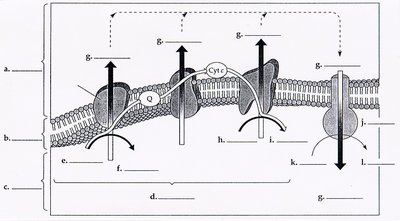
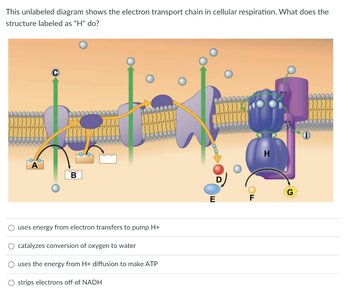
The ETC uses electron carriers to transfer electrons, pumping protons to create a gradient used by ATP synthase.
ATP synthase: Enzyme that synthesizes ATP using proton motive force.
Proton gradient: Drives ATP production.
Animal Nutrition
Dietary Needs and Essential Nutrients
Animals require chemical energy, organic molecules, and four classes of essential nutrients: amino acids, fatty acids, vitamins, and minerals.
Chemical energy: Provided by carbohydrates, fats, and proteins.
Essential nutrients: Cannot be synthesized by the body and must be obtained from diet.
Food Processing Stages
Ingestion: Intake of food.
Digestion: Breakdown of food into absorbable molecules.
Absorption: Uptake of nutrients into cells.
Elimination: Removal of undigested material.
Digestive System Organization
Gastrovascular cavity: Single opening for digestion and absorption.
Alimentary canal: Complete digestive tract with separate mouth and anus.
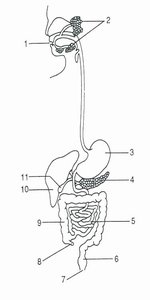
Mammalian Digestive System
Mouth: Mechanical and enzymatic digestion.
Esophagus: Transports food to stomach.
Stomach: Churning and enzymatic breakdown.
Small intestine: Major site of absorption.
Large intestine: Water absorption and feces formation.
Evolutionary Adaptations
Digestive systems are adapted to diet, such as longer intestines in herbivores for cellulose digestion.
Negative Feedback in Nutrition Regulation
Negative feedback mechanisms regulate nutrient intake, processing, and storage, maintaining homeostasis. Example: Insulin and glucagon regulate blood glucose levels.
Vocabulary Review
Key Terms
Active Transport: Movement of substances against a concentration gradient using energy.
ATP Synthase: Enzyme that produces ATP in mitochondria.
Enzyme: Protein catalyst for biochemical reactions.
Fermentation: Anaerobic process producing ATP.
Glycolysis: First step in cellular respiration.
Metabolism: All chemical reactions in an organism.
Osmosis: Diffusion of water.
Selective Permeability: Membrane property allowing certain substances to pass.
Signal Transduction: Cellular process of responding to signals.
Additional info: These notes expand on brief learning objectives and vocabulary to provide a comprehensive, exam-focused review of membrane transport, metabolism, cellular respiration, and animal nutrition, with relevant diagrams included for visual reinforcement.
