 Indietro
Exam 4 Review: Photosynthesis, Cellular Respiration, and Cell Cycle
Guida di studio - Note intelligenti
 Appunti personalizzati basati sui tuoi materiali, ampliati con definizioni chiave, esempi e contesto.
Photosynthesis
Overview of Photosynthesis
Photosynthesis is the process by which autotrophic organisms, such as plants, convert light energy into chemical energy stored in glucose. It occurs in the chloroplasts and consists of two main stages: the light-dependent reactions and the Calvin Cycle (light-independent reactions).
Photosynthetic Equation:
Autotrophs: Organisms that produce their own food via photosynthesis.
Chloroplast: The organelle where photosynthesis occurs.
Light-Dependent Reactions
These reactions occur in the thylakoid membranes of the chloroplast and require light to produce ATP and NADPH.
Location: Thylakoid membrane
Reactants: Water, light, ADP, NADP+
Products: Oxygen, ATP, NADPH
Calvin Cycle (Light-Independent Reactions)
The Calvin Cycle uses ATP and NADPH to convert CO2 into glucose.
Location: Stroma of the chloroplast
Reactants: CO2, ATP, NADPH
Products: Glucose, ADP, NADP+
Stages: Carbon fixation, reduction, regeneration of RuBP
Types of Photosynthetic Plants
C3 Plants: Use the Calvin Cycle directly; most common.
C4 Plants: Adapted to hot climates; minimize photorespiration.
CAM Plants: Adapted to arid environments; open stomata at night.
Photosynthetic Pigments
Chlorophyll a: Main pigment
Chlorophyll b, carotenoids: Accessory pigments
Cellular Respiration
Overview of Cellular Respiration
Cellular respiration is the process by which cells extract energy from glucose to produce ATP. It occurs in the mitochondria and consists of glycolysis, the citric acid cycle, and the electron transport chain.
Cellular Respiration Equation:
Aerobic Respiration: Requires oxygen
ATP: The main energy currency of the cell
Steps of Cellular Respiration
Glycolysis: Occurs in the cytoplasm; breaks down glucose into pyruvate; produces 2 ATP
Citric Acid Cycle (Krebs Cycle): Occurs in the mitochondrial matrix; produces CO2, NADH, FADH2, and 2 ATP
Electron Transport Chain: Occurs in the inner mitochondrial membrane; produces most ATP (up to 34 ATP)
Fermentation
Fermentation is an anaerobic process that occurs when oxygen is not available. It allows glycolysis to continue by regenerating NAD+.
Location: Cytoplasm
Products: Lactic acid (animals), ethanol (plants and fungi)
Comparison: Both fermentation and cellular respiration start with glycolysis, but fermentation produces less ATP.
Energy Organelles
Mitochondria vs. Chloroplast
Both mitochondria and chloroplasts are energy organelles involved in cellular metabolism.
Mitochondria: Site of cellular respiration; found in all eukaryotic cells
Chloroplast: Site of photosynthesis; found in plant and algal cells
ReDox Cycle: Both organelles participate in oxidation-reduction reactions
Mitochondria Structure and Function
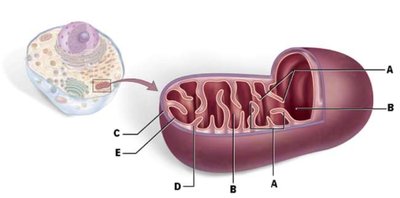
The mitochondrion has distinct regions where different steps of cellular respiration occur.
Outer Membrane (A): Separates mitochondrion from cytoplasm
Inner Membrane (B): Site of electron transport chain
Intermembrane Space (C): Space between outer and inner membranes
Matrix (D): Site of citric acid cycle
Cristae (E): Folds of inner membrane; increase surface area for ATP production
The Cell Cycle
Stages of the Cell Cycle
The cell cycle is the series of events that cells go through as they grow and divide.
Interphase: G1 (growth), S (DNA synthesis), G2 (preparation for division)
Mitosis: Division of the nucleus; includes prophase, metaphase, anaphase, telophase
Cytokinesis: Division of the cytoplasm
Apoptosis and Cancer
Apoptosis: Programmed cell death; involves enzymes called caspases
Cancer: Uncontrolled cell division; caused by mutations in proto-oncogenes and tumor-suppressor genes
Angiogenesis: Formation of new blood vessels to supply tumors
Metastasis: Spread of cancer cells to other parts of the body
Diploid vs. Haploid Cells
Diploid (2n): Cells with two sets of chromosomes
Haploid (n): Cells with one set of chromosomes
Calculation: Diploid number = 2 × haploid number
Binary Fission and Mitosis
Binary Fission
Binary fission is the method by which prokaryotic cells divide.
Location of genetic information: Nucleoid region in bacteria
Comparison: Binary fission is simpler than mitosis; no mitotic spindle
Mitosis
Mitosis is the process by which eukaryotic cells divide their nucleus.
Phases: Prophase, metaphase, anaphase, telophase
Cytokinesis: Animal cells form a cleavage furrow; plant cells form a cell plate
Failure of cytokinesis: Results in multinucleated cells
Summary Table: Cellular Respiration Steps
Step | Location | ATP Produced | Main Products |
|---|---|---|---|
Glycolysis | Cytoplasm | 2 | Pyruvate, NADH |
Citric Acid Cycle | Mitochondrial Matrix | 2 | CO2, NADH, FADH2 |
Electron Transport Chain | Inner Mitochondrial Membrane | ~34 | ATP, H2O |
Summary Table: Photosynthesis Reactions
Reaction | Location | Reactants | Products |
|---|---|---|---|
Light-Dependent | Thylakoid Membrane | H2O, Light | O2, ATP, NADPH |
Calvin Cycle | Stroma | CO2, ATP, NADPH | Glucose |
Additional info: Academic context was added to clarify the steps, locations, and products of photosynthesis and cellular respiration, as well as the structure and function of mitochondria.
