 Indietro
Exam II Review: Invertebrate & Vertebrate Diversity, Animal Form and Function, and Study Strategies
Guida di studio - Note intelligenti
 Appunti personalizzati basati sui tuoi materiali, ampliati con definizioni chiave, esempi e contesto.
Invertebrate & Vertebrate Diversity
Phylogeny and Classification of Animal Groups
Understanding the diversity of invertebrates and vertebrates is essential for grasping evolutionary relationships and the defining traits of each phylum. Students should be able to draw phylogenetic trees from memory, name representative organisms, and describe key characteristics.
Invertebrates: Include phyla such as Porifera (sponges), Mollusca, Arthropoda, Annelida, Echinodermata, and Cnidaria.
Vertebrates: Subphylum of Chordata, characterized by a backbone, including fish, amphibians, reptiles, birds, and mammals.
Defining Traits: Each phylum has unique features, such as water vascular systems in echinoderms, open circulatory systems in arthropods, and notochord in chordates.
Example: "State which phylum includes sponges." (Porifera)
Key Chordate Characteristics
Chordates share four key traits: notochord, dorsal hollow nerve cord, pharyngeal slits, and a muscular post-anal tail. Vertebrates are a subgroup of chordates distinguished by the presence of vertebrae.
Notochord: Flexible rod providing support.
Dorsal, hollow nerve cord: Develops into the central nervous system.
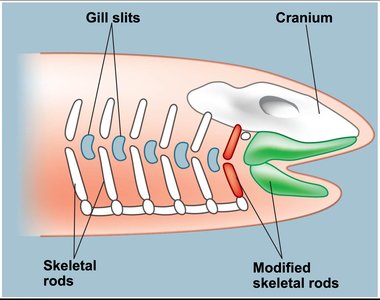
Pharyngeal slits: Used for filter-feeding or gas exchange.
Muscular post-anal tail: Provides mobility.
Example: "Which chordate group has all four key characteristics as a larva?" (Tunicates)
Evolution of Vertebrate Traits
Vertebrates evolved several unique features, including neural crest cells, jaws, and amniotic eggs. The skeletal components of jaws are derived from pharyngeal arches.
Neural crest cells: Contribute to the development of diverse structures.
Jaws: Modified skeletal rods from pharyngeal arches.
Amniotic egg: Key adaptation for terrestrial life.
Animal Form and Function
Levels of Biological Organization
Biological complexity is organized hierarchically, from organelles to organ systems. Understanding this hierarchy is fundamental for studying animal physiology.
Order of complexity: Organ system > Organ > Tissue > Cell > Organelle
Example: "Place the following levels in order of complexity."
Basic Tissue Types
All organs and organ systems are composed of four basic tissue types: epithelial, muscle, nervous, and connective tissue.
Epithelial tissue: Lines and covers organs and body cavities.
Muscle tissue: Produces movement through contraction.
Nervous tissue: Transmits information within the body.
Connective tissue: Stabilizes and connects anatomical structures.
Homeostasis and Thermoregulation
Homeostasis is the maintenance of stable internal conditions. Thermoregulation involves physiological and behavioral adaptations to regulate body temperature.
Four universal components of homeostatic control: Sensor, Control Center, Effector, Response.
Heat exchange mechanisms: Conduction, convection, radiation, evaporation.
Example: "When a snake moves to a sun-warmed patch, conduction transfers heat from pavement to snake."
Metabolic Rate and Energetics
Metabolic rate is influenced by thermoregulation strategies. Ectotherms have lower energetic requirements than endotherms.
Standard Metabolic Rate (SMR): Measured under comfortable temperature range.
Example: "SMR of an alligator is less than 1/20th that of a human."
Animal Nutrition and Digestion
Digestive System Structure and Function
Animals must exchange nutrients, gases, and waste with the environment. The digestive system includes specialized organs and enzymes for nutrient absorption.
Organs of digestion: Mouth, stomach, small intestine, large intestine.
Digestive enzymes: Amylase, pepsin, lipase, etc.
Sites of nutrient absorption: Small intestine (amino acids, sugars), lymphatic system (fats).
Example: "First opportunity for enzymatic hydrolysis is in the mouth."
Digestive Tract Types
A complete digestive tract (alimentary canal) differs from a gastrovascular cavity by having specialized compartments and permitting extracellular digestion.
Alimentary canal: Mouth to anus, specialized regions.
Gastrovascular cavity: Single opening, less specialization.
Enzymes and Secretions
Digestive enzymes and secretions play critical roles in breaking down food. Hydrochloric acid activates pepsinogen and denatures proteins; bile salts emulsify fats.
Hydrochloric acid: Activates pepsinogen, denatures proteins.
Bile salts: Emulsify fat droplets for digestion.
Example: "Bile salts function by emulsifying big droplets of fats to small droplets."
Absorption Pathways
After digestion, nutrients are absorbed via different pathways. Amino acids enter the vascular system, while fats (as chylomicrons) enter the lymphatic system.
Chylomicrons: Transported via lymphatic system.
Amino acids: Absorbed into vascular system.
Study Strategies for Biology
Effective Textbook Reading
Active reading strategies enhance learning and retention. Students should preview chapters, focus on bold terms, and summarize concepts in their own words.
Preview: Flip through pages to understand structure.
Question: Read end-of-chapter questions.
Highlight: Focus on bold words and headings.
Summarize: Write notes as if teaching a friend.
Pomodoro Technique
The Pomodoro Technique is a time management method that encourages focused study sessions followed by short breaks, improving productivity and retention.
Work in intervals: Typically 25 minutes of study, 5-minute break.
Repeat: After four sessions, take a longer break.
Bloom’s Taxonomy and Critical Thinking
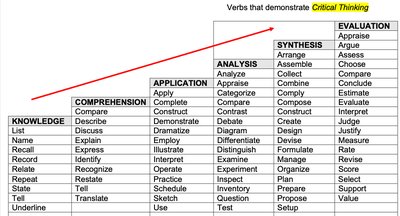
Bloom’s Taxonomy provides a framework for developing higher-order thinking skills, from knowledge recall to evaluation and synthesis. Using verbs and question stems from each level helps students self-test and deepen understanding.
Levels: Knowledge, Comprehension, Application, Analysis, Synthesis, Evaluation.
Useful verbs: Tell, explain, apply, analyze, create, judge.
Sample question stems: "Can you write in your own words...?" "Can you design a ...?" "Is there a better solution to ...?"
Sample Question Stems by Bloom’s Level
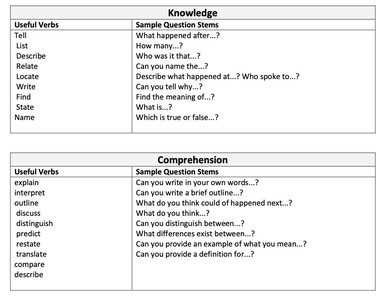
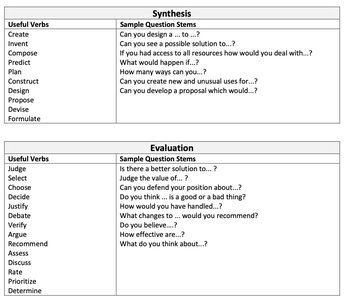
Using specific question stems helps target different cognitive skills. Below are examples for Knowledge, Comprehension, Synthesis, and Evaluation.
Level | Useful Verbs | Sample Question Stems |
|---|---|---|
Knowledge | Tell, List, Describe, Relate, Locate, Write, Find, State | What happened after...? How many...? Who was it that...? Which is true or false...? |
Comprehension | Explain, Interpret, Outline, Discuss, Distinguish, Predict, Translate, Compare, Describe | Can you write in your own words...? What do you think could have happened next...? What differences exist between...? |
Synthesis | Create, Invent, Compose, Predict, Plan, Construct, Design, Propose, Devise, Formulate | Can you design a ... to...? What would happen if...? Can you create new and unusual uses for...? |
Evaluation | Judge, Select, Decide, Justify, Verify, Argue, Assess, Discuss, Rate, Determine | Is there a better solution to...? Judge the value of...? How would you rate...? What changes would you recommend...? |
Additional info: The study tips and question stems are directly relevant for exam preparation in General Biology, especially for topics on animal diversity, physiology, and critical thinking.
