 Indietro
Extensions to Mendelian Genetics: Linkage, Recombination, and Non-Mendelian Inheritance
Guida di studio - Note intelligenti
 Appunti personalizzati basati sui tuoi materiali, ampliati con definizioni chiave, esempi e contesto.
Extensions to Mendelian Genetics
Introduction
Mendel’s principles of inheritance laid the foundation for classical genetics, but many patterns of inheritance observed in nature extend beyond his original laws. This section explores key extensions to Mendelian genetics, including genetic recombination, linkage mapping, co-dominance, gene interactions, and phenomena such as pleiotropy and multiple allelism.
I. Genetic Recombination
Definition and Mechanism
Genetic recombination refers to the exchange of genetic material between homologous chromosomes during meiosis, resulting in new combinations of alleles in offspring.
This process increases genetic diversity and is a fundamental aspect of sexual reproduction.
Example: If an organism has the genotype ABCDEF/abcdef, crossing over before gene C can produce gametes with mixed combinations of alleles, such as ABcdef or abcDEF.
II. Linkage and Linkage Mapping
Linkage
Linked genes are genes located close together on the same chromosome and tend to be inherited together.
Mendel did not describe linkage, as the genes he studied were on different chromosomes or far apart on the same chromosome.
Linkage Mapping
Linkage mapping is the process of determining the relative positions of genes on a chromosome based on recombination frequencies.
Sturtevant’s insight: The percentage of recombinant offspring is proportional to the physical distance between genes.
Example: In fruit flies, the recombination frequency between yellow and white eye genes is 1.4%, while between yellow and sable body it is 43%. This suggests yellow and white are close together, while yellow and sable are far apart.
Sample Linkage Map Data
Gene Pair | Recombination Frequency (%) |
|---|---|
Yellow - White | 1.4 |
Yellow - Sable | 43 |
White - Sable | 41.6 |
Crossveinless - Sable | 29.3 |
Crossveinless - White | 12.3 |
Application: These frequencies are used to construct genetic maps, with 1% recombination equivalent to 1 map unit (centimorgan, cM).
Chromosome Structure Example
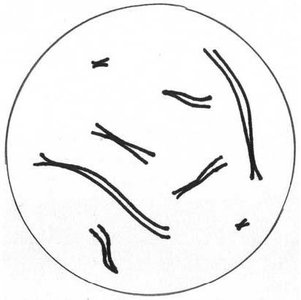
The following image shows a cell with chromosomes at a stage of division, useful for visualizing chromosome number and structure in linkage studies.
III. Co-dominance
Definition and Example
Co-dominance occurs when both alleles in a heterozygote are fully expressed, resulting in offspring with a phenotype that is neither dominant nor recessive.
Example: The ABO blood group system in humans:
IA allele: Glycoprotein A on red blood cells
IB allele: Glycoprotein B on red blood cells
i allele: No gene product
Genotypes and phenotypes:
IAIA or IAi: Type A blood
IBIB or IBi: Type B blood
IAIB: Type AB blood (both glycoproteins present; co-dominance)
ii: Type O blood
Application: If Sarah has blood type A, her parents could have genotypes that produce A or O alleles (e.g., IAIA, IAi, or ii).
IV. Gene Interactions and Other Extensions
Gene x Gene and Gene x Environment Interactions
Phenotypes can be influenced by interactions between different genes (epistasis) or between genes and environmental factors.
Pleiotropy and Multiple Allelism
Pleiotropy: A single gene affects multiple traits.
Multiple allelism: More than two alleles exist for a gene in a population (e.g., ABO blood group).
V. Practice Problems and Applications
Determining chromosome number and ploidy: For a genotype such as ABCDEF/abcdef, if there are 8 chromosomes, the cell is diploid.
Predicting gametes: Crossing over before a gene can produce recombinant gametes with new allele combinations.
Statistical tests: To analyze experimental data (e.g., termite behavior), appropriate tests include linear regression, t-test, ANOVA, histogram, or chi-square, depending on the data type and hypothesis.
Additional info: These extensions to Mendelian genetics are fundamental for understanding complex inheritance patterns, genetic mapping, and the molecular basis of traits in populations.
