 Indietro
Lecture 15
Guida di studio - Note intelligenti
 Appunti personalizzati basati sui tuoi materiali, ampliati con definizioni chiave, esempi e contesto.
Fermentation
Overview of Fermentation
Fermentation is a catabolic pathway that enables cells to break down glucose and produce ATP without the presence of oxygen. This process is essential for organisms that live in anaerobic environments or when oxygen is temporarily unavailable.
Definition: Fermentation is the metabolic process that converts glucose to energy (ATP) in the absence of oxygen.
Location: Entirely occurs in the cytoplasm of the cell.
Required Molecules: Glucose, ATP, NAD+
Steps of Fermentation
Glycolysis
Location: Cytoplasm
Purpose: Converts glucose into pyruvate, producing ATP and NADH.
Reactants: 1 Glucose, 2 NAD+, 2 ATP
Products: 2 Pyruvate, 2 NADH, 4 ATP (net gain: 2 ATP)
Fermentation Pathways
Purpose: Regenerates NAD+ from NADH, allowing glycolysis to continue.
Location: Cytoplasm
Types:
Lactic Acid Fermentation
Reactants: 2 Pyruvate, 2 NADH
Products: 2 Lactate, 2 NAD+
Example: Occurs in human muscle cells during intense exercise.
Ethanol Fermentation
Reactants: 2 Pyruvate, 2 NADH
Products: 2 Ethanol, 2 CO2, 2 NAD+
Example: Occurs in yeast cells, used in brewing and baking.
Summary Table: Fermentation Pathways
Pathway | Reactants | Products | Example Organism |
|---|---|---|---|
Lactic Acid Fermentation | 2 Pyruvate, 2 NADH | 2 Lactate, 2 NAD+ | Humans (muscle cells) |
Ethanol Fermentation | 2 Pyruvate, 2 NADH | 2 Ethanol, 2 CO2, 2 NAD+ | Yeast |
Purpose and Importance
Regeneration of NAD+: Essential for continued glycolysis and ATP production.
Energy Yield: Fermentation yields less ATP than aerobic respiration.
Photosynthesis
Introduction to Photosynthesis
Photosynthesis is the process by which photoautotrophs convert solar energy into chemical energy, producing organic molecules and oxygen. It is fundamental to life on Earth, supporting both autotrophs and heterotrophs.
Autotrophs: Organisms that produce their own food from inorganic sources (e.g., plants, algae, cyanobacteria).
Photoautotrophs: Use sunlight to synthesize organic compounds.
Heterotrophs: Obtain energy and carbon from organic material produced by other organisms.
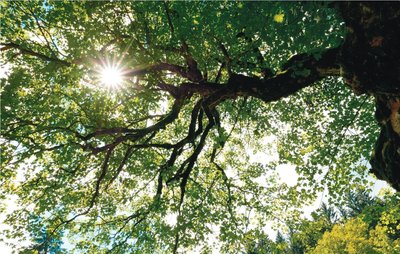
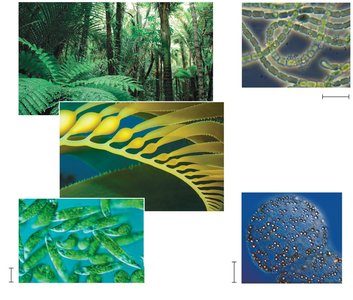
Photoautotrophs and Their Diversity
Photoautotrophs include a wide range of organisms, from plants to unicellular protists and bacteria. They are the primary producers in most ecosystems.
Examples: Plants, multicellular algae, unicellular protists, cyanobacteria, purple sulfur bacteria.
Chloroplasts: The Site of Photosynthesis
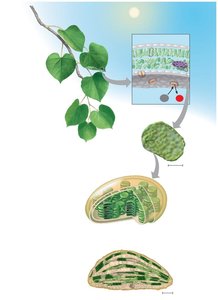
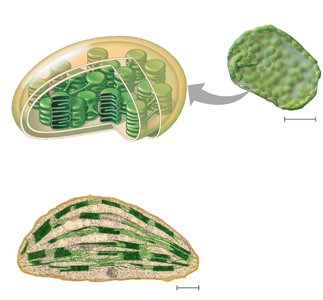
Photosynthesis occurs in chloroplasts, which are specialized organelles found mainly in the mesophyll cells of leaves. Chloroplasts contain the molecular machinery required for capturing light energy and converting it into chemical energy.
Leaf Structure: CO2 enters and O2 exits through stomata.
Mesophyll Cells: Interior tissue of the leaf, rich in chloroplasts.
Chloroplast Structure: Contains outer and inner membranes, thylakoids (site of light reactions), and stroma (site of Calvin cycle).
Photosynthesis: The Overall Equation
Photosynthesis is a complex series of reactions summarized by the following equation:
Reactants: 6 CO2, 12 H2O
Products: C6H12O6, 6 H2O, 6 O2
Equation:

Photosynthesis as a Redox Process
Photosynthesis reverses the direction of electron flow compared to cellular respiration. Water is oxidized, and carbon dioxide is reduced, with light energy driving the endergonic reaction.
Oxidation: Loss of electrons (H2O → O2)
Reduction: Gain of electrons (CO2 → C6H12O6)
Stages of Photosynthesis
Photosynthesis consists of two main stages: the light reactions and the Calvin cycle. These stages cooperate to convert light energy into chemical energy and synthesize organic molecules.
Light Reactions: Occur in the thylakoid membranes; convert solar energy to ATP and NADPH, release O2.
Calvin Cycle: Occurs in the stroma; uses ATP and NADPH to convert CO2 into sugars.
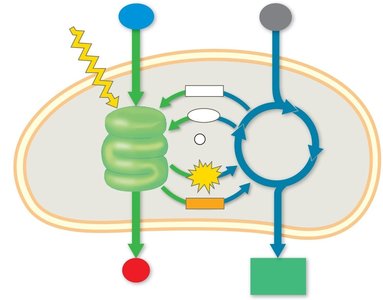
Summary Table: Stages of Photosynthesis
Stage | Location | Main Reactants | Main Products |
|---|---|---|---|
Light Reactions | Thylakoid Membrane | H2O, Light, NADP+, ADP | O2, ATP, NADPH |
Calvin Cycle | Stroma | CO2, ATP, NADPH | Glucose (or 3-carbon sugar), NADP+, ADP |
Importance of Photosynthesis
Supports the Biosphere: Provides food and oxygen for nearly all life forms.
Foundation of Ecosystems: Autotrophs are primary producers; heterotrophs depend on them.
Study Tips
Review concept maps and diagrams of fermentation and photosynthesis.
Practice explaining each step, including reactants, products, and purposes.
Draw and label the stages and organelles involved in both processes.
Additional info: The direct product of photosynthesis is a three-carbon sugar (G3P), which is used to make glucose. Fermentation is less efficient than aerobic respiration, yielding only 2 ATP per glucose molecule.
