 Indietro
Foundations of Biology: Cells, Microscopy, and the Chemical Context of Life
Guida di studio - Note intelligenti
 Appunti personalizzati basati sui tuoi materiali, ampliati con definizioni chiave, esempi e contesto.
The Process of Science and Foundations of Biology
Introduction to Biology
Biology is the scientific study of life, encompassing a wide range of topics from molecular mechanisms to ecosystem dynamics. The process of science involves observation, hypothesis formation, experimentation, and analysis to understand the natural world. - Biology seeks to answer fundamental questions such as "What is life?" - The scientific method is central to biological inquiry. 
Properties of Life
Living organisms share several key properties that distinguish them from non-living matter. - Order: Highly organized structures. - Regulation: Ability to maintain internal stability (homeostasis). - Evolutionary adaptation: Ability to change over generations. - Reproduction: Ability to produce offspring. - Energy processing: Use and transformation of energy. - Response to environment: Reacting to stimuli. - Growth and development: Increase in size and complexity. 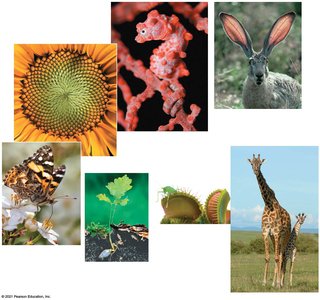
Microscopy and an Overview of Cells
Cells: The Fundamental Unit of Life
Cells are the lowest level of structure capable of performing all activities of life. All living organisms are composed of cells, which can be classified as prokaryotic or eukaryotic. - Cell theory: All living things are composed of cells; cells are the basic unit of life. - Two basic cell types: prokaryotic and eukaryotic. 
The Three Domains of Life
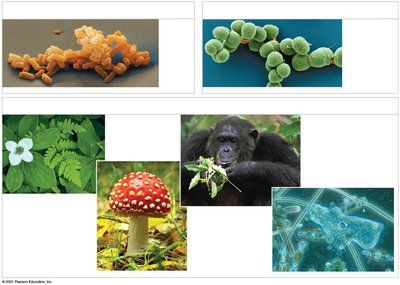
Life is classified into three domains based on cell type and genetic characteristics: Bacteria, Archaea, and Eukarya. - Prokaryotes: Domains Bacteria and Archaea; unicellular, lack membrane-bound organelles. - Eukaryotes: Domain Eukarya; includes animals, plants, fungi, and protists; can be unicellular or multicellular. 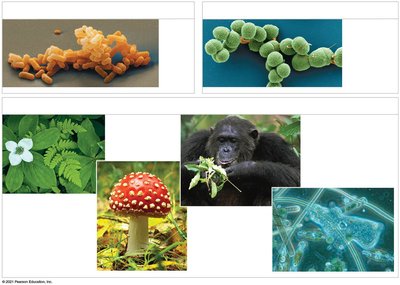
Levels of Biological Organization
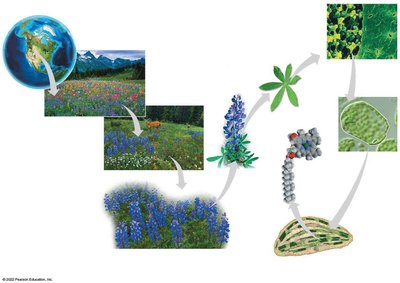
Multicellular organisms exhibit structural levels above the cell: tissues, organs, and organ systems. - Tissues: Groups of similar cells performing specialized functions. - Organs: Structures composed of multiple tissues working together. - Organ systems: Groups of organs coordinating to perform major functions. 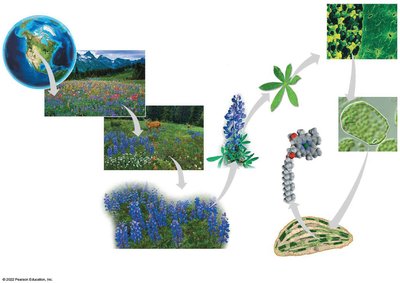
Comparing Prokaryotic and Eukaryotic Cells
Prokaryotic cells are simpler and smaller, lacking a nucleus and membrane-bound organelles. Eukaryotic cells have internal membranes and organelles, including a nucleus. - All cells: Enclosed by a semi-permeable membrane and use DNA as genetic information. - Prokaryotic cells: DNA in nucleoid, no membrane-bound organelles. - Eukaryotic cells: DNA in nucleus, membrane-bound organelles. 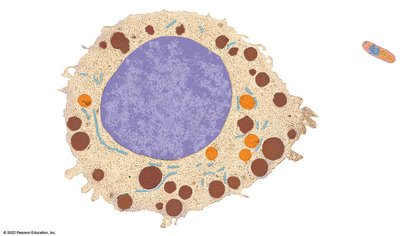
Cell Size and Microscopy
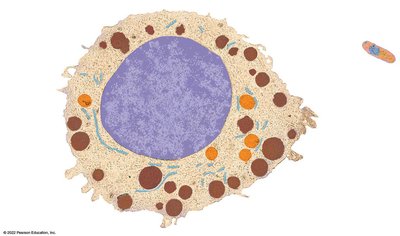
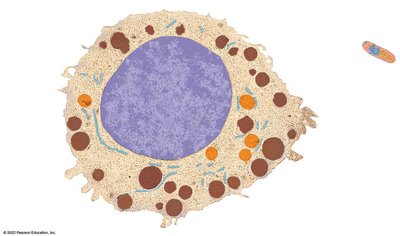
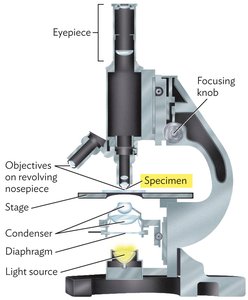
Cells vary in size, with bacteria typically 1–5 μm and eukaryotic cells 10–100 μm. Microscopes are essential tools for studying cell structure. - Magnification: Ratio of image size to real size. - Resolution: Clarity of the image; minimum distance between distinguishable points. - Contrast: Difference in brightness between light and dark areas. 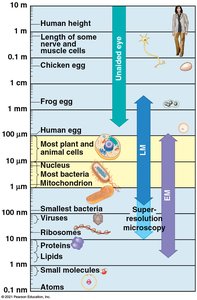
Types of Microscopy
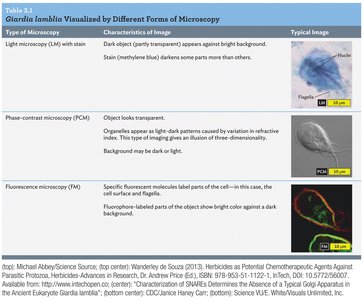
Different forms of microscopy provide varying levels of detail and contrast.
Type of Microscopy | Characteristics | Typical Image |
|---|---|---|
Light microscopy (LM) | Dark object against bright background; stains enhance contrast | Flagella (LM) |
Phase-contrast microscopy (PCM) | Transparent objects; enhances contrast by refractive index | PCM image |
Fluorescence microscopy (FM) | Fluorescent molecules label cell parts; bright color against dark background | FM image |
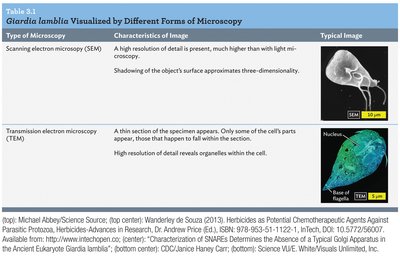
Type of Microscopy | Characteristics | Typical Image |
|---|---|---|
Scanning electron microscopy (SEM) | High resolution; surface detail; three-dimensional appearance | SEM image |
Transmission electron microscopy (TEM) | High resolution; internal cell detail; thin section | TEM image |
Overview of Eukaryotic Cell Types
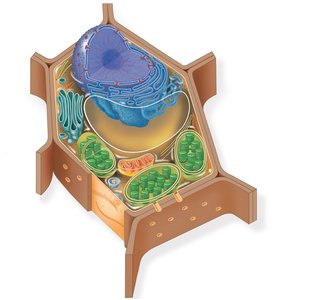
Eukaryotic cells contain various organelles, each with specialized functions. - Nucleus: Contains DNA, controls cell activities. - Endoplasmic reticulum (ER): Synthesis of proteins and lipids. - Golgi apparatus: Modifies, sorts, and packages proteins. - Mitochondrion: Site of cellular respiration and ATP production. - Lysosome: Digests macromolecules. - Peroxisome: Metabolic functions, detoxification. - Cytoskeleton: Structural support, cell movement. 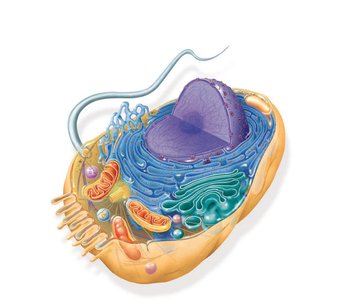
The Chemical Context of Life
Matter, Elements, and Atoms
Matter is anything that occupies space and has mass. It is composed of elements, which are substances that cannot be broken down by chemical reactions. - Element: Pure substance with unique properties; 92 naturally occurring elements. - Atom: Smallest unit of an element, retains its properties. 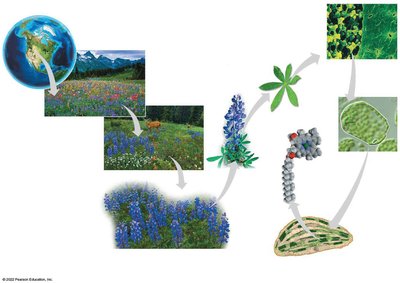
Essential Elements and Trace Elements
Only a subset of elements are essential for life. - Essential elements: Required for survival, growth, and reproduction; include carbon, hydrogen, oxygen, and nitrogen (96% of living matter). - Trace elements: Needed in minute quantities (e.g., iron, zinc, iodine).
Element | Symbol | Percentage of Body Mass |
|---|---|---|
Oxygen | O | 65.0% |
Carbon | C | 18.5% |
Hydrogen | H | 9.5% |
Nitrogen | N | 3.3% |
Calcium | Ca | 1.5% |
Phosphorus | P | 1.0% |
Potassium | K | 0.4% |
Sulfur | S | 0.3% |
Sodium | Na | 0.2% |
Chlorine | Cl | 0.2% |
Magnesium | Mg | 0.1% |
Atomic Structure
The properties of an element depend on the structure of its atoms, which are composed of subatomic particles: protons, neutrons, and electrons. - Protons: Positive charge, found in nucleus. - Neutrons: No charge, found in nucleus. - Electrons: Negative charge, orbit nucleus. - Atomic number: Number of protons in nucleus. - Mass number: Number of protons plus neutrons. - Atomic mass: Total mass, approximated by mass number.
Scale and Structure of Atoms
Atoms are extremely small, with the nucleus occupying a tiny fraction of the total volume. Electrons form a cloud around the nucleus. - Analogy: If an atom were the size of a football field, the nucleus would be the size of a pencil eraser, and electrons would be like gnats flying around the perimeter. Example: Sodium (Na) has 11 protons, 12 neutrons, and 11 electrons in a neutral atom. Additional info: These foundational concepts are essential for understanding subsequent topics in cell biology, genetics, and biochemistry.
