 Indietro
Foundations of Biology: Themes, Organization, and Evolution (Chapter 1 Study Notes)
Guida di studio - Note intelligenti
 Appunti personalizzati basati sui tuoi materiali, ampliati con definizioni chiave, esempi e contesto.
Foundations of Biology
Introduction to Biology
Biology is the scientific study of life, encompassing the structure, function, growth, origin, evolution, and distribution of living organisms. Understanding biology provides insight into the unity and diversity of life, as well as the processes that sustain living systems.
Major Themes in Biology
Common Themes in the Study of Life
Organization: Life is structured in a hierarchical manner, from atoms to the biosphere.
Information: Genetic information is stored and transmitted through DNA.
Energy and Matter: Living organisms acquire, transform, and use energy and matter.
Interactions: Organisms interact with each other and their environment.
Evolution: Evolution explains both the unity and diversity of life.
Properties of Life
Defining Characteristics of Living Organisms
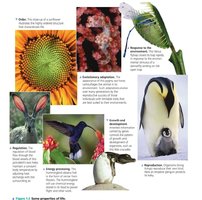
Order: Living things exhibit complex but ordered organization.
Sensitivity or Response to Stimuli: Organisms respond to environmental changes.
Reproduction: Life comes from pre-existing life through reproduction.
Growth and Development: Organisms grow and develop according to specific instructions coded in their genes.
Regulation/Homeostasis: Organisms maintain stable internal conditions.
Energy Processing: Living things obtain and use energy to power activities.
Evolutionary Adaptation: Populations evolve over generations.
Levels of Biological Organization
Hierarchy of Life
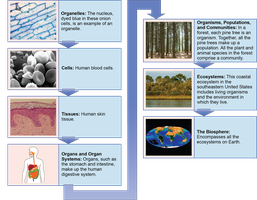
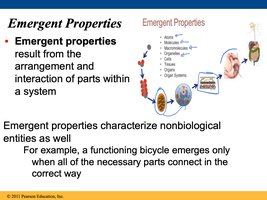
Life can be studied at different levels, from the smallest chemical building blocks to the entire biosphere. Each level exhibits emergent properties not present at lower levels.
Atoms
Molecules
Macromolecules
Organelles
Cells
Tissues
Organs and Organ Systems
Organisms
Populations
Communities
Ecosystems
Biosphere
The Cell: Basic Unit of Life
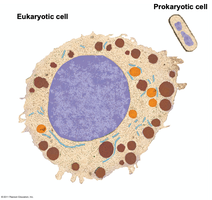
The cell is the fundamental unit of structure and function in living organisms. All cells are enclosed by a membrane and use DNA as their genetic material.
Eukaryotic cells: Have membrane-bound organelles, including a nucleus.
Prokaryotic cells: Lack a nucleus and membrane-bound organelles; generally smaller and simpler.
Emergent Properties and Reductionism
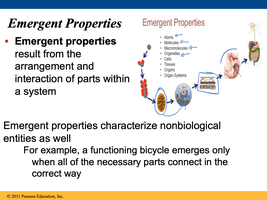
Emergent properties arise from the arrangement and interaction of parts within a system. While reductionism breaks complex systems into simpler components for study, understanding biology also requires integrating these parts to see how they function together.
Information Flow: DNA and Heredity
Genetic Information and Its Transmission
The continuity of life is based on heritable information in the form of DNA. Chromosomes contain DNA, which is organized into genes—the units of inheritance. Genes encode instructions for building proteins, which determine an organism's structure and function.
DNA is passed from parents to offspring, ensuring continuity of life.
Each chromosome contains one long DNA molecule with many genes.
Gene expression involves transcription (DNA to RNA) and translation (RNA to protein).
Gene Expression Equation:
Energy and Matter in Living Systems
Energy Transfer and Transformation
Living organisms require energy to maintain order, grow, and reproduce. Energy flows through ecosystems, typically entering as sunlight and exiting as heat. Organisms transform energy from one form to another (e.g., photosynthesis converts light energy to chemical energy).
Producers (e.g., plants) capture energy from sunlight.
Consumers (e.g., animals) obtain energy by eating other organisms.
Decomposers recycle nutrients back into the ecosystem.
Interactions in Biological Systems
Ecological Relationships
Organisms interact with each other and their environment, forming complex ecological networks. These interactions can be mutualistic, competitive, or predatory, and they help maintain ecosystem health and stability.
Example: Surgeonfish set up cleaning stations where turtles and other fish come to have algae and parasites removed, benefiting both parties.
Evolution: The Core Theme of Biology
Evolution Explains Unity and Diversity
Evolution is the process by which modern organisms have descended from ancient ancestors. It accounts for both the similarities (unity) and differences (diversity) among living things. The theory of evolution is supported by evidence from many scientific disciplines.
Natural Selection: The mechanism proposed by Charles Darwin, where organisms better adapted to their environment tend to survive and reproduce more successfully.
Domains of Life: All living organisms are classified into three domains—Bacteria, Archaea, and Eukarya—based on genetic and cellular differences.
Definition: Evolution is the change in the heritable characteristics of biological populations over successive generations.
Modern Perspectives on Evolution
Recent discoveries in genetics, epigenetics, and developmental biology have expanded our understanding of evolution. Epigenetic mechanisms can influence gene activity and inheritance, showing that evolution is shaped by more than just genetic changes.
Epigenetics: Molecular mechanisms that regulate gene activity without altering the DNA sequence. These changes can sometimes be inherited.
Example: Environmental factors can cause epigenetic changes that affect an organism's traits and may be passed to offspring.
Summary Table: Properties of Life
Property | Description | Example |
|---|---|---|
Order | Highly organized structure | Sunflower's spiral pattern |
Response to Stimuli | Reacting to environment | Venus flytrap closing |
Reproduction | Producing offspring | Penguins laying eggs |
Growth and Development | Increase in size and complexity | Birds developing feathers |
Regulation/Homeostasis | Maintaining internal balance | Rabbits regulating ear temperature |
Energy Processing | Obtaining and using energy | Hummingbird feeding on nectar |
Evolutionary Adaptation | Inherited traits that enhance survival | Camouflage in animals |
Conclusion
Biology is unified by core themes that help us understand the complexity of life. From the molecular level to the biosphere, living systems are organized, process information, require energy, interact with their environment, and evolve over time. These foundational concepts provide the framework for all further study in biology.
