 Indietro
Foundations of General Biology I: Scientific Inquiry, Evolution, and Biological Themes
Guida di studio - Note intelligenti
 Appunti personalizzati basati sui tuoi materiali, ampliati con definizioni chiave, esempi e contesto.
Introduction to General Biology I
Course Overview and Structure
This course, General Biology I (BIOL 1111), provides a foundational survey of biochemistry, genetics, cell structure and function, and the process of scientific inquiry. It is designed to introduce students to the core principles and unifying themes of biology, preparing them for advanced topics in subsequent courses.
Required Materials: Campbell Biology in Focus (4th Edition) with Mastering Biology access.
Course Components: Chemistry, Cell Structure and Function, Genetics, Gene Expression/Regulation.
Evaluation: In-class activities, assignments, exams, and a cumulative final exam.



Scientific Inquiry and the Process of Science
The Scientific Method
The scientific method is a systematic approach used by biologists to investigate natural phenomena. It involves making observations, forming hypotheses, conducting experiments, collecting and analyzing data, and drawing conclusions.
Observation: Gathering information about the natural world.
Hypothesis: A testable explanation for an observation.
Experiment: A controlled procedure to test the hypothesis.
Data Collection: Recording and analyzing results.
Conclusion: Determining whether the data support or refute the hypothesis.
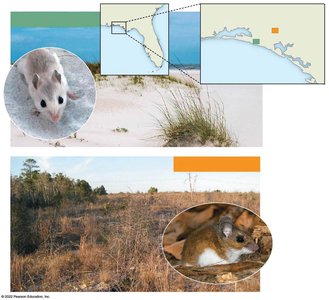
Example: The case study of coat color in mouse populations demonstrates the application of the scientific method to test the hypothesis that camouflage affects predation rates.
Case Study: Coat Color in Mouse Populations
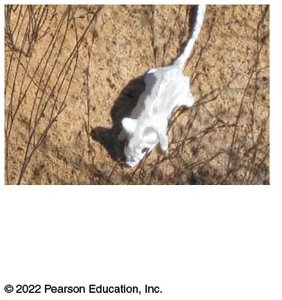
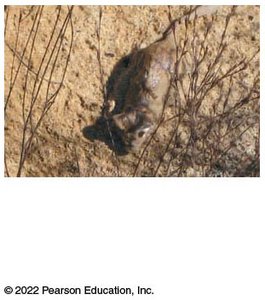
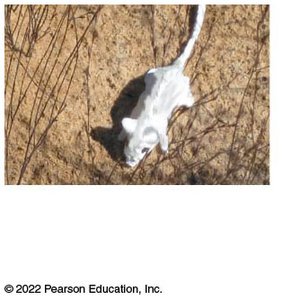
This case study investigates whether the coloration of Peromyscus polionotus (oldfield mouse) populations is an adaptation to their environments, protecting them from predators through camouflage.
Beach Population: Inhabits light-colored sand dunes; has lighter fur.
Inland Population: Inhabits darker, vegetated fields; has darker fur.
Hypothesis: Fur coloration evolved as an adaptation to reduce predation in each habitat.
Experimental Design
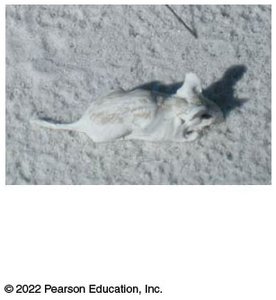
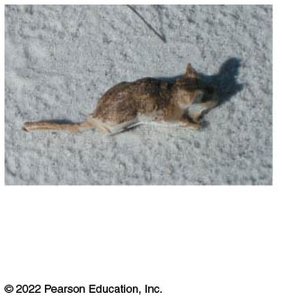
Researchers built mouse models painted to resemble either beach or inland mice and placed them in both habitats overnight. The number of predation events was recorded the next morning.
Controlled Experiment: Compares an experimental group (non-camouflaged models) to a control group (camouflaged models).
Variables:
Independent Variable: Mouse model coloration (light or dark).
Dependent Variable: Percentage of models attacked by predators.
Results and Interpretation
The results showed that camouflaged models (matching the habitat) were attacked less frequently than non-camouflaged models, supporting the hypothesis that camouflage reduces predation risk.
Habitat | Model Color | Camouflage Status | Predation Rate |
|---|---|---|---|
Beach | Light | Camouflaged (Control) | Low |
Beach | Dark | Non-camouflaged (Experimental) | High |
Inland | Light | Non-camouflaged (Experimental) | High |
Inland | Dark | Camouflaged (Control) | Low |
Unifying Themes of Biology
The Five Unifying Themes
Biology is organized around five unifying themes that help make sense of the diversity and complexity of life:
Organization: Biological systems are structured in a hierarchy from molecules to the biosphere.
Information: Genetic information encoded in DNA determines traits and is passed from one generation to the next.
Energy and Matter: Life requires the transfer and transformation of energy and cycling of matter.
Interactions: Organisms interact with each other and their environment, affecting survival and evolution.
Evolution: The process of evolution drives the diversity and unity of life.
Example: The mouse case study illustrates all five themes, from genetic information (fur color genes) to evolutionary adaptation (camouflage).
Biological Organization
Life is organized into a hierarchy of structural levels:
Molecule → Organelle → Cell → Tissue → Organ → Organism → Population → Community → Ecosystem → Biosphere
Each level has emergent properties not present at lower levels.
Metacognition and Study Strategies
Effective Learning Techniques
Metacognition involves being aware of and taking control of your own learning. The study cycle is a recommended approach for mastering biology content:
Preview: Skim materials before class to anticipate topics.
Attend: Engage actively in class by asking questions and taking notes.
Review: Go over notes soon after class to fill gaps and clarify concepts.
Study: Deepen understanding by connecting new material to prior knowledge.
Assess: Regularly evaluate your mastery and adjust study strategies as needed.
Asking yourself questions and discussing concepts with classmates can further enhance understanding.
Summary
General Biology I introduces the foundational concepts and methods of biological science.
The process of science is illustrated through hypothesis-driven experiments, such as the mouse camouflage study.
Five unifying themes help organize biological knowledge and connect topics across the discipline.
Effective study strategies and metacognition are essential for success in college-level biology.
