 Indietro
From Genes to Proteins: Transcription and Translation in Eukaryotes
Guida di studio - Note intelligenti
 Appunti personalizzati basati sui tuoi materiali, ampliati con definizioni chiave, esempi e contesto.
From Genes to Proteins: Transcription and Translation in Eukaryotes
Overview of Genetic Information Flow
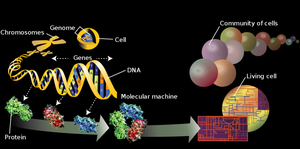
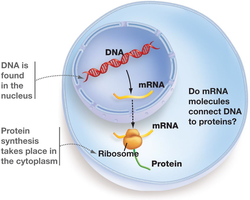
The central dogma of molecular biology describes the flow of genetic information within a biological system: DNA is transcribed into RNA, which is then translated into protein. This process is fundamental to all living organisms and underlies the expression of genetic traits.
Genes are specific regions of DNA that encode instructions for making proteins.
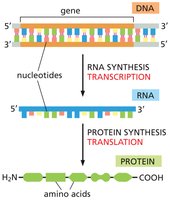
Proteins are synthesized through two main processes: transcription (DNA to RNA) and translation (RNA to protein).
Structure of a Eukaryotic Gene
Gene Organization
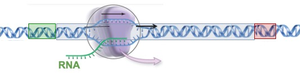
Every functional gene in eukaryotes consists of three main regions:
Promoter: Controls when and where transcription begins.
Transcribed region: The DNA sequence that is copied into RNA.
Terminator: Signals the end of transcription.
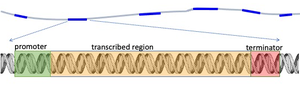
A gene is a region of DNA that carries information for a specific hereditary characteristic.
Transcription: DNA to RNA
Mechanism of Transcription
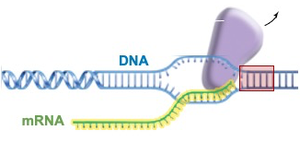
Transcription is the process by which a DNA sequence in a gene is copied into an RNA molecule. Only one strand of DNA (the template strand) is used for RNA synthesis, and the resulting RNA is complementary to this template.
RNA polymerase is the enzyme that catalyzes RNA synthesis.
Transcription factors bind to the promoter to help RNA polymerase initiate transcription.
Initiation, Elongation, and Termination
Initiation: Transcription factors and RNA polymerase bind to the promoter, and the DNA double helix unwinds.
Elongation: RNA polymerase moves along the template strand, synthesizing RNA in the 5' to 3' direction.
Termination: When RNA polymerase reaches the terminator sequence, transcription stops, and the RNA molecule is released.
Types of RNA Produced
mRNA (messenger RNA): Encodes the information for protein synthesis.
tRNA (transfer RNA): Brings amino acids to the ribosome during translation.
rRNA (ribosomal RNA): Forms the core of ribosomes and catalyzes peptide bond formation.
microRNA and other small RNAs: Regulate gene expression (mainly in eukaryotes).
RNA Processing in Eukaryotes
mRNA Processing Steps
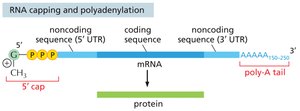
In eukaryotes, the primary RNA transcript (pre-mRNA) undergoes several modifications before becoming mature mRNA:
5' Capping: Addition of a modified guanine nucleotide to the 5' end for protection and ribosome recognition.
3' Polyadenylation: Addition of a poly-A tail (a string of adenine nucleotides) to the 3' end for stability and export from the nucleus.
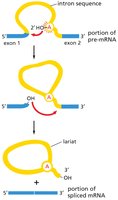
Splicing: Removal of non-coding sequences (introns) and joining of coding sequences (exons).
RNA Splicing and Alternative Splicing
Splicing is carried out by a complex called the spliceosome, which recognizes intron-exon boundaries and removes introns. Alternative splicing allows a single gene to produce multiple protein isoforms by including or excluding different exons.
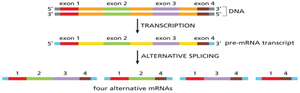
Importance: The 5' cap and 3' poly-A tail protect mRNA from degradation and assist in export and translation.
Translation: mRNA to Protein
Genetic Code and Codons
The genetic code is a set of rules by which the sequence of nucleotides in mRNA is translated into the sequence of amino acids in a protein. Each three-nucleotide sequence (codon) specifies one amino acid.
Start codon (AUG): Specifies methionine and signals the start of translation.
Stop codons (UAA, UAG, UGA): Signal the end of translation.
There are 64 possible codons and 20 amino acids.
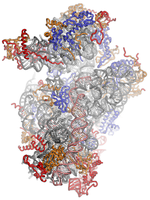
Ribosome Structure and Function
Ribosomes are the molecular machines that synthesize proteins. Each ribosome consists of a large and a small subunit, both made of rRNA and proteins. The ribosome reads the mRNA codons and catalyzes peptide bond formation between amino acids.
The large subunit contains the catalytic rRNA (a ribozyme).
Ribosomes have three binding sites for tRNA: A (aminoacyl), P (peptidyl), and E (exit).
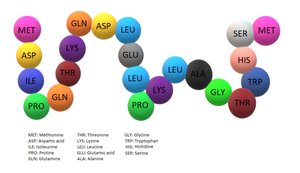
Role of tRNA and Anticodons
tRNAs are adaptor molecules that bring specific amino acids to the ribosome. Each tRNA has an anticodon that pairs with a complementary codon on the mRNA, ensuring the correct amino acid is added to the growing polypeptide chain.
Aminoacyl-tRNA synthetases attach the correct amino acid to each tRNA.
Steps of Translation
Initiation: The small ribosomal subunit binds to the mRNA near the start codon. The initiator tRNA (carrying methionine) binds to the start codon, and the large subunit joins to form the complete ribosome.
Elongation: tRNAs bring amino acids to the ribosome, matching their anticodons to codons on the mRNA. Peptide bonds form between amino acids, and the ribosome moves along the mRNA.
Termination: When a stop codon is reached, a release factor binds, causing the ribosome to release the completed polypeptide and dissociate from the mRNA.
Ribozymes vs. Enzymes
Ribozymes are RNA molecules with catalytic activity (e.g., rRNA in the ribosome).
Enzymes are typically proteins that catalyze biochemical reactions.
Summary Table: DNA vs. RNA
Feature | DNA | RNA |
|---|---|---|
Sugar | Deoxyribose | Ribose |
Bases | A, T, G, C | A, U, G, C |
Strandedness | Double-stranded | Single-stranded |
Shape | Double helix | Varied, can fold into complex shapes |
Practice and Application
Given a DNA template strand, predict the sequence of the transcribed mRNA.
Use a codon chart to determine the amino acid sequence from an mRNA sequence.
Identify exons and introns in a pre-mRNA and describe the mature mRNA after splicing.
Explain how alternative splicing can produce different proteins from the same gene.
Additional info: In eukaryotes, transcription also occurs in mitochondria and chloroplasts, which have their own genomes and transcription machinery.
