 Indietro
Fungi Life Cycle, Ecological Roles, and Comparative Traits Study Guide
Guida di studio - Note intelligenti
 Appunti personalizzati basati sui tuoi materiali, ampliati con definizioni chiave, esempi e contesto.
Q1. Place the following terms in the correct place on the fungal life cycle diagram AND label each structure as haploid (n), diploid (2n), or heterokaryotic (dikaryotic; n+n).
Background
Topic: Fungal Life Cycle
This question tests your understanding of the stages in the fungal life cycle, including the transitions between haploid, diploid, and dikaryotic phases, and the processes of sexual reproduction.
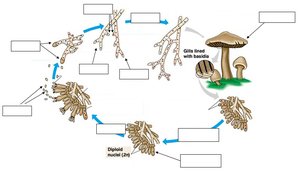
Key Terms:
Mycelium: The network of fungal hyphae, usually haploid (n).
Gametes: Haploid reproductive cells.
Zygote: Diploid cell formed after karyogamy.
Karyogamy: Fusion of nuclei (creates diploid stage).
Meiosis: Reduces chromosome number, produces haploid spores.
Plasmogamy: Fusion of cytoplasm (creates dikaryotic stage).
Spores: Haploid cells for dispersal.
Fruiting body: Structure for spore production, often dikaryotic.
Key Concepts:
Haploid (n): One set of chromosomes.
Diploid (2n): Two sets of chromosomes.
Dikaryotic (n+n): Two nuclei per cell, each haploid.
Step-by-Step Guidance
Identify the starting point: Mycelium with mating types (– and +) are haploid (n).
Plasmogamy occurs when two haploid mycelia fuse their cytoplasm, resulting in a dikaryotic (n+n) stage.
The dikaryotic mycelium forms the fruiting body, which is also dikaryotic (n+n).
Karyogamy happens inside specialized cells, fusing the two nuclei to create a diploid (2n) zygote.
Meiosis follows karyogamy, producing haploid (n) spores from the diploid zygote.
These spores germinate to form new haploid mycelia, restarting the cycle.
Try solving on your own before revealing the answer!
Final Answer:
Mycelium with mating type –: Haploid (n)
Mycelium with mating type +: Haploid (n)
Gametes: Haploid (n)
Zygote: Diploid (2n)
Karyogamy: Transition to diploid (2n)
Meiosis: Produces haploid (n) spores
Plasmogamy: Transition to dikaryotic (n+n)
Spores: Haploid (n)
Mycelia germinate from spores: Haploid (n)
Fruiting body: Dikaryotic (n+n)
Each stage is labeled according to its ploidy, and the terms are placed in the correct order on the diagram.
Q1a. Do fungi spend most of their life cycle in haploid or diploid forms?
Background
Topic: Fungal Life Cycle Dominance
This question tests your understanding of which ploidy stage dominates the fungal life cycle.
Key Terms:
Haploid (n): One set of chromosomes.
Diploid (2n): Two sets of chromosomes.
Dikaryotic (n+n): Two haploid nuclei per cell.
Step-by-Step Guidance
Recall the stages of the fungal life cycle: haploid, dikaryotic, and diploid.
Consider which stage lasts the longest in most fungi.
Think about the duration of the diploid stage compared to the haploid and dikaryotic stages.
Try solving on your own before revealing the answer!
Final Answer:
Fungi spend most of their life cycle in the haploid (n) and dikaryotic (n+n) forms. The diploid stage is very brief, occurring only after karyogamy and before meiosis.
Q1b. What kind of life cycle is this (gametic, sporic, zygotic)?
Background
Topic: Types of Eukaryotic Life Cycles
This question tests your ability to classify the fungal life cycle based on when meiosis occurs and which stage is dominant.
Key Terms:
Gametic life cycle: Diploid dominant, gametes produced by meiosis.
Sporic life cycle: Alternation of generations (both haploid and diploid multicellular stages).
Zygotic life cycle: Haploid dominant, zygote is the only diploid stage.
Step-by-Step Guidance
Review the diagram and note when meiosis occurs.
Determine which stage is multicellular and dominant.
Compare the fungal life cycle to the definitions of gametic, sporic, and zygotic cycles.
Try solving on your own before revealing the answer!
Final Answer:
The fungal life cycle is a zygotic life cycle, where the haploid stage is dominant and the diploid stage (zygote) is brief.
Q1c. What are advantages of the sexual portion of the life cycle? What about the asexual portion?
Background
Topic: Sexual vs. Asexual Reproduction in Fungi
This question tests your understanding of the evolutionary benefits of sexual and asexual reproduction in fungi.
Key Terms:
Sexual reproduction: Involves genetic recombination.
Asexual reproduction: Produces genetically identical offspring.
Step-by-Step Guidance
Consider the benefits of genetic diversity from sexual reproduction.
Think about the speed and efficiency of asexual reproduction.
Reflect on how each mode helps fungi adapt to their environment.
Try solving on your own before revealing the answer!
Final Answer:
Sexual reproduction increases genetic diversity, helping fungi adapt to changing environments. Asexual reproduction allows rapid population growth and colonization when conditions are stable.
Q1d. What are the ways fungi can spread? Which of these allows for long distance spread?
Background
Topic: Fungal Dispersal Mechanisms
This question tests your knowledge of how fungi disperse and which methods are most effective for long-distance spread.
Key Terms:
Spores: Tiny reproductive cells dispersed by wind, water, or animals.
Mycelial growth: Local spread through substrate.
Step-by-Step Guidance
List the main dispersal methods: spores and mycelial growth.
Consider which method is most effective for covering large distances.
Think about environmental factors that aid spore dispersal.
Try solving on your own before revealing the answer!
Final Answer:
Fungi spread by producing spores (for long-distance dispersal) and by mycelial growth (for local spread). Spores can travel far via wind, water, or animals.
Q2. Re-draw only the new part of your Mindomo Tree and check it with your LA. It should include: Groups: Fungi, Animals; Traits: multicellularity, absorptive heterotrophy, cell wall, mobility, complex organ systems, zygotic life cycle, gametic life cycle.
Background
Topic: Comparative Traits of Fungi and Animals
This question tests your ability to organize and compare key traits of fungi and animals in a conceptual diagram.
Key Terms:
Multicellularity: Composed of multiple cells.
Absorptive heterotrophy: Obtain nutrients by absorption.
Cell wall: Structural feature present in fungi, absent in animals.
Mobility: Ability to move (animals are mobile, fungi are not).
Complex organ systems: Present in animals.
Zygotic life cycle: Fungi.
Gametic life cycle: Animals.
Step-by-Step Guidance
Start by drawing two branches: one for Fungi, one for Animals.
List traits under each group: e.g., Fungi (multicellularity, cell wall, absorptive heterotrophy, zygotic life cycle); Animals (multicellularity, mobility, complex organ systems, gametic life cycle).
Highlight differences: cell wall (present in fungi, absent in animals), mobility (present in animals, absent in fungi).
Include shared traits: multicellularity.
Try solving on your own before revealing the answer!
Final Answer:
Your Mindomo Tree should show two main groups (Fungi and Animals) with their respective traits. Fungi: multicellularity, cell wall, absorptive heterotrophy, zygotic life cycle. Animals: multicellularity, mobility, complex organ systems, gametic life cycle. Shared trait: multicellularity.
Q3. For each of the following fungi, describe the structures and processes involved in feeding and reproduction. Explain the ecological roles/interactions. For mutualistic species, highlight what the fungus obtains from its partner and what it provides.
Background
Topic: Fungal Diversity and Ecological Roles
This question tests your ability to analyze different fungi, their feeding and reproductive strategies, and their ecological interactions.
Key Terms:
Hyphae: Filamentous structures for feeding.
Fruiting body: Structure for spore production.
Mutualism: Symbiotic relationship where both partners benefit.
Parasitism: One organism benefits at the expense of another.
Step-by-Step Guidance
For each fungus, identify its feeding structures (e.g., hyphae, fruiting body).
Describe its reproductive process (sexual/asexual, spore production).
Explain its ecological role (decomposer, pathogen, mutualist).
For mutualists, specify what the fungus gives and receives in the partnership.
Try solving on your own before revealing the answer!
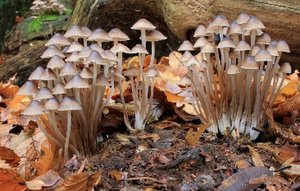
Mycena inclinata (clustered bonnet mushroom)
Final Answer:
Feeding: Uses hyphae to decompose leaf litter and wood, absorbing nutrients.
Reproduction: Produces spores in fruiting bodies (mushrooms).
Ecological role: Decomposer, recycles nutrients in forest ecosystems.
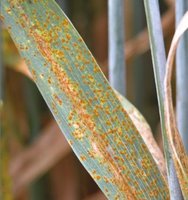
Puccinia triticina (wheat leaf rust fungus)
Final Answer:
Feeding: Parasitic hyphae invade plant tissues, extracting nutrients.
Reproduction: Produces spores that infect new plants.
Ecological role: Plant pathogen, causes crop losses and impacts agriculture.
Ophiocordyceps unilateralis (ant-infecting fungus)
Final Answer:
Feeding: Parasitic hyphae invade and consume ant tissues.
Reproduction: Produces fruiting bodies from the ant's body, releasing spores.
Ecological role: Parasite, regulates ant populations and influences ecosystem dynamics.
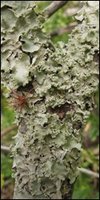
Parmotrema praesorediosum (lichen)
Final Answer:
Feeding: Fungus absorbs water and minerals; photosynthetic partner (alga/cyanobacterium) provides sugars.
Reproduction: Can reproduce sexually (spores) or asexually (fragments).
Ecological role: Mutualist, pioneer species in harsh environments, contributes to soil formation.
Mutualism: Fungus receives sugars; provides protection and water/mineral access to partner.
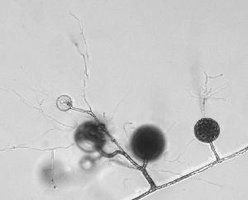
Rhizophagus irregularis (mycorrhizal fungus)
Final Answer:
Feeding: Forms hyphal networks with plant roots, absorbs nutrients from soil.
Reproduction: Produces spores for dispersal.
Ecological role: Mutualist, enhances plant nutrient uptake, improves soil health.
Mutualism: Fungus receives sugars from plant; provides increased nutrient and water access to plant.
