 Indietro
Fungi: Structure, Function, Diversity, and Ecological Roles
Guida di studio - Note intelligenti
 Appunti personalizzati basati sui tuoi materiali, ampliati con definizioni chiave, esempi e contesto.
Fungi: Structure, Function, Diversity, and Ecological Roles
Overview of Fungi
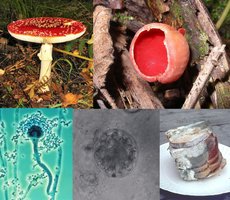
Fungi are a diverse group of mostly multicellular eukaryotic organisms classified within the Opisthokonts. They are more closely related to animals than to plants and play essential roles in ecosystems as decomposers, mutualists, and pathogens. Fungi absorb nutrients from their environment, recycling vital elements and affecting productivity and biodiversity.
Key Characteristics: Multicellular (except yeasts), cell walls made of chitin, store glucose as glycogen, and reproduce via spores.
Ecological Importance: Decompose organic matter, form mutualistic relationships, and can be pathogenic.
Estimated Diversity: Approximately 1.5 million species.
Fungal Phylogeny and Evolution
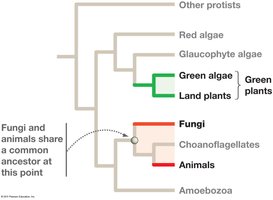
Fungi share a common ancestor with animals and choanoflagellates, diverging from other eukaryotic lineages. Their evolutionary history includes a transition from aquatic to terrestrial environments and convergence on multicellularity with animals.
Opisthokonts: Clade including fungi, animals, and their closest protistan relatives.
Origin: Oldest terrestrial fungi date to ~460 million years ago, among the earliest multicellular land colonizers.
Mutualism: Early fungi formed symbiotic relationships with land plants, aiding colonization of terrestrial habitats.
Fungal Nutrition and Structure
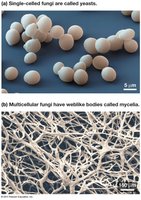
Fungi are heterotrophs that absorb nutrients after external digestion. Their ecological success is due to a wide variety of enzymes that break down complex organic materials. Fungi exist as single-celled yeasts or multicellular filaments called hyphae, which collectively form a mycelium.
Lifestyles: Decomposers (saprophytes), parasites, and mutualists.
Hyphae: Thread-like filaments that penetrate substrates and absorb nutrients.
Cell Walls: Composed of chitin, providing structural support.
Yeasts: Unicellular fungi that reproduce by budding or fission.
Hyphal Structure: Septate and Coenocytic Hyphae
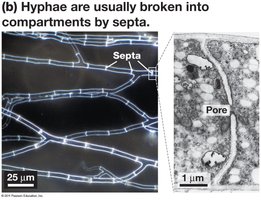
Most fungi have hyphae divided into cells by septa, which contain pores for cytoplasmic streaming. Some fungi have coenocytic hyphae, lacking septa and containing many nuclei within a continuous cytoplasm. The thinness of hyphae allows efficient nutrient absorption and substrate penetration.
Septate Hyphae: Hyphae with cross-walls (septa) separating cells.
Coenocytic Hyphae: Hyphae without septa, forming a multinucleate cell.
Specialized Hyphae and Mycorrhizae
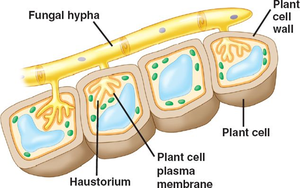
Some fungi possess specialized hyphae called haustoria, which penetrate host tissues to extract nutrients. Mycorrhizae are mutualistic associations between fungal hyphae and plant roots, enhancing nutrient and water uptake for plants while receiving carbohydrates in return.
Haustoria: Specialized hyphae for nutrient exchange with host cells.
Mycorrhizae: Symbiotic relationship crucial for plant health and growth.
Fungal Reproduction
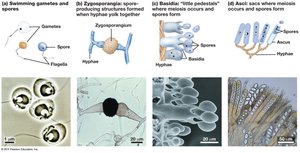
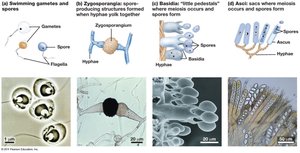
Fungi reproduce both sexually and asexually, with diverse life cycles. Sexual reproduction involves the fusion of hyphae from different mating types (plasmogamy), followed by nuclear fusion (karyogamy) and meiosis to produce genetically diverse spores. Asexual reproduction typically involves mitosis to produce spores or budding in yeasts.
Sexual Structures: Chytrids (flagellated gametes), Zygomycetes (zygosporangia), Ascomycetes (asci in ascocarps), Basidiomycetes (basidia in basidiocarps).
Asexual Reproduction: Molds produce spores by mitosis; yeasts reproduce by budding or fission.
Life Cycle Stages: Haploid (n), heterokaryotic (n+n), diploid (2n).
Major Fungal Groups and Diversity
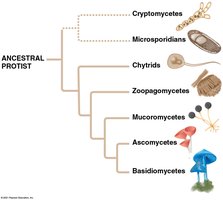
Fungi are classified into several major groups based on reproductive structures and genetic data. These include Chytrids, Zoopagomycetes, Mucoromycetes, Ascomycetes, and Basidiomycetes, each with unique life cycles and ecological roles.
Chytrids: Aquatic fungi with flagellated gametes.
Zoopagomycetes: Animal and fungal parasites, produce durable zygosporangia.
Mucoromycetes: Important decomposers, coenocytic hyphae, asexual and sexual reproduction via zygosporangia.
Ascomycetes: "Sac fungi" with asci in ascocarps, include yeasts, molds, and morels.
Basidiomycetes: "Club fungi" with basidia in basidiocarps, include mushrooms, puffballs, and shelf fungi.
Fungi in the Environment
Fungi play critical roles as decomposers, mutualists, and pathogens. They recycle nutrients, form essential symbioses with plants (mycorrhizae), and can cause diseases in plants and animals. Lichens, a symbiotic association between fungi and photosynthetic organisms, are important for soil formation and as pioneer species in barren environments.
Decomposers: Break down complex organic materials, especially lignin in wood.
Mutualists: Mycorrhizae and lichens benefit both partners.
Pathogens: Cause diseases in plants (e.g., ergots on rye) and animals (e.g., chytrid fungus in amphibians).
Economic Importance: Used in food production (bread, cheese, beer), antibiotics (penicillin), and biotechnology.
Generalized Fungal Life Cycle
The fungal life cycle typically alternates between haploid, heterokaryotic, and diploid stages. Sexual reproduction increases genetic diversity, while asexual reproduction allows rapid colonization of substrates.
Plasmogamy: Fusion of cytoplasm from two parent mycelia.
Heterokaryotic Stage: Cells contain two or more genetically distinct nuclei.
Karyogamy: Fusion of nuclei to form a diploid zygote.
Meiosis: Produces haploid spores that germinate into new mycelia.
Equation for Spore Production:
Additional info: The heterokaryotic stage can persist for extended periods in some fungi, allowing for genetic recombination before karyogamy.
Summary Table: Major Fungal Groups
Group | Key Structure | Habitat/Ecology | Example |
|---|---|---|---|
Chytrids | Flagellated gametes | Aquatic, decomposers/parasites | Batrachochytrium dendrobatidis |
Zoopagomycetes | Zygosporangium | Animal/fungal parasites | Entomophthora muscae |
Mucoromycetes | Zygosporangium | Decomposers, mycorrhizae | Rhizopus stolonifer |
Ascomycetes | Ascus (ascocarp) | Decomposers, pathogens, mutualists | Morels, truffles, yeasts |
Basidiomycetes | Basidium (basidiocarp) | Decomposers, mycorrhizae | Mushrooms, puffballs |
