 Indietro
Gel Electrophoresis: Principles and Applications
Guida di studio - Note intelligenti
 Appunti personalizzati basati sui tuoi materiali, ampliati con definizioni chiave, esempi e contesto.
Gel Electrophoresis
Introduction to Electrophoresis
Electrophoresis is a laboratory technique used to separate charged molecules, such as DNA, RNA, or proteins, by applying an electric field. The movement of these molecules depends on several factors, including their net charge, mass, molecular shape, and the properties of the medium through which they migrate.
Net Charge: Molecules with a higher net charge move faster in an electric field.
Mass: Smaller molecules migrate more quickly than larger ones.
Molecular Shape: Compact shapes move more easily through the gel matrix.
Matrix Properties: Temperature, porosity, and viscosity of the gel affect migration rates.
Principle of Gel Electrophoresis
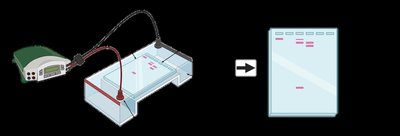
Gel electrophoresis is a method for separating and analyzing macromolecules (such as DNA, RNA, and proteins) or their fragments based on size and charge. The gel acts as a molecular sieve, allowing smaller molecules to move faster than larger ones when an electric current is applied.
Medium: Gels (commonly agarose or polyacrylamide) suppress thermal convection and maintain separation.
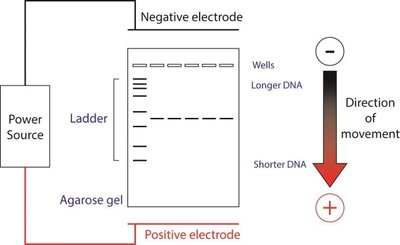
Process: Samples are loaded into wells in the gel, and an electric current is applied, causing molecules to migrate at different rates.
Factors Affecting Migration
The rate at which molecules move through the gel depends on their charge and size:
Charge: Charged molecules migrate toward the electrode with the opposite charge (anode for negatively charged molecules, cathode for positively charged molecules).
Size: Smaller molecules move more quickly through the gel matrix, while larger molecules move more slowly.
Visualization of Separated Molecules
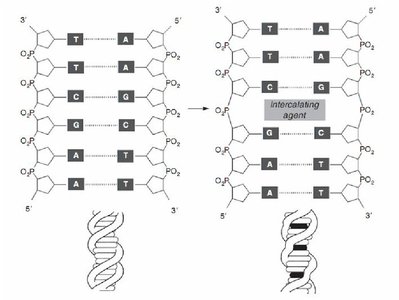
After electrophoresis, the separated molecules are visualized by staining the gel. For nucleic acids, DNA intercalating agents (such as ethidium bromide or SYBR Green) are commonly used. These agents insert themselves between the base pairs of DNA, allowing the bands to be seen under UV light.
Staining: Makes the separated molecules visible for analysis.
Intercalating Agents: Bind to DNA and fluoresce under UV light, highlighting the bands.
Applications of Gel Electrophoresis
Analysis of DNA fragments (e.g., restriction digests, PCR products)
RNA analysis (e.g., Northern blotting)
Protein separation (e.g., SDS-PAGE)
Genetic fingerprinting and diagnostics
Summary Table: Factors Affecting Gel Electrophoresis
Factor | Effect on Migration |
|---|---|
Net Charge | Higher charge increases migration speed |
Size (Mass) | Smaller molecules move faster |
Molecular Shape | Compact shapes move more easily |
Gel Porosity | Higher porosity allows faster movement |
Voltage | Higher voltage increases speed but may reduce resolution |
Key Equations
The migration rate (v) of a molecule in an electric field can be described by:
Where q is the net charge, E is the electric field strength, and f is the frictional coefficient (related to size and shape).
