 Indietro
Gene Expression and the Central Dogma: DNA, RNA, and Protein Synthesis
Guida di studio - Note intelligenti
 Appunti personalizzati basati sui tuoi materiali, ampliati con definizioni chiave, esempi e contesto.
Gene Expression and the Central Dogma
Overview of the Central Dogma
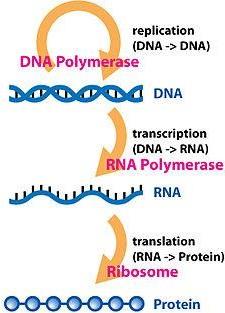
Gene expression is the process by which information encoded in DNA is used to produce RNA and proteins, the functional molecules of the cell. The central dogma describes the flow of genetic information: DNA is transcribed into RNA, which is then translated into protein.
DNA Replication: DNA is copied to produce identical DNA molecules before cell division.
Transcription: DNA is used as a template to synthesize RNA.
Translation: RNA is used to assemble proteins.
Exceptions to the Central Dogma
While the central dogma is the standard pathway, there are exceptions:
Retroviruses: Use reverse transcriptase to transcribe RNA into DNA (RNA → DNA → RNA → protein).
RNA Viruses: Some viruses use only RNA to produce proteins, bypassing DNA.
Prions: Misfolded proteins that propagate by converting normal proteins into the prion form (Protein → Protein).
Structure of Nucleic Acids
DNA and RNA Structure
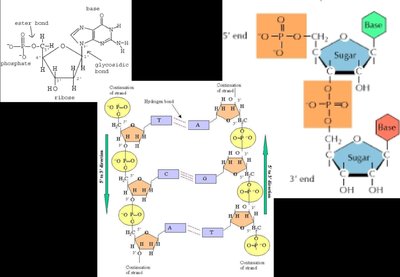
Nucleic acids are polymers of nucleotides, each consisting of a sugar, a phosphate group, and a nitrogenous base. DNA and RNA differ in their sugars and bases.
DNA: Contains deoxyribose sugar and bases adenine (A), thymine (T), cytosine (C), and guanine (G).
RNA: Contains ribose sugar and bases adenine (A), uracil (U), cytosine (C), and guanine (G).
Base Pairing: In DNA, A pairs with T, and C pairs with G. In RNA, A pairs with U.
The Nature of Genetic Information
DNA Sequence: The order of nucleotides in DNA encodes genetic information.
Genes: Subsets of DNA sequences that code for RNA or protein products.
Transcription: Enzymes use the DNA sequence of a gene as a template to assemble a strand of RNA.
Basic Structure of a Gene
Gene Organization in Eukaryotes
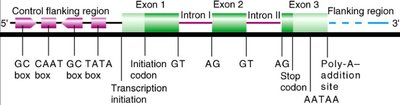
Genes are composed of regulatory regions, coding regions (exons), and noncoding regions (introns).
Regulatory Region: Controls gene expression.
Exons: Coding regions that are expressed.
Introns: Noncoding regions removed during RNA splicing.
RNA Splicing: Introns are removed, and exons are joined to form a contiguous coding sequence.
Gene Structure in Prokaryotes vs. Eukaryotes
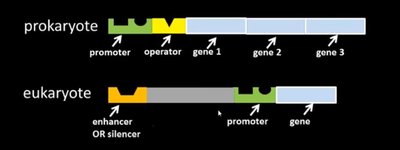
Prokaryotes: Genes are organized in operons with promoters and operators.
Eukaryotes: Genes have enhancers/silencers, promoters, and are typically not organized in operons.
DNA Replication
Mechanism of DNA Replication
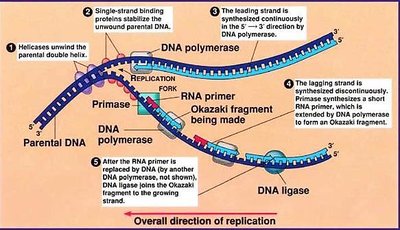
DNA replication is the process by which a cell copies its DNA before division.
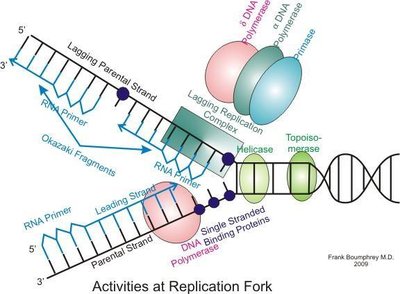
Helicase: Unwinds the DNA double helix.
Single-Strand Binding Proteins (SSBP): Stabilize unwound DNA.
Primase: Synthesizes RNA primers.
DNA Polymerase: Adds nucleotides to the growing DNA strand using base pairing rules.
DNA Ligase: Seals gaps in the DNA strand.
Okazaki Fragments: Short DNA fragments synthesized on the lagging strand.
Accuracy and Mutations in DNA Replication
Proofreading: DNA polymerases can correct errors during replication.
Mutations: Errors that escape repair mechanisms can result in mutations, which are the original source of variation in traits.
Transcription: DNA to RNA
Transcription Process
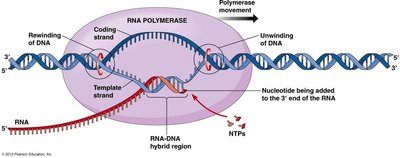
Transcription is the synthesis of RNA from a DNA template.
RNA Polymerase: Binds to the promoter region and synthesizes RNA by reading the DNA template strand.
Transcription Bubble: The region where DNA is unwound and RNA is synthesized.
Termination: RNA polymerase releases the RNA transcript at the terminator sequence.
RNA Processing in Eukaryotes
5' Cap: Modified guanine added to the 5' end for protection and ribosome recognition.
Poly-A Tail: Addition of adenine nucleotides to the 3' end for protection and transport.
Splicing: Removal of introns and joining of exons to produce mature mRNA.
Messenger RNA (mRNA) and the Genetic Code
Properties of mRNA
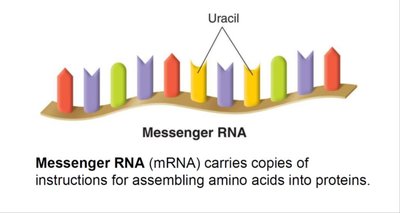
Messenger RNA (mRNA) carries the information for building proteins.
Length: Typically 500 to 1000 nucleotides long.
Codons: Sequence of three bases that specify an amino acid.
Start Codon: AUG (methionine).
Stop Codons: UAA, UAG, UGA.















The Genetic Code
64 Codons: Each codon codes for an amino acid or a stop signal.
Redundancy: Multiple codons can code for the same amino acid.
Translation: RNA to Protein
Translation Process
Translation is the process by which the sequence of codons in mRNA is used to assemble a polypeptide.
Initiation: Ribosome assembles on the mRNA, and the initiator tRNA pairs with the start codon.
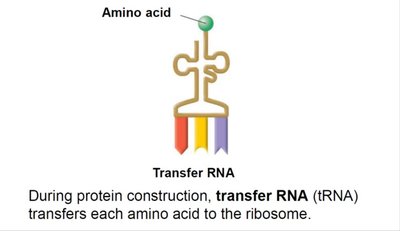
Elongation: tRNAs bring amino acids to the ribosome, which are joined by peptide bonds.
Termination: Translation ends when a stop codon is reached.
Types of RNA Involved in Translation
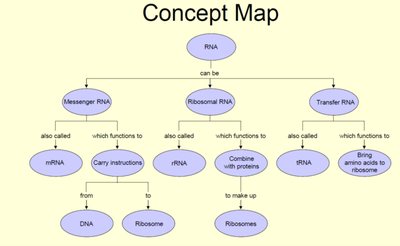
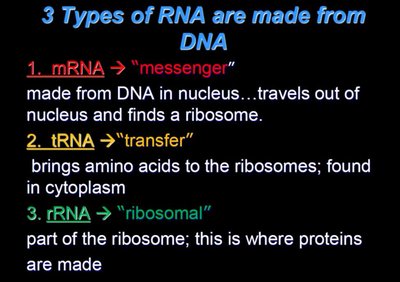
mRNA: Carries the genetic code from DNA.
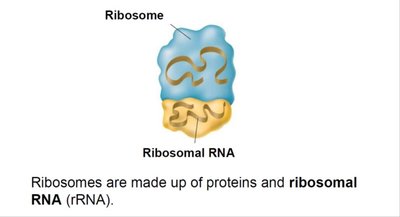
rRNA: Forms the core of the ribosome and catalyzes peptide bond formation.
tRNA: Brings amino acids to the ribosome and matches them to the mRNA codons via its anticodon.



Mutations and Their Effects
Types and Causes of Mutations
Mutations are changes in the DNA sequence that can affect gene expression and protein function.
Types: Deletions, insertions, base pair substitutions.
Causes: Spontaneous errors during replication, activity of transposable elements, ionizing radiation, and chemical damage.
Effects: Can be harmful, neutral, or beneficial; responsible for genetic variation.
Example: Transcription of a DNA Sequence
Complementary RNA Strand
DNA Sequence: 5'-GCGTATG-3'
RNA Sequence: 3'-CGCAUAC-5'

Summary Table: Types of RNA
Type of RNA | Function | Location |
|---|---|---|
mRNA | Carries genetic information from DNA to ribosome | Nucleus & Cytoplasm |
tRNA | Transfers amino acids to ribosome | Cytoplasm |
rRNA | Forms ribosome structure and catalyzes protein synthesis | Ribosome |
Key Equations and Concepts
Base Pairing Rules: , (DNA); , (RNA)
Central Dogma:
Transcription:
Translation:
Additional info:
Gene expression is tightly regulated at multiple levels, including transcriptional, post-transcriptional, translational, and post-translational.
Mutations in regulatory regions can affect gene expression without altering the protein coding sequence.
