 Indietro
CH17 - Gene Expression: From DNA to Protein and Mutations
Guida di studio - Note intelligenti
 Appunti personalizzati basati sui tuoi materiali, ampliati con definizioni chiave, esempi e contesto.
Gene Expression and the Central Dogma
Genes Specify Proteins
Genes are specific sequences in DNA that dictate the synthesis of proteins, which in turn determine an organism's traits. Proteins serve as the link between genotype and phenotype, and gene expression is the process by which DNA directs protein synthesis.
Key Point: Gene expression involves transcription and translation, converting genetic information into functional proteins.
Key Point: The relationship between genes and proteins was discovered through studies of metabolic defects and nutritional mutants.
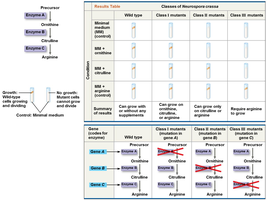
Example: Beadle and Tatum's experiments with Neurospora demonstrated that mutations in specific genes led to defects in enzyme synthesis.
Evidence from Metabolic Defects
Cells synthesize and degrade molecules in metabolic pathways. Inherited diseases often reflect the inability to synthesize certain enzymes, as shown in studies using model organisms.
Key Point: Mutations in genes can disrupt metabolic pathways, leading to nutritional mutants.
Example: Beadle and Tatum exposed bread mold to X-rays, creating mutants unable to synthesize arginine.
One Gene–One Enzyme Hypothesis
Beadle and Tatum hypothesized that one gene dictates the production of one specific enzyme. This concept evolved into the one gene–one protein (polypeptide) hypothesis.
Key Point: DNA and protein do not speak the same language; the central dogma describes the flow of genetic information: DNA → RNA → Protein.
Key Point: Transcription and translation are the two steps required to convert DNA to protein.
Transcription and Translation
Transcription
Transcription is the synthesis of RNA using information in DNA. It produces messenger RNA (mRNA), which carries the genetic code from the nucleus to the cytoplasm.
Key Point: RNA polymerase catalyzes transcription without the need for a primer.
Key Point: The DNA template strand guides the sequence of complementary nucleotides in the RNA transcript.
Translation
Translation is the synthesis of a polypeptide using information in mRNA. Ribosomes facilitate the process by coupling tRNA anticodons with mRNA codons.
Key Point: Translation occurs in the cytoplasm and involves ribosomes, tRNA, and mRNA.
Key Point: The process includes initiation, elongation, and termination steps.
Prokaryote versus Eukaryote
In prokaryotes, translation can begin before transcription is finished, making it a coupled reaction. In eukaryotes, the nuclear envelope separates transcription from translation, and pre-mRNA undergoes modifications before translation.
The Genetic Code
Codons: Triplets of Nucleotides
The genetic code consists of triplets of nucleotides called codons, each specifying an amino acid. There are 64 codons, 61 for amino acids and 3 for stop signals.
Key Point: The code is redundant (multiple codons for one amino acid) but not ambiguous (each codon specifies only one amino acid).
Key Point: Codons must be read in the correct reading frame to produce the correct polypeptide.
RNA Processing
Modifications of pre-mRNA
In eukaryotes, pre-mRNA undergoes processing before leaving the nucleus. This includes the addition of a 5’ cap, a poly-A tail, and the removal of introns through splicing.
Key Point: Introns are noncoding regions, while exons are coding regions.
Key Point: Spliceosomes, composed of proteins and snRNPs, catalyze RNA splicing.
Key Point: Ribozymes are RNA molecules with catalytic activity.
Alternative RNA Splicing
Alternative splicing allows a single gene to encode multiple polypeptides, increasing protein diversity.
Key Point: Protein domains are often encoded by different exons, and exon shuffling can lead to new proteins.
Molecular Components of Translation
Transfer RNA (tRNA)
tRNA transfers amino acids to the growing polypeptide chain. Each tRNA has an anticodon that pairs with a codon on mRNA.
Key Point: Aminoacyl-tRNA synthetase matches tRNA with its corresponding amino acid.
Key Point: Wobble pairing at the third base allows some tRNAs to bind to more than one codon.
Ribosomes
Ribosomes are composed of a large and small subunit, proteins, and ribosomal RNA (rRNA). They coordinate the translation process through three sites: P, A, and E.
Key Point: rRNA catalyzes peptide bond formation.
Key Point: Translation proceeds through initiation, elongation, and termination.
Mutations and Their Effects
Types of Mutations
Mutations are changes in the genetic material of a cell or virus. They can be spontaneous or induced by mutagens such as chemicals or radiation.
Key Point: Mutations may not always lead to phenotypic changes.
Key Point: General types include somatic and germline mutations.
Small Scale Mutations
Point mutations include nucleotide-pair substitutions, insertions, and deletions. These can result in silent, missense, or nonsense mutations.
Key Point: Silent mutations do not affect the amino acid sequence.
Key Point: Missense mutations change one amino acid.
Key Point: Nonsense mutations create a stop codon, leading to a nonfunctional protein.
Key Point: Insertions and deletions can cause frameshift mutations, altering the reading frame.
Examples of Mutation Effects
Mutations can have significant effects, such as sickle cell anemia, which is caused by a missense mutation in the hemoglobin gene. Lactase persistence in adults is due to a mutation in the regulatory region of the lactase gene.
What Is a Gene?
Modern Definition
A gene is a region of DNA that can be expressed to produce a final functional product, either a polypeptide or an RNA molecule.
Key Point: Genes are discrete units of inheritance, regions of specific nucleotide sequence, and DNA sequences that code for specific polypeptide chains.
Summary Table: Nutritional Mutants in Neurospora
The following table summarizes the results of Beadle and Tatum's experiments with Neurospora mutants:
Medium | Wild type | Class I mutants | Class II mutants | Class III mutants |
|---|---|---|---|---|
Minimal medium | Growth | No growth | No growth | No growth |
Minimal medium + ornithine | Growth | Growth | No growth | No growth |
Minimal medium + citrulline | Growth | Growth | Growth | No growth |
Minimal medium + arginine | Growth | Growth | Growth | Growth |
Purpose: This table compares the growth of wild type and mutant Neurospora strains on different media, illustrating the one gene–one enzyme hypothesis.
