 Indietro
Gene Expression: From Gene to Protein (Central Dogma and the Flow of Genetic Information)
Guida di studio - Note intelligenti
 Appunti personalizzati basati sui tuoi materiali, ampliati con definizioni chiave, esempi e contesto.
Gene Expression: From Gene to Protein
Introduction to the Central Dogma of Biology
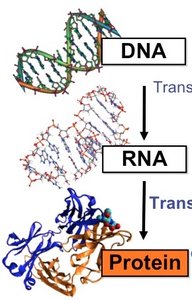
The central dogma of molecular biology describes the flow of genetic information within a biological system. It explains how the information encoded in DNA is used to synthesize proteins, which perform most cellular functions.
Central Dogma: Information flows from DNA to RNA to Protein.
Transcription: The process of copying a gene's DNA sequence into an RNA molecule.
Translation: The process by which the sequence of an mRNA molecule is used to direct the synthesis of a polypeptide (protein).
Proteins: The functional molecules that result from gene expression and carry out cellular activities.
Linking Genes to Enzymes: The One Gene-One Polypeptide Hypothesis
Beadle and Tatum's Experiments
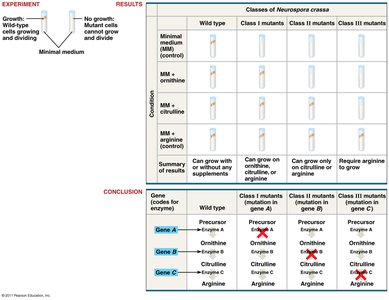
Early geneticists hypothesized that genes control the production of enzymes. The one gene-one enzyme hypothesis was refined to the one gene-one polypeptide hypothesis, recognizing that not all proteins are enzymes and some proteins are composed of multiple polypeptides.
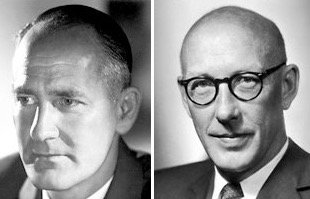
Beadle and Tatum: Demonstrated that specific genes encode specific enzymes using Neurospora crassa (bread mold) mutants.
Experimental Design: Mutants unable to synthesize certain amino acids were used to show that each gene encodes a single enzyme in a metabolic pathway.
The Flow of Genetic Information
Transcription and Translation Overview
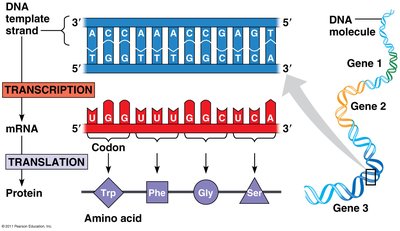
Genetic information is transcribed from DNA to RNA and then translated from RNA to protein. This process is fundamental to all living organisms.
Transcription: Synthesis of RNA from a DNA template.
Translation: Synthesis of a polypeptide using the information in the mRNA sequence.
The Genetic Code
Properties and Structure of the Genetic Code
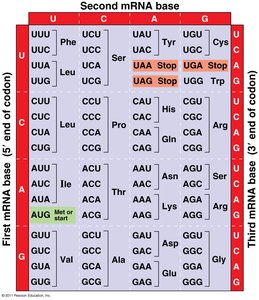
The genetic code is the set of rules by which the nucleotide sequence of mRNA is translated into the amino acid sequence of proteins.
Codon: A sequence of three nucleotides in mRNA that specifies a particular amino acid or a stop signal.
Redundancy: Most amino acids are encoded by more than one codon.
Start Codon: AUG (methionine) signals the start of translation.
Stop Codons: UAA, UAG, UGA signal the end of translation.
Universality: The genetic code is nearly universal among organisms.
Transcription: From DNA to RNA
Steps of Transcription
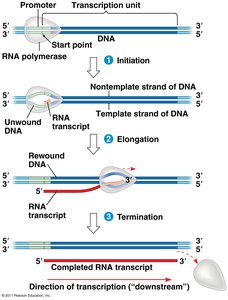
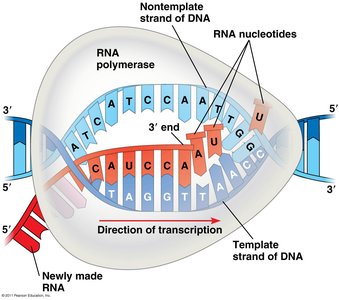
Transcription is the process by which a segment of DNA is used as a template to generate a complementary RNA strand. It occurs in three main steps: initiation, elongation, and termination.
Initiation: RNA polymerase binds to the promoter region with the help of transcription factors and unwinds the DNA.
Elongation: RNA polymerase synthesizes the RNA strand in the 5' to 3' direction, using the DNA template strand.
Termination: RNA synthesis ends when the polymerase reaches a terminator sequence.
RNA Processing in Eukaryotes
Modification and Splicing of Pre-mRNA
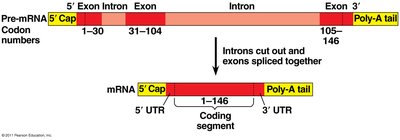
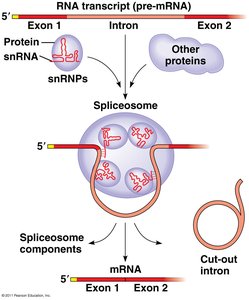
In eukaryotic cells, the primary RNA transcript (pre-mRNA) undergoes several modifications before becoming mature mRNA that can be translated.
5' Capping: Addition of a modified guanine nucleotide to the 5' end.
3' Polyadenylation: Addition of a poly-A tail to the 3' end.
Splicing: Removal of non-coding sequences (introns) and joining of coding sequences (exons).

Translation: From mRNA to Protein
Mechanism of Translation
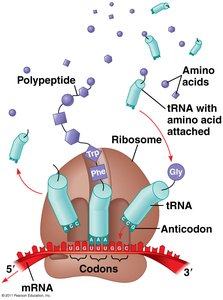
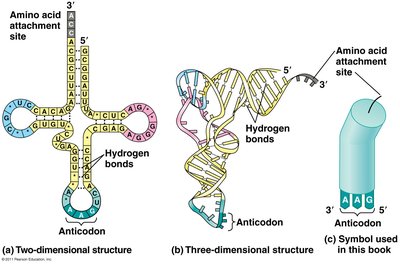
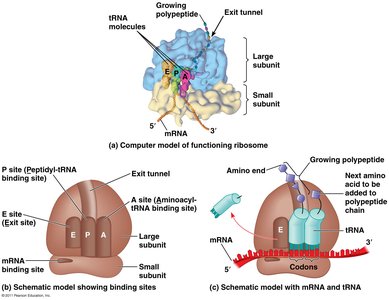
Translation is the process by which ribosomes synthesize proteins using the sequence of codons in mRNA. Transfer RNA (tRNA) molecules bring amino acids to the ribosome, matching their anticodons to the codons in mRNA.
Initiation: The small ribosomal subunit binds to mRNA, and the initiator tRNA binds to the start codon (AUG).
Elongation: Amino acids are added one by one to the growing polypeptide chain as the ribosome moves along the mRNA.
Termination: When a stop codon is reached, the completed polypeptide is released.
Gene Expression in Prokaryotes vs. Eukaryotes
Coupling and Compartmentalization
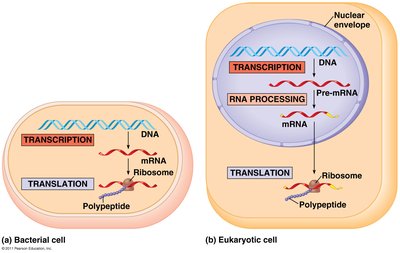
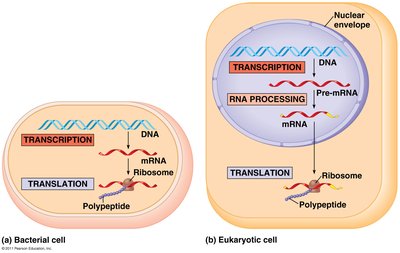
Gene expression differs between prokaryotic and eukaryotic cells, primarily due to the presence of a nucleus in eukaryotes.
Prokaryotes: Transcription and translation are coupled; both occur in the cytoplasm.
Eukaryotes: Transcription occurs in the nucleus, and translation occurs in the cytoplasm. RNA processing is required before translation.
Protein Targeting and Mutations
Protein Targeting to the Endoplasmic Reticulum (ER)
Some proteins are synthesized with a signal peptide that directs the ribosome to the ER, where the protein is completed and processed for secretion or membrane insertion.
Signal-Recognition Particle (SRP): Binds to the signal peptide and brings the ribosome to the ER membrane.
Point Mutations and Their Effects
Mutations are changes in the DNA sequence. Point mutations affect a single nucleotide and can have various effects on protein structure and function.
Silent Mutation: No change in amino acid sequence.
Missense Mutation: Changes one amino acid in the protein.
Nonsense Mutation: Introduces a premature stop codon.
Frameshift Mutation: Insertion or deletion of nucleotides that alters the reading frame.
Example: Sickle cell disease is caused by a single nucleotide change, resulting in an abnormal hemoglobin protein.
Modern Applications: CRISPR-Cas9 Gene Editing
Gene Editing for Disease Treatment
CRISPR-Cas9 is a revolutionary technology that allows for precise editing of genes. It has been used to correct genetic mutations, such as those causing sickle cell disease, offering potential cures for genetic disorders.
CRISPR-Cas9: A tool for targeted modification of DNA sequences in living cells.
Application: Used to reduce expression of disease-causing genes and treat genetic diseases.
