 Indietro
Gene Expression: From Gene to Protein (Chapter 17 Study Guide)
Guida di studio - Note intelligenti
 Appunti personalizzati basati sui tuoi materiali, ampliati con definizioni chiave, esempi e contesto.
Gene Expression: From Gene to Protein
The Flow of Genetic Information
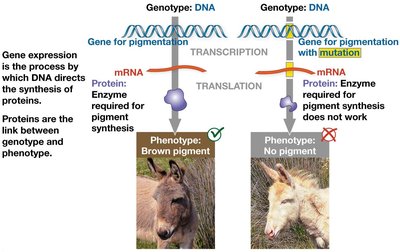
Gene expression is the process by which DNA directs the synthesis of proteins, linking genotype to phenotype. This process involves two main stages: transcription and translation. The central dogma of molecular biology describes the flow of information: DNA → RNA → Protein.
Transcription: DNA is used as a template to synthesize messenger RNA (mRNA).
Translation: mRNA is decoded by ribosomes to build a polypeptide (protein).
Phenotype: The physical traits of an organism are determined by the proteins produced.
Cellular Compartmentalization of Gene Expression
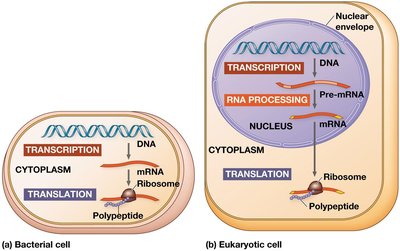
Gene expression differs between prokaryotic and eukaryotic cells due to cellular structure. In eukaryotes, transcription and RNA processing occur in the nucleus, while translation occurs in the cytoplasm. In prokaryotes, transcription and translation can occur simultaneously in the cytoplasm.
Eukaryotic cells: Nuclear envelope separates transcription (nucleus) from translation (cytoplasm).
Prokaryotic cells: No nucleus; translation can begin before transcription finishes.
Basic Principles of Gene Expression
Transcription and Translation Overview
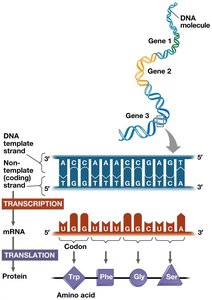
Genes are segments of DNA that encode instructions for building proteins. The DNA template strand is used to synthesize complementary mRNA, which is then translated into a sequence of amino acids.
Template strand: Used to synthesize mRNA.
Coding strand: Has the same sequence as mRNA (except T replaces U).
Codon: A three-nucleotide sequence in mRNA specifying an amino acid.
The Genetic Code
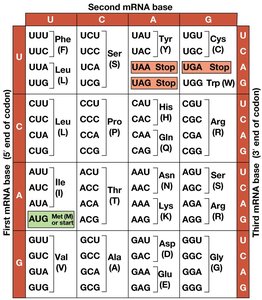
The genetic code consists of 64 codons, with 61 coding for amino acids and 3 serving as stop codons. The code is redundant, meaning multiple codons can specify the same amino acid. Codons must be read in the correct reading frame to ensure proper translation.
Start codon: AUG (Methionine)
Stop codons: UAA, UAG, UGA
Redundancy: Multiple codons for one amino acid
Transcription: DNA-Directed Synthesis of RNA
Stages of Transcription
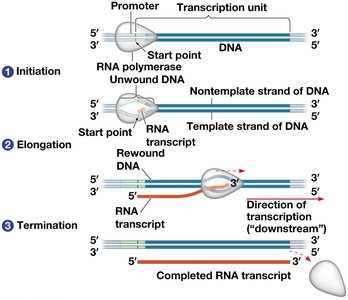
Transcription is the first stage of gene expression, carried out by RNA polymerase. It occurs in three stages: initiation, elongation, and termination.
Initiation: RNA polymerase binds to the promoter region of DNA.
Elongation: RNA polymerase synthesizes RNA in the 5′ → 3′ direction.
Termination: Transcription ends at a terminator sequence (prokaryotes) or polyadenylation signal (eukaryotes).
Initiation of Transcription in Eukaryotes
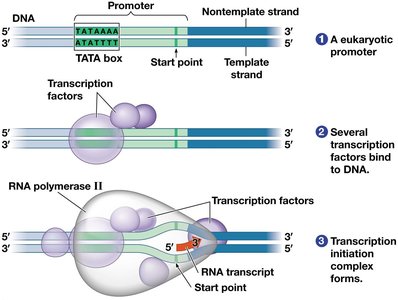
In eukaryotes, transcription initiation requires transcription factors and a promoter element called the TATA box. These factors help RNA polymerase II bind and form the transcription initiation complex.
Promoter: DNA sequence where transcription begins.
Transcription factors: Proteins that guide RNA polymerase binding.
TATA box: Crucial promoter element in eukaryotes.
Elongation and Termination of Transcription
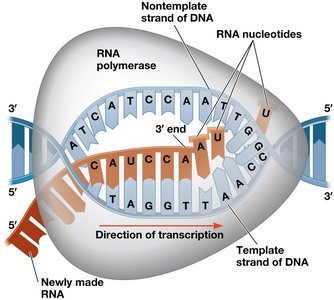
During elongation, RNA polymerase moves along the template strand, adding RNA nucleotides to the 3′ end. Termination occurs when the polymerase encounters a terminator or polyadenylation signal.
Elongation: RNA grows 5′ → 3′.
Termination: RNA transcript is released.
Eukaryotic RNA Processing
Modification of mRNA Ends
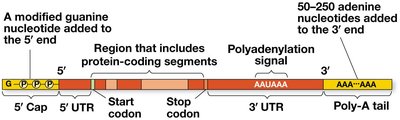
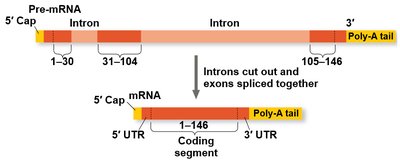
Before translation, eukaryotic pre-mRNA undergoes processing in the nucleus. The 5′ end receives a modified guanine nucleotide (5′ cap), and the 3′ end receives a poly-A tail. These modifications facilitate export, protect mRNA, and help ribosome binding.
5′ cap: Modified guanine nucleotide added to the 5′ end.
Poly-A tail: 50–250 adenine nucleotides added to the 3′ end.
Functions: Export, protection, ribosome attachment.
RNA Splicing
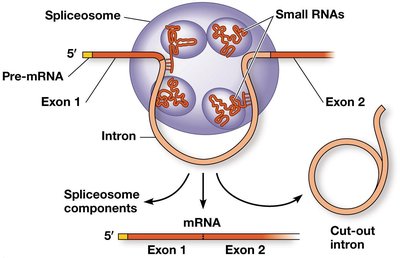
Most eukaryotic genes contain introns (noncoding regions) and exons (coding regions). RNA splicing removes introns and joins exons to produce mature mRNA. This process is carried out by spliceosomes, which are complexes of proteins and small RNAs.
Introns: Removed from pre-mRNA.
Exons: Retained in mature mRNA.
Spliceosome: Removes introns and joins exons.
Alternative RNA Splicing
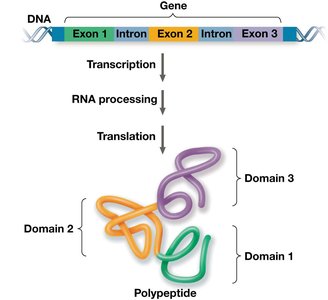
Alternative RNA splicing allows different combinations of exons to be joined, producing multiple polypeptides from a single gene. This increases protein diversity and enables the formation of distinct functional domains within proteins.
Alternative splicing: Different mRNAs from the same gene.
Domains: Distinct functional regions in proteins.
Translation: RNA-Directed Synthesis of a Polypeptide
Molecular Components of Translation
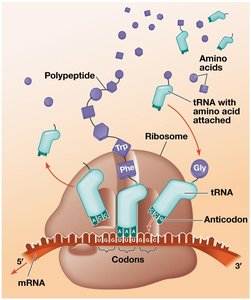
Translation is the process by which ribosomes read mRNA codons and tRNAs bring the corresponding amino acids to build a polypeptide. The ribosome matches tRNA anticodons with mRNA codons.
mRNA: Provides codon sequence.
tRNA: Carries specific amino acids; has an anticodon.
Ribosome: Matches tRNA with mRNA and builds polypeptide.
Structure and Function of tRNA
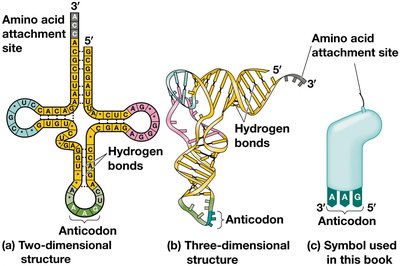
Each tRNA molecule connects an mRNA codon to a specific amino acid. The anticodon base-pairs with the complementary codon on mRNA, ensuring the correct amino acid is added to the growing polypeptide.
Amino acid attachment site: 3′ end of tRNA.
Anticodon: Base-pairs with mRNA codon.
Matching tRNAs with Amino Acids
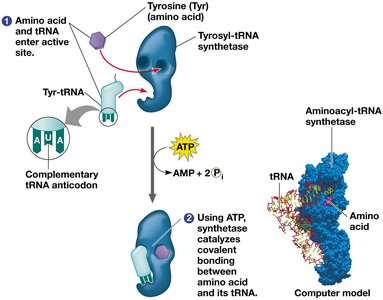
Aminoacyl-tRNA synthetases are enzymes that attach the correct amino acid to its tRNA. This process requires ATP and ensures the fidelity of translation.
Aminoacyl-tRNA synthetase: Enzyme that attaches amino acid to tRNA.
ATP: Required for the attachment process.
Structure and Function of Ribosomes
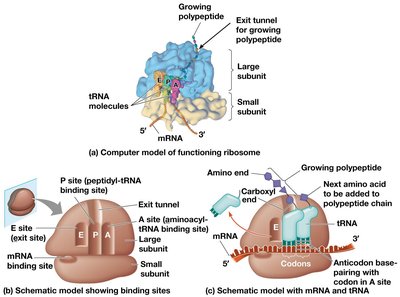
Ribosomes are composed of large and small subunits made of ribosomal RNA (rRNA) and proteins. They have three binding sites for tRNA: A (arrival), P (polypeptide), and E (exit).
A site: Incoming tRNA with next amino acid.
P site: tRNA holding growing polypeptide chain.
E site: Exit site for discharged tRNAs.
Stages of Translation
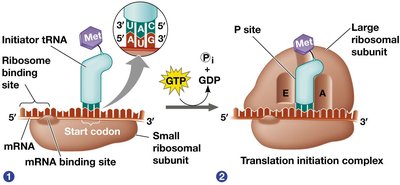
Translation occurs in three stages: initiation, elongation, and termination. Each stage requires protein factors and energy.
Initiation: Assembly of translation machinery; start codon recognized.
Elongation: Addition of amino acids to the growing chain.
Termination: Stop codon reached; polypeptide released.
From Polypeptide to Functional Protein
Protein Folding and Targeting
After translation, polypeptides fold into their specific three-dimensional shapes, often undergo post-translational modifications, and are targeted to their correct cellular locations. Ribosomes can be free in the cytosol or bound to the endoplasmic reticulum (ER), determining the destination of the synthesized protein.
Folding: Determines protein function.
Modification: May include addition of functional groups.
Targeting: Free ribosomes → cytosolic proteins; ER-bound ribosomes → secreted/endosomal proteins.
Mutations and Their Effects on Protein Structure and Function
Types of Mutations
Mutations are changes in the genetic information of a cell. Point mutations affect a single nucleotide pair and can be classified as silent, missense, or nonsense. Insertions or deletions may cause frameshifts, altering the reading frame and potentially leading to dramatic changes in protein structure and function.
Silent mutation: No change in amino acid.
Missense mutation: Different amino acid.
Nonsense mutation: Stop codon introduced.
Frameshift: Reading frame altered by insertion/deletion.
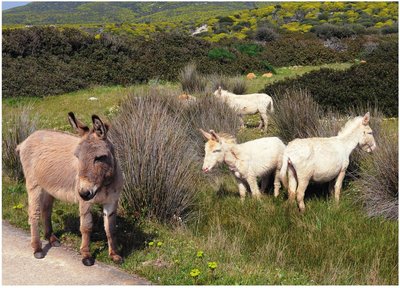
Example: Mutation in the gene for pigmentation can result in a dramatic change in appearance, such as loss of pigment in donkeys.
Summary Table: Central Dogma and Mutations
Stage | Key Process | Location | Key Enzyme/Component |
|---|---|---|---|
Transcription | DNA → RNA | Nucleus (eukaryotes), cytoplasm (prokaryotes) | RNA polymerase |
RNA Processing | pre-mRNA → mature mRNA | Nucleus (eukaryotes) | Spliceosome, capping enzymes |
Translation | mRNA → polypeptide | Cytoplasm | Ribosome, tRNA |
Mutation | DNA sequence change | Genome | DNA polymerase (errors), mutagens |
Key Equations and Concepts
Transcription direction:
Translation direction:
Genetic code:
Frameshift mutation:
