Indietro
Gene Expression: From Gene to Protein – Study Notes
Guida di studio - Note intelligenti
 Appunti personalizzati basati sui tuoi materiali, ampliati con definizioni chiave, esempi e contesto.
Gene Expression: From Gene to Protein
Importance of DNA in Cellular Function
DNA is the fundamental molecule that stores genetic information in all living organisms. Loss of DNA would result in catastrophic failure of cellular processes, especially in organs with rapid cell turnover, leading to rapid immune system collapse and death.
DNA encodes instructions for protein synthesis.
Proteins are essential for cell structure, function, and regulation.
Acute radiation syndrome demonstrates the critical role of DNA repair mechanisms in survival.
High radiation doses destroy bone marrow and GI tract, leading to infection, dehydration, and death.
The Flow of Genetic Information
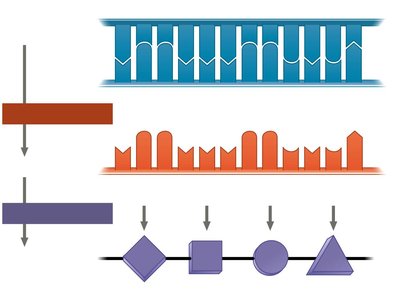
Genetic information flows from DNA to RNA to protein, a process known as gene expression. This flow is governed by the central dogma of molecular biology.
Transcription: DNA is used as a template to synthesize messenger RNA (mRNA).
Translation: mRNA is decoded by ribosomes to synthesize a polypeptide (protein).
Proteins link genotype (genetic makeup) to phenotype (observable traits).
Central Dogma: Cells follow a chain of command: DNA → RNA → Protein.

Basic Principles of Transcription and Translation
Transcription and translation are the two main stages of gene expression. RNA acts as the bridge between genes and the proteins they encode.
Transcription: Synthesis of RNA from DNA template.
Translation: Synthesis of polypeptide from mRNA template.
Ribosomes: Cellular structures where translation occurs.
Primary transcript: Initial RNA transcript before processing.
The Genetic Code
The genetic code is the set of rules by which information encoded in DNA is translated into proteins. It is based on codons, which are triplets of nucleotides.
There are 20 amino acids and only four nucleotide bases in DNA.
Codon: A sequence of three nucleotides that corresponds to a specific amino acid.
The code is redundant (multiple codons for one amino acid) but not ambiguous (each codon specifies only one amino acid).
Of 64 possible codons, 61 code for amino acids and 3 are stop signals.
Codons: Triplets of Nucleotides
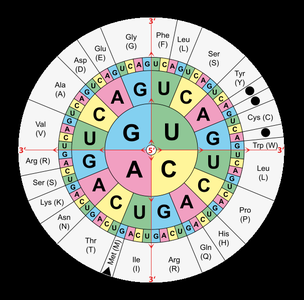
During translation, mRNA codons are read in the 5′ → 3′ direction. Each codon specifies the amino acid to be placed at the corresponding position in the polypeptide.
Reading frame: The correct grouping of codons is essential for proper protein synthesis.
Example: The mRNA sequence UGG UUU GGC UCA codes for Trp, Phe, Gly, Ser.
Codon Table for mRNA
The codon table is used to determine which amino acid corresponds to each mRNA codon. It is a key tool in decoding genetic information.
Analogy to Human Writing
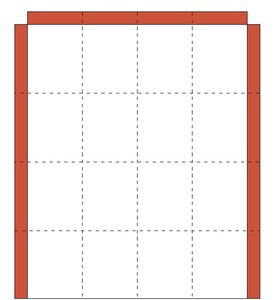
The structure of genetic information can be compared to human language:
DNA bases = letters
Codons (amino acids) = words
Genes (proteins) = sentences
Chromosome = book
Human genome = library
Practice Example: Decoding DNA
Given a template DNA sequence 5’ CAT 3’:
mRNA: 5’ GUA 3’
Amino acid: Valine (Val)
Origin of Life and the RNA World Hypothesis
The RNA world hypothesis suggests that RNA was the first genetic material, capable of self-replication. However, laboratory evidence shows limitations in RNA's ability to assemble and function without assistance.
Ribozymes can self-replicate, but cannot perform all cellular functions.
No clear explanation for the origin of the genetic code or its translation.
First information sequence is analogous to assembling words from random letters (scrabble analogy).