 Indietro
Gene Expression: From Gene to Protein – Study Notes
Guida di studio - Note intelligenti
 Appunti personalizzati basati sui tuoi materiali, ampliati con definizioni chiave, esempi e contesto.
Gene Expression: From Gene to Protein
Introduction to Gene Expression
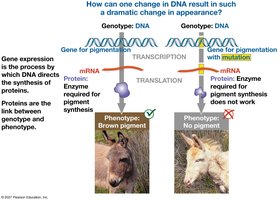
Gene expression is the process by which information encoded in DNA directs the synthesis of proteins, which are responsible for an organism’s traits. This process links genotype (genetic makeup) to phenotype (observable characteristics).
Gene expression involves two main stages: transcription and translation.
Proteins are the functional molecules that determine phenotype.
Mutations in DNA can lead to dramatic changes in appearance by altering protein function.
Basic Principles of Transcription and Translation
Overview of Genetic Information Flow
The flow of genetic information in cells follows the central dogma: DNA → RNA → Protein. This process is fundamental to all living organisms.
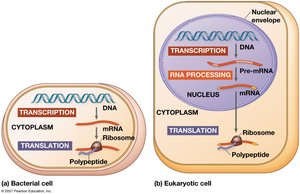
Transcription: Synthesis of RNA from a DNA template.
Translation: Synthesis of a polypeptide (protein) using the information in mRNA.
In prokaryotes, transcription and translation occur in the cytoplasm; in eukaryotes, transcription occurs in the nucleus and translation in the cytoplasm.
The Triplet Code and Codons
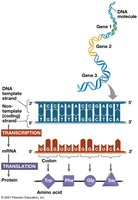
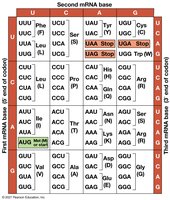
The genetic code is based on triplets of nucleotides called codons, each specifying an amino acid or a stop signal during translation.
Each codon consists of three RNA nucleotides.
There are 64 possible codons: 61 code for amino acids, 3 are stop signals.
The code is redundant (multiple codons for one amino acid) but not ambiguous (each codon specifies only one amino acid).
Correct reading frame is essential for proper protein synthesis.
Universality and Evolution of the Genetic Code
The genetic code is nearly universal among all organisms, indicating a common evolutionary origin. Genes can often be expressed in different species due to this universality.
Molecular Components of Transcription
RNA Synthesis and RNA Polymerase
Transcription is catalyzed by RNA polymerase, which synthesizes RNA using one DNA strand as a template. RNA polymerase does not require a primer and uses uracil (U) instead of thymine (T).
Stages of Transcription
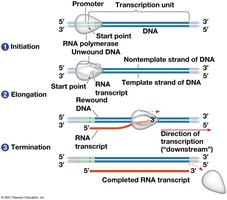
Transcription occurs in three main stages: initiation, elongation, and termination.
Initiation: RNA polymerase binds to the promoter region, aided by transcription factors in eukaryotes.
Elongation: RNA polymerase moves along the DNA, synthesizing the RNA transcript.
Termination: Transcription ends when RNA polymerase reaches a terminator sequence.
RNA Processing in Eukaryotes
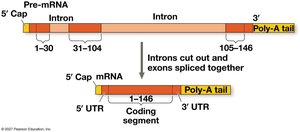
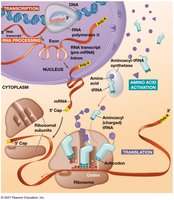
In eukaryotes, the primary RNA transcript (pre-mRNA) undergoes processing before becoming mature mRNA.
The 5′ end receives a modified nucleotide cap (5′ cap).
The 3′ end receives a poly-A tail.
These modifications facilitate mRNA export, protect from degradation, and help ribosome binding.
Introns (non-coding regions) are removed, and exons (coding regions) are spliced together.
Alternative RNA Splicing
Some genes can produce multiple polypeptides through alternative RNA splicing, where different exons are combined in various ways. This increases protein diversity without increasing gene number.
Translation: From mRNA to Protein
Transfer RNA (tRNA) Structure and Function
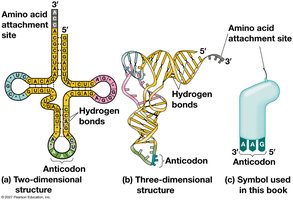
tRNA molecules serve as adaptors that match amino acids to codons in mRNA during translation. Each tRNA has an anticodon that pairs with a specific mRNA codon and an attachment site for its amino acid.
Aminoacyl-tRNA synthetase attaches the correct amino acid to its tRNA.
Wobble: Flexible pairing at the third codon position allows some tRNAs to recognize multiple codons.
Ribosome Structure and Function
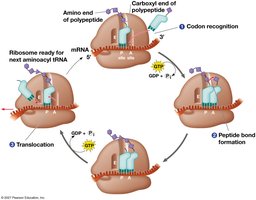
Ribosomes are the molecular machines that facilitate the coupling of tRNA anticodons with mRNA codons during protein synthesis. Each ribosome has three binding sites for tRNA:
P site: Holds the tRNA with the growing polypeptide chain.
A site: Holds the tRNA with the next amino acid.
E site: Exit site for discharged tRNAs.
Stages of Translation
Translation occurs in three stages: initiation, elongation, and termination.
Initiation: The small ribosomal subunit binds to mRNA and initiator tRNA (carrying methionine), then the large subunit joins to form the complete initiation complex.
Elongation: Amino acids are added one by one to the growing polypeptide chain.
Termination: When a stop codon is reached, a release factor binds, causing the release of the polypeptide and disassembly of the translation complex.
Protein Folding and Post-Translational Modifications
Newly synthesized polypeptides fold into their functional three-dimensional shapes. Some proteins undergo further modifications, such as cleavage or addition of chemical groups, before becoming fully functional.
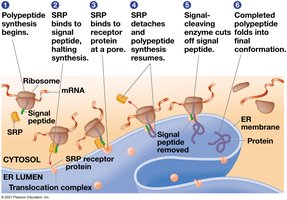
Targeting Proteins to Specific Locations
Some proteins contain signal peptides that direct them to specific cellular locations, such as the endoplasmic reticulum (ER). The signal mechanism ensures proteins reach their correct destinations.
Summary of Transcription and Translation in Eukaryotic Cells
In eukaryotes, transcription occurs in the nucleus, where pre-mRNA is processed into mature mRNA. Translation occurs in the cytoplasm, where ribosomes synthesize proteins based on mRNA instructions.
Mutations and Their Effects on Genes
Types of Mutations
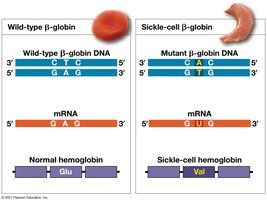
Mutations are changes in the DNA sequence that can affect gene function and phenotype.
Substitutions: One nucleotide pair is replaced by another.
Silent mutations: No effect on the amino acid sequence.
Missense mutations: Change one amino acid to another.
Nonsense mutations: Change an amino acid codon to a stop codon, leading to a truncated, usually nonfunctional protein.
Insertions and deletions: Addition or loss of nucleotide pairs, often causing frameshift mutations that alter the reading frame and usually result in nonfunctional proteins.
Gene Editing: CRISPR-Cas9 System
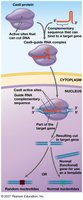
The CRISPR-Cas9 system is a powerful tool for gene editing, allowing precise modifications to DNA sequences in living cells. It uses a guide RNA to direct the Cas9 enzyme to a specific DNA sequence, where it introduces a double-strand break that can be repaired to alter the gene.
What Is a Gene?
Modern Definition of a Gene
A gene is a region of DNA that can be expressed to produce a final functional product, either a polypeptide (protein) or an RNA molecule. This definition reflects the complexity and versatility of gene function in cells.
