 Indietro
Gene Expression: From Gene to Protein – Study Notes
Guida di studio - Note intelligenti
 Appunti personalizzati basati sui tuoi materiali, ampliati con definizioni chiave, esempi e contesto.
Gene Expression: From Gene to Protein
Overview of Gene Expression
Gene expression is the process by which information from a gene is used to synthesize a functional gene product, typically a protein. This process involves two main stages: transcription and translation.
Gene: A segment of DNA that contains instructions for building a specific protein or RNA molecule.
Transcription: The synthesis of RNA from a DNA template.
Translation: The synthesis of a protein from an mRNA template.
Central Dogma: The flow of genetic information from DNA to RNA to protein.
Example: The gene for hemoglobin is transcribed into mRNA, which is then translated into the hemoglobin protein in red blood cells.
Transcription: DNA to RNA
Transcription is the first step of gene expression, where a particular segment of DNA is copied into RNA by the enzyme RNA polymerase.
Initiation: RNA polymerase binds to the promoter region of the gene.
Elongation: RNA polymerase moves along the DNA, synthesizing the RNA strand.
Termination: Transcription ends when RNA polymerase reaches a terminator sequence.
mRNA: Messenger RNA carries the genetic code from DNA to the ribosome for protein synthesis.
Key Point: In eukaryotes, the initial RNA transcript (pre-mRNA) undergoes processing, including the addition of a 5' cap, a poly-A tail, and splicing to remove introns.
Translation: RNA to Protein
Translation is the process by which the sequence of bases in mRNA is decoded to produce a specific sequence of amino acids, forming a polypeptide (protein).
Ribosome: The molecular machine that facilitates the translation of mRNA into protein.
tRNA: Transfer RNA brings amino acids to the ribosome and matches them to the coded mRNA message.
Codon: A sequence of three mRNA nucleotides that codes for a specific amino acid.
Anticodon: A sequence of three bases on tRNA complementary to an mRNA codon.
Example: The mRNA codon AUG codes for the amino acid methionine, which is the start signal for translation.
Genetic Code
The genetic code is universal and redundant, meaning that most amino acids are encoded by more than one codon. It is read in groups of three nucleotides (codons).
Start Codon: AUG (methionine) signals the start of translation.
Stop Codons: UAA, UAG, UGA signal the end of translation.
Mutations and Their Effects
Mutations are changes in the DNA sequence that can affect gene expression and protein function.
Point Mutation: A change in a single nucleotide pair.
Silent Mutation: Does not change the amino acid sequence.
Missense Mutation: Changes one amino acid in the protein.
Nonsense Mutation: Changes a codon to a stop codon, truncating the protein.
Frameshift Mutation: Insertion or deletion of nucleotides that alters the reading frame.
Example: Sickle cell anemia is caused by a missense mutation in the hemoglobin gene.
Prokaryotic vs. Eukaryotic Gene Expression
There are key differences in gene expression between prokaryotes and eukaryotes.
Feature | Prokaryotes | Eukaryotes |
|---|---|---|
Location of Transcription | Cytoplasm | Nucleus |
RNA Processing | None | 5' cap, poly-A tail, splicing |
Translation | Can begin before transcription ends | Occurs after RNA processing and export |
Summary Table: Key Terms in Gene Expression
Term | Definition |
|---|---|
DNA | Deoxyribonucleic acid, carrier of genetic information |
RNA | Ribonucleic acid, intermediate in gene expression |
mRNA | Messenger RNA, template for protein synthesis |
tRNA | Transfer RNA, brings amino acids to ribosome |
rRNA | Ribosomal RNA, structural and catalytic component of ribosomes |
Codon | Three-nucleotide sequence on mRNA coding for an amino acid |
Anticodon | Three-nucleotide sequence on tRNA complementary to codon |
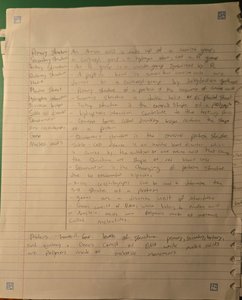
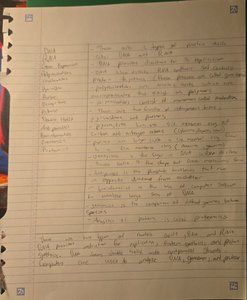
Additional info: These notes cover the core concepts of gene expression, including the central dogma, transcription, translation, the genetic code, mutations, and differences between prokaryotic and eukaryotic gene expression, which are central to General Biology (Ch. 17: Gene Expression: From Gene to Protein).
