 Indietro
Gene Expression Regulation & Epigenetics: Study Guide and Case Analysis
Guida di studio - Note intelligenti
 Appunti personalizzati basati sui tuoi materiali, ampliati con definizioni chiave, esempi e contesto.
Q1. What is differential gene expression?
Background
Topic: Regulation of Gene Expression
This question tests your understanding of how cells with identical DNA can have different functions and characteristics due to differences in gene expression.
Key Terms:
Differential gene expression: The process by which cells express different sets of genes, leading to cell specialization.
Phenotype: Observable characteristics of an organism, resulting from gene expression.
Step-by-Step Guidance
Recall that all somatic cells in a multicellular organism contain the same DNA sequence.
Think about how different cell types (e.g., muscle, nerve, skin) perform unique functions despite having the same genetic material.
Consider what it means for a gene to be "expressed" (transcribed and translated into protein) versus "silent" (not transcribed).
Reflect on how the selective activation or repression of genes leads to the diversity of cell types and functions.
Try solving on your own before revealing the answer!
Final Answer:
Differential gene expression is the process by which cells with the same genetic material express different sets of genes, resulting in different cell types and functions. This selective gene expression is responsible for the diversity of tissues and organs in multicellular organisms.
Q2. Describe the stages in gene expression that can be regulated in eukaryotes.
Background
Topic: Eukaryotic Gene Regulation
This question focuses on the multiple points at which gene expression can be controlled in eukaryotic cells.
Key Terms and Concepts:
Transcriptional regulation
Post-transcriptional regulation
Translational regulation
Post-translational regulation
Step-by-Step Guidance
List the main stages of gene expression: transcription, RNA processing, translation, and post-translational modification.
For each stage, consider what mechanisms might increase or decrease gene expression (e.g., chromatin remodeling, mRNA splicing, mRNA stability, protein modification).
Think about how these regulatory points allow for fine-tuned control of protein production in response to cellular needs.
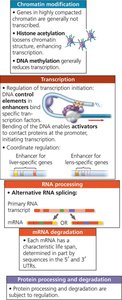
Refer to diagrams or figures (such as Figure 15.6) that summarize these regulatory steps.
Try solving on your own before revealing the answer!
Final Answer:
Gene expression in eukaryotes can be regulated at several stages: (1) chromatin modification (e.g., histone acetylation, DNA methylation), (2) transcription initiation, (3) RNA processing (e.g., alternative splicing), (4) mRNA degradation, (5) translation, and (6) post-translational modification and degradation of proteins. Each stage provides opportunities for the cell to control the amount and timing of protein production.
Q3. Describe the nature of chromatin structure.
Background
Topic: Chromatin Structure and Gene Regulation
This question examines your understanding of how DNA is packaged in eukaryotic cells and how this packaging affects gene accessibility.
Key Terms:
Chromatin: The complex of DNA and proteins (mainly histones) that forms chromosomes within the nucleus.
Nucleosome: The basic unit of chromatin, consisting of DNA wrapped around histone proteins.
Step-by-Step Guidance
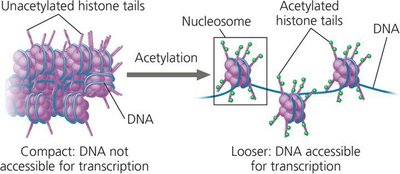
Recall that DNA in eukaryotic cells is wrapped around histone proteins to form nucleosomes.
Understand that chromatin can exist in a compact (heterochromatin) or loose (euchromatin) state.
Consider how the degree of compaction affects the accessibility of DNA to transcription machinery.
Try solving on your own before revealing the answer!
Final Answer:
Chromatin structure refers to the organization of DNA and histone proteins into a compact form within the nucleus. When chromatin is tightly packed (heterochromatin), genes are generally inaccessible and not transcribed. When chromatin is loosely packed (euchromatin), genes are accessible and can be transcribed.
Q4. Describe 3 ways that can regulate chromatin structure and how you can access the DNA (promoter).
Background
Topic: Epigenetic Regulation of Gene Expression
This question tests your knowledge of mechanisms that alter chromatin structure to regulate gene accessibility and transcription.
Key Terms and Mechanisms:
Histone acetylation
Histone methylation
DNA methylation
Step-by-Step Guidance
Identify chemical modifications to histones (e.g., acetylation, methylation) and their effects on chromatin structure.
Consider how DNA methylation can directly affect gene accessibility.
Think about chromatin remodeling complexes that reposition nucleosomes to expose or hide promoter regions.
Try solving on your own before revealing the answer!
Final Answer:
Three ways to regulate chromatin structure are: (1) histone acetylation (loosens chromatin, increases access), (2) histone methylation (can either activate or repress depending on the site), and (3) DNA methylation (usually represses gene expression by making DNA less accessible). These modifications can expose or hide promoter regions, affecting transcription initiation.
Q5. What is histone acetylation/deacetylation and how does this affect chromatin structure and transcription?
Background
Topic: Epigenetic Regulation—Histone Modification
This question focuses on how the addition or removal of acetyl groups from histones influences gene expression.
Key Terms:
Histone acetylation: Addition of acetyl groups to histone tails, usually associated with gene activation.
Histone deacetylation: Removal of acetyl groups, usually associated with gene repression.
Step-by-Step Guidance
Recall that histones are proteins around which DNA is wrapped in nucleosomes.
Understand that acetylation of histone tails reduces their positive charge, decreasing their affinity for DNA.
Consider how this loosens chromatin structure, making DNA more accessible for transcription.
Think about the opposite effect: deacetylation leads to tighter packing and reduced gene expression.
Try solving on your own before revealing the answer!
Final Answer:
Histone acetylation adds acetyl groups to histone tails, loosening chromatin and making DNA accessible for transcription. Histone deacetylation removes these groups, resulting in tighter chromatin and reduced transcription. Thus, acetylation generally activates gene expression, while deacetylation represses it.
Q7. Describe the process of chromatin remodeling and accessing the promoter and binding of RNA polymerase to initiate transcription.
Background
Topic: Chromatin Remodeling and Transcription Initiation
This question examines how chromatin structure is altered to allow transcription machinery to access DNA.
Key Terms:
Chromatin remodeling: The dynamic modification of chromatin architecture to allow access to DNA.
Promoter: DNA sequence where RNA polymerase binds to initiate transcription.
Step-by-Step Guidance
Recall that in tightly packed chromatin, promoters are not accessible to RNA polymerase.
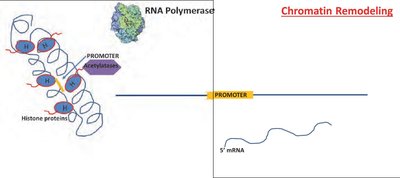
Understand that chromatin remodeling complexes or histone modifications (like acetylation) can loosen chromatin.
Once the promoter is exposed, general transcription factors and RNA polymerase can bind to initiate transcription.
Try solving on your own before revealing the answer!
Final Answer:
Chromatin remodeling involves modifying histones or repositioning nucleosomes to expose promoter regions. This allows RNA polymerase and transcription factors to bind the promoter and initiate transcription, leading to gene expression.
Q8. Describe how DNA methylation regulates gene expression.
Background
Topic: Epigenetic Regulation—DNA Methylation
This question tests your understanding of how chemical modification of DNA can silence genes.
Key Terms:
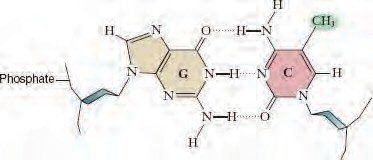
DNA methylation: Addition of methyl groups to cytosine bases in DNA, often at CpG islands.
Step-by-Step Guidance
Recall that methylation typically occurs at cytosine bases in CpG dinucleotides.
Understand that methylated DNA is recognized by proteins that repress transcription.
Consider how methylation can lead to long-term gene silencing, especially in development and disease.
Try solving on your own before revealing the answer!
Final Answer:
DNA methylation involves adding methyl groups to cytosine bases, which usually represses gene expression by making DNA less accessible to transcription factors and RNA polymerase. This is a key mechanism for long-term gene silencing.
