 Indietro
Gene Expression: Transcription and Translation
Guida di studio - Note intelligenti
 Appunti personalizzati basati sui tuoi materiali, ampliati con definizioni chiave, esempi e contesto.
Gene Expression: From Gene to Protein
Overview of the Central Dogma
The central dogma of molecular biology describes the flow of genetic information within a biological system. It states that information is transferred from DNA to RNA (by transcription), and then from RNA to protein (by translation). This process is fundamental to all living organisms and explains how genes dictate cellular structure and function.
DNA Replication: DNA makes a copy of itself.
Transcription: DNA is transcribed into messenger RNA (mRNA).
Translation: mRNA is translated into a protein (polypeptide chain).
Gene: A segment of DNA that contains the instructions for making a specific protein or functional RNA.
Gene Expression: The process by which information from a gene is used to synthesize a functional gene product (protein or RNA).
Key Point: All cells in an organism contain the same DNA, but different cell types express different sets of genes, leading to cell specialization.
Transcription: DNA to RNA
Mechanism and Steps of Transcription
Transcription is the process by which an mRNA molecule is synthesized from a DNA template. This occurs in the nucleus of eukaryotic cells and involves several key steps:
Initiation: Transcription factors bind to the promoter region (often containing a TATA box) upstream of the gene, recruiting RNA polymerase to the correct site.
Elongation: RNA polymerase separates the DNA strands and synthesizes a complementary RNA strand by adding nucleotides to the 3' end of the growing mRNA molecule.
Termination: Transcription ends when RNA polymerase reaches a termination signal, releasing the newly formed pre-mRNA.
Template Strand: The DNA strand read by RNA polymerase (3' to 5') to synthesize mRNA (5' to 3').
Coding Strand: The DNA strand not used as a template; its sequence matches the mRNA (except T is replaced by U in RNA).
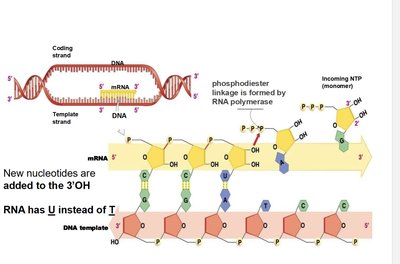
Phosphodiester bonds are formed between nucleotides during mRNA synthesis, and RNA contains uracil (U) instead of thymine (T).
mRNA Processing in Eukaryotes
Before mRNA can be translated, it undergoes several modifications:
5' Cap Addition: A modified guanine nucleotide is added to the 5' end, stabilizing the mRNA and aiding in ribosome binding.
Splicing: Non-coding regions (introns) are removed, and coding regions (exons) are joined together.
3' Poly(A) Tail: A string of adenine nucleotides (100-300 A's) is added to the 3' end, stabilizing the mRNA and promoting translation.
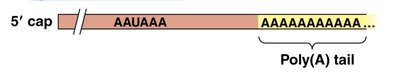
Alternative Splicing: The same pre-mRNA can be spliced in different ways, producing multiple protein variants from a single gene.
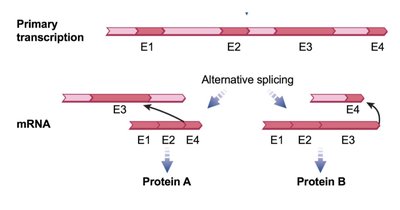
Example: A gene with exons E1, E2, E3, and E4 can produce different proteins by including or excluding certain exons during splicing.
Translation: mRNA to Protein
Genetic Code and Codons
Translation is the process by which ribosomes synthesize proteins using the sequence of codons in mRNA. Each codon (a sequence of three mRNA bases) specifies a particular amino acid.
Start Codon: AUG (codes for methionine; signals the start of translation)
Stop Codons: UAA, UAG, UGA (signal the end of translation)
There are 64 possible codons: 61 code for amino acids, 3 are stop signals.
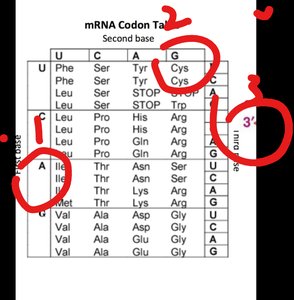
Key Point: Ribosomes read mRNA codons in the 5' to 3' direction, and the polypeptide is synthesized from the N-terminus to the C-terminus.
tRNA and Aminoacyl-tRNA Synthetase
tRNA (transfer RNA): Adaptor molecule that brings the correct amino acid to the ribosome. Each tRNA has an anticodon (complementary to the mRNA codon) and an amino acid attachment site.
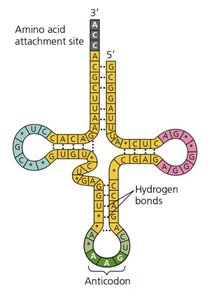
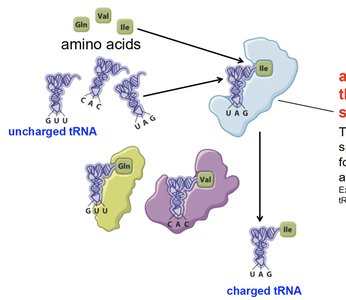
Aminoacyl-tRNA Synthetase: Enzyme that attaches the correct amino acid to its corresponding tRNA, forming a "charged tRNA." There are 20 different synthetases, one for each amino acid.
Steps of Translation
Translation occurs in the cytoplasm and involves three main stages:
Initiation: The small ribosomal subunit binds to the 5' cap of mRNA. It scans for the start codon (AUG), where the initiator tRNA (carrying methionine) binds. The large subunit then joins to form the complete initiation complex.
Elongation: tRNAs bring amino acids to the ribosome. The ribosome has three binding sites: A (aminoacyl), P (peptidyl), and E (exit). Peptide bonds form between amino acids, and the ribosome moves along the mRNA.
Termination: When a stop codon enters the A site, a release factor binds, causing the polypeptide to be released and the ribosomal subunits to dissociate.
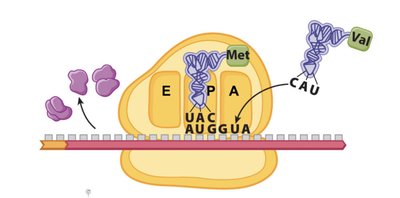
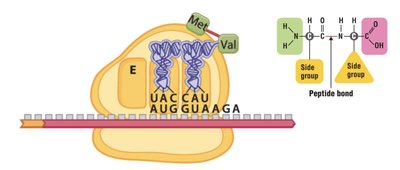
Directionality: mRNA is read 5' to 3'; the polypeptide is synthesized from the N-terminus to the C-terminus.
Summary Table: Key Steps in Gene Expression
Step | Location | Main Enzyme/Component | Product |
|---|---|---|---|
Transcription | Nucleus | RNA Polymerase | Pre-mRNA |
mRNA Processing | Nucleus | Spliceosome, capping enzymes, poly(A) polymerase | Mature mRNA |
Translation | Cytoplasm (ribosome) | Ribosome, tRNA, aminoacyl-tRNA synthetase | Polypeptide (protein) |
Key Equations and Concepts
Number of possible codons:
Direction of mRNA synthesis:
Direction of polypeptide synthesis: -terminus -terminus
Additional info: The notes above integrate foundational concepts from Chapter 17 (Gene Expression: From Gene to Protein) and related molecular biology chapters, providing a comprehensive overview suitable for college-level General Biology students.
