 Indietro
Gene Expression: Transcription, Translation, and Mutations
Guida di studio - Note intelligenti
 Appunti personalizzati basati sui tuoi materiali, ampliati con definizioni chiave, esempi e contesto.
Gene Expression: From DNA to Protein
Overview of Gene Expression
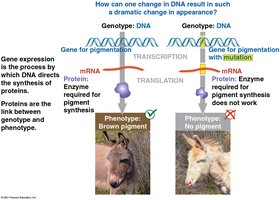
Gene expression is the process by which information encoded in DNA is used to direct the synthesis of proteins, which are responsible for an organism's traits. This process involves two main stages: transcription and translation. Proteins serve as the link between genotype (genetic makeup) and phenotype (observable traits).
Transcription: DNA is used as a template to synthesize messenger RNA (mRNA).
Translation: Ribosomes read the mRNA and synthesize a polypeptide (protein).
Mutations: Changes in DNA can alter protein function, leading to changes in phenotype.
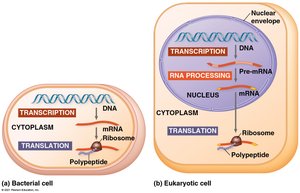
Central Dogma of Molecular Biology
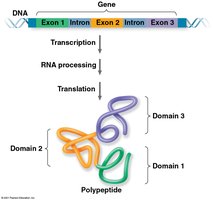
The central dogma describes the flow of genetic information: DNA → RNA → Protein.
Transcription: Occurs in the nucleus (eukaryotes) or cytoplasm (prokaryotes).
RNA Processing: Eukaryotic cells modify RNA before translation.
Translation: Occurs in the cytoplasm at ribosomes.
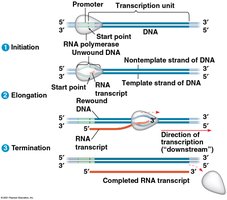
Transcription: DNA-Directed Synthesis of RNA
Stages of Transcription
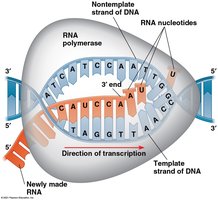
Transcription is catalyzed by RNA polymerase and consists of three stages:
Initiation: RNA polymerase binds to the promoter region of DNA.
Elongation: RNA polymerase synthesizes the RNA strand by adding nucleotides to the 3' end.
Termination: Transcription ends when RNA polymerase reaches a terminator sequence (prokaryotes) or polyadenylation signal (eukaryotes).
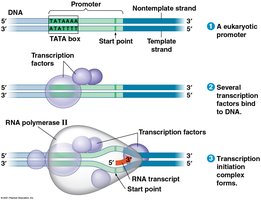
Promoters and Initiation Complex
Promoter: DNA sequence where RNA polymerase attaches.
TATA Box: A specific promoter sequence in eukaryotes.
Transcription Factors: Proteins that help RNA polymerase bind and initiate transcription.
RNA Synthesis and Base Pairing
RNA is synthesized using the DNA template strand.
Base pairing rules: A-U, T-A, C-G, G-C (uracil replaces thymine in RNA).
RNA Processing in Eukaryotes
Modification of mRNA Ends
Eukaryotic pre-mRNA undergoes modifications:
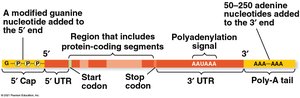
5' Cap: Addition of a modified guanine nucleotide to the 5' end.
Poly-A Tail: Addition of 50–250 adenine nucleotides to the 3' end.
These modifications facilitate export, protect mRNA, and help ribosome binding.
RNA Splicing: Removal of Introns
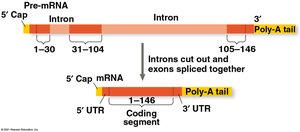
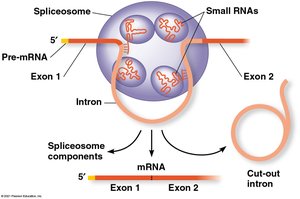
Introns: Noncoding regions removed from pre-mRNA.
Exons: Coding regions joined together to form mature mRNA.
Spliceosomes: Complexes of proteins and small RNAs that catalyze splicing.
Protein Domains and Exon Shuffling
Proteins have modular domains, often encoded by separate exons.
Exon shuffling can create new proteins by mixing exons from different genes.
Translation: RNA-Directed Synthesis of Polypeptides
Genetic Code and Codons
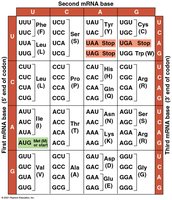
The genetic code consists of triplet codons in mRNA, each specifying an amino acid.
There are 64 codons: 61 code for amino acids, 3 are stop signals.
The code is redundant but not ambiguous.
Translation Process
Translation occurs in three stages:
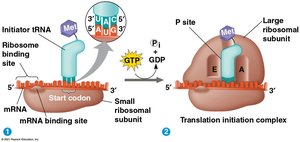
Initiation: Small ribosomal subunit binds mRNA and initiator tRNA (methionine), then large subunit joins.
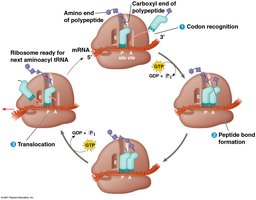
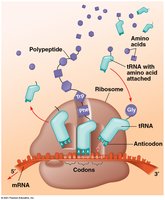
Elongation: Amino acids are added to the growing chain via codon recognition, peptide bond formation, and translocation.
Termination: Stop codon is reached, release factor binds, polypeptide is released.
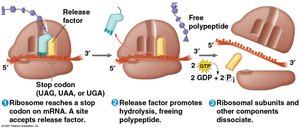
tRNA and Ribosome Function
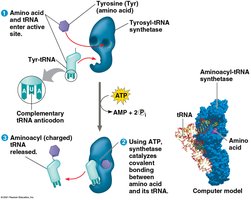
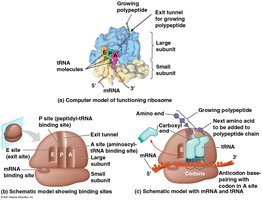
tRNA: Transfers specific amino acids to the ribosome; has an anticodon complementary to mRNA codon.
Aminoacyl-tRNA Synthetase: Enzyme that attaches amino acids to tRNA.
Ribosome: Has three sites: A (aminoacyl), P (peptidyl), E (exit).
Post-Translational Modifications and Protein Targeting
Protein Folding and Modification
Polypeptides fold into specific three-dimensional shapes (secondary and tertiary structure).
Post-translational modifications (e.g., glycosylation, methylation) may be required for function.
Targeting Proteins to Specific Locations
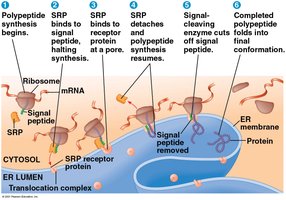
Free ribosomes synthesize cytosolic proteins; bound ribosomes synthesize proteins for secretion or membrane.
Signal peptides direct proteins to the endoplasmic reticulum (ER) or other organelles.
Signal-recognition particle (SRP) binds signal peptide and escorts ribosome to ER.
Mutations: Effects on Protein Structure and Function
Types of Mutations
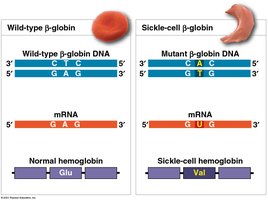
Point Mutations: Change a single nucleotide pair.
Substitutions: Replace one nucleotide pair with another.
Silent Mutation: No effect on amino acid sequence.
Missense Mutation: Changes one amino acid to another.
Nonsense Mutation: Changes an amino acid codon to a stop codon.
Insertions/Deletions: Add or remove nucleotide pairs, often causing frameshift mutations.
Mutagens and Carcinogens
Spontaneous mutations occur during DNA replication or recombination.
Mutagens are physical or chemical agents that cause mutations; most carcinogens are mutagens.
Summary Table: Types of Mutations
Type | Description | Effect |
|---|---|---|
Silent | Substitution, no amino acid change | No effect |
Missense | Substitution, changes amino acid | Possible altered function |
Nonsense | Substitution, creates stop codon | Nonfunctional protein |
Insertion/Deletion | Add/remove nucleotides | Frameshift, often severe |
Key Concepts and Applications
Gene expression is essential for linking genotype to phenotype.
Transcription and translation are fundamental processes in all cells.
Mutations can have diverse effects, from benign to severe.
Understanding these processes is crucial for fields such as genetics, biotechnology, and medicine.
