 Indietro
Gene Expression: Transcription, Translation, and Mutations
Guida di studio - Note intelligenti
 Appunti personalizzati basati sui tuoi materiali, ampliati con definizioni chiave, esempi e contesto.
Gene Expression: From DNA to Protein
Overview of Gene Expression
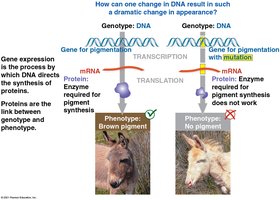
Gene expression is the process by which information encoded in DNA is used to direct the synthesis of proteins, which are responsible for an organism's traits. This process involves two main stages: transcription and translation. Proteins serve as the link between genotype (genetic makeup) and phenotype (observable traits).
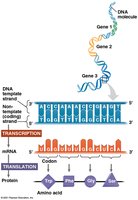
Transcription: DNA is used as a template to synthesize messenger RNA (mRNA).
Translation: Ribosomes read the mRNA and synthesize a polypeptide (protein).
Mutations: Changes in DNA can alter protein function, leading to changes in phenotype.
Central Dogma of Molecular Biology
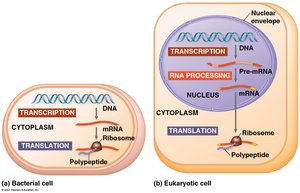
The central dogma describes the flow of genetic information: DNA → RNA → Protein.
Transcription: Occurs in the nucleus (eukaryotes) or cytoplasm (prokaryotes).
RNA Processing: Eukaryotic cells modify RNA before translation.
Translation: Occurs in the cytoplasm at ribosomes.
Transcription: DNA-Directed Synthesis of RNA
Basic Principles
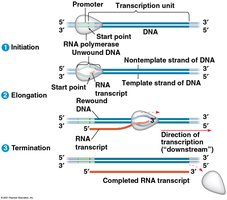
RNA Polymerase: Enzyme that synthesizes RNA from a DNA template.
Promoter: DNA sequence where RNA polymerase binds to start transcription.
Stages: Initiation, Elongation, Termination.
Base Pairing: RNA uses uracil (U) instead of thymine (T).
Initiation of Transcription
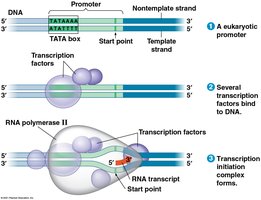
TATA Box: A promoter element crucial for initiation in eukaryotes.
Transcription Factors: Proteins that help RNA polymerase bind and initiate transcription.
Elongation and Termination
RNA polymerase moves along the DNA, synthesizing RNA in the 5' → 3' direction.
Termination differs between prokaryotes and eukaryotes.
RNA Processing in Eukaryotes
Modification of mRNA Ends
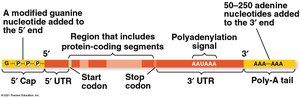
Eukaryotic pre-mRNA undergoes modifications:
5' Cap: Modified guanine nucleotide added to the 5' end.
Poly-A Tail: 50–250 adenine nucleotides added to the 3' end.
These modifications protect mRNA and aid in export and translation.
RNA Splicing
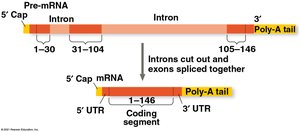
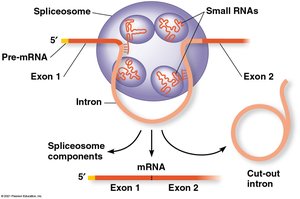
Introns: Noncoding regions removed from pre-mRNA.
Exons: Coding regions joined together to form mature mRNA.
Spliceosome: Complex responsible for removing introns.
Alternative Splicing and Protein Domains
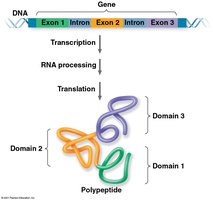
Alternative splicing allows a single gene to code for multiple proteins.
Proteins often have modular domains encoded by different exons.
Translation: RNA-Directed Synthesis of Polypeptides
Genetic Code and Codons
The genetic code consists of triplets of nucleotides (codons) in mRNA.
Each codon specifies an amino acid or a stop signal.
The code is redundant but not ambiguous.
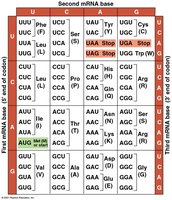
Reading DNA and mRNA
DNA template strand is used to synthesize complementary mRNA.
mRNA is read in the 5' → 3' direction during translation.
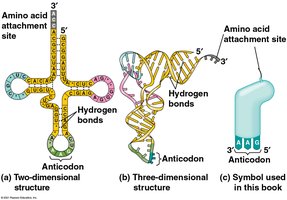
Transfer RNA (tRNA) Structure and Function
tRNA carries specific amino acids and matches them to codons in mRNA via its anticodon.
tRNA structure allows it to form hydrogen bonds and attach amino acids.
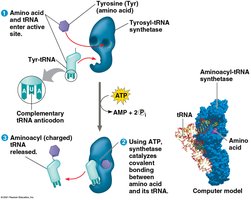
Aminoacyl-tRNA Synthetase
Enzyme that attaches the correct amino acid to its tRNA.
Requires ATP for the attachment process.
Ribosome Structure and Function
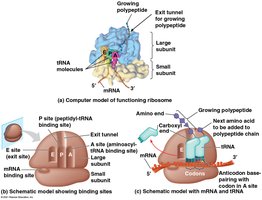
Ribosomes have large and small subunits, each with tRNA binding sites: A, P, and E.
Facilitate the coupling of tRNA anticodons with mRNA codons.
Stages of Translation
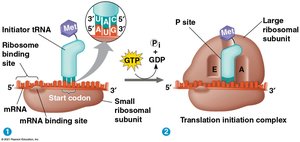
Initiation: Small ribosomal subunit binds mRNA and initiator tRNA; large subunit joins.
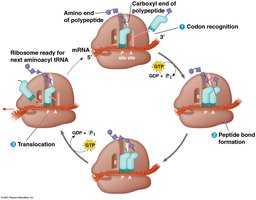
Elongation: Amino acids are added one by one; involves codon recognition, peptide bond formation, and translocation.
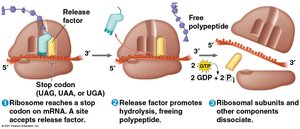
Termination: Stop codon is reached; release factor causes polypeptide release.
Post-Translational Modifications and Protein Targeting
Proteins may undergo modifications (glycosylation, methylation) after translation.
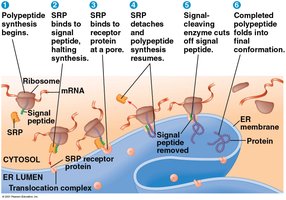
Signal peptides direct proteins to specific cellular locations.
SRP (signal-recognition particle) helps target proteins to the ER.
Polyribosomes
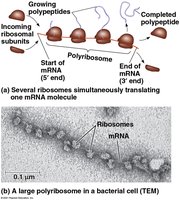
Multiple ribosomes can translate a single mRNA simultaneously, forming a polyribosome.
Allows rapid production of many polypeptides.
Mutations and Their Effects on Protein Structure
Types of Mutations
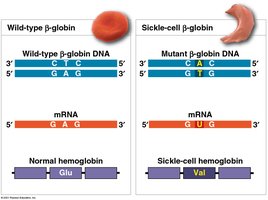
Point Mutations: Change in a single nucleotide pair.
Substitutions: Replace one nucleotide pair with another.
Insertions/Deletions: Add or remove nucleotide pairs, often causing frameshift mutations.
Effects of Mutations
Silent Mutation: No effect on protein due to redundancy in the genetic code.
Missense Mutation: Changes one amino acid to another.
Nonsense Mutation: Changes an amino acid codon to a stop codon, leading to a truncated protein.
Frameshift Mutation: Alters the reading frame, often resulting in a nonfunctional protein.
Mutagens
Mutagens are physical or chemical agents that cause mutations.
Most carcinogens are mutagens.
Summary Table: Types of Mutations
Type | Description | Effect |
|---|---|---|
Substitution | One nucleotide pair replaced | Silent, missense, or nonsense |
Insertion/Deletion | Added or removed nucleotide pairs | Frameshift, often severe |
Mutagen | Agent causing mutation | Varies, often carcinogenic |
Key Vocabulary
Gene Expression
Transcription
Translation
mRNA
tRNA
Ribosome
Codon
Mutation
Introns/Exons
Spliceosome
Polyribosome
Important Equations and Concepts
Base Pairing in Transcription:
Central Dogma:
Example: Using the Genetic Code
Given mRNA sequence: AUG-GCU-UAA
Using the genetic code table, AUG = Methionine (start), GCU = Alanine, UAA = Stop
Resulting polypeptide: Methionine-Alanine
Summary
Understanding gene expression, transcription, translation, and mutations is fundamental to molecular biology. These processes explain how genetic information is converted into functional proteins and how changes in DNA can impact traits and health. Mastery of these concepts is essential for success in General Biology.
