 Indietro
Lecture 15 (Unit 2) -Gene Structure, Expression, and the Genetic Code: From DNA to Protein
Guida di studio - Note intelligenti
 Appunti personalizzati basati sui tuoi materiali, ampliati con definizioni chiave, esempi e contesto.
Gene Structure and Definition
Classical and Molecular Definition of a Gene
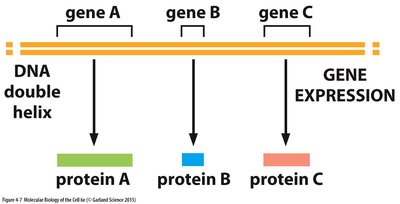
The concept of a gene has evolved from classical genetics to molecular biology, where genes are defined as segments of DNA that encode functional products, typically proteins. Early studies using bacterial viruses (bacteriophage) and genetic complementation tests were crucial in clarifying the molecular nature of genes.
Gene: A segment of DNA that codes for a specific protein or functional RNA.
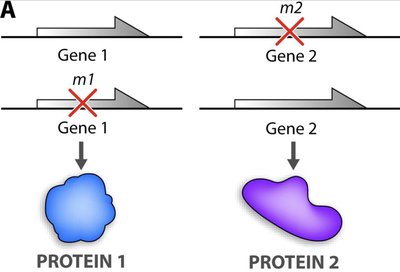
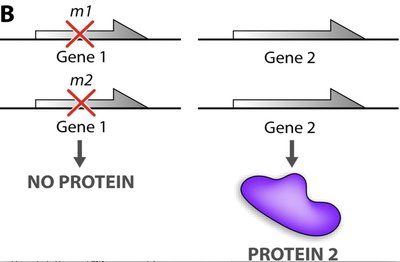
Genetic complementation test: A method to determine whether mutations affect the same gene or different genes by observing if two mutations can restore function when combined.
Functional unit: The minimum DNA sequence required to produce a functional product.
Bacteriophage: Viruses that infect bacteria, used in early genetic studies.
Complementation: Mutations in different genes can complement each other, restoring function; mutations in the same gene cannot.
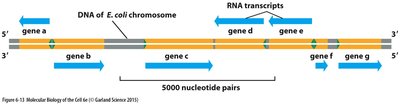
Gene organization: Genes involved in a pathway are often sequentially arranged on the chromosome.
Genetic Complementation and Pathway Analysis
Complementation tests are used to define genes in biosynthetic pathways. By combining mutations in different genes, researchers can determine the number of genes required for a process, such as amino acid synthesis.
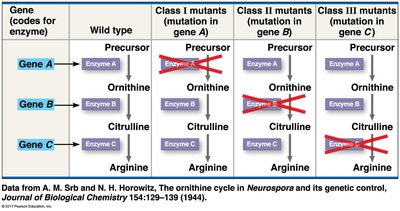
Pathway analysis: Genes encode enzymes that catalyze sequential steps in a biosynthetic pathway.
Mutant classes: Mutations in different genes disrupt different steps, allowing genetic mapping of pathways.
Gene Expression: Transcription and Translation
Transcription in Prokaryotes and Eukaryotes
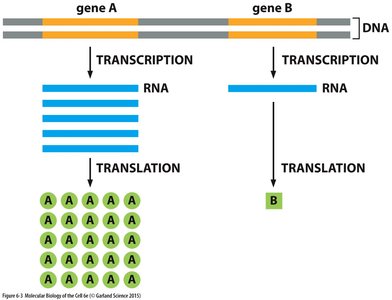
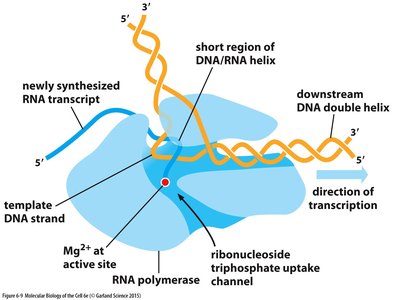
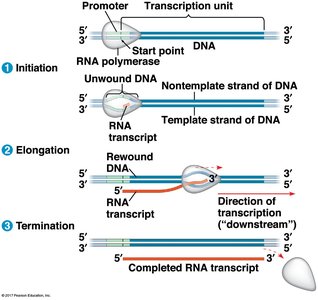
Gene expression is primarily regulated at the level of transcription, where RNA polymerase synthesizes messenger RNA (mRNA) from a DNA template. The process differs between prokaryotes and eukaryotes.
Transcription: The synthesis of RNA from a DNA template by RNA polymerase.
Promoter: DNA sequence where RNA polymerase binds to initiate transcription.
Direction: RNA is synthesized in the 5' to 3' direction.
Termination: Specific signals cause RNA polymerase to release the completed mRNA.
Eukaryotic transcription: Involves additional regulatory proteins and post-transcriptional processing (splicing, 5' cap, 3' poly-A tail).
Post-Transcriptional Processing in Eukaryotes
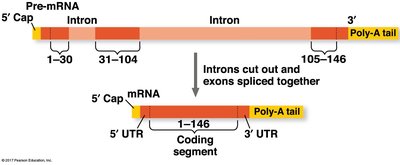
Eukaryotic mRNA undergoes several modifications before translation, including splicing to remove introns and addition of a 5' cap and 3' poly-A tail. Exons often correspond to independent domains of the protein.
Introns: Non-coding sequences removed from pre-mRNA.
Exons: Coding sequences joined together to form mature mRNA.
Spliceosome: Complex responsible for splicing introns.
5' cap and 3' poly-A tail: Modifications that stabilize mRNA and facilitate translation.
Reading the Genetic Code
Structure and Properties of the Genetic Code
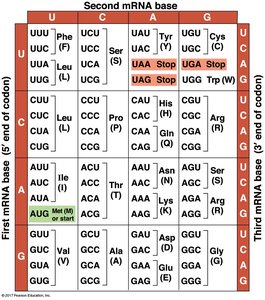
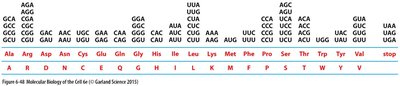
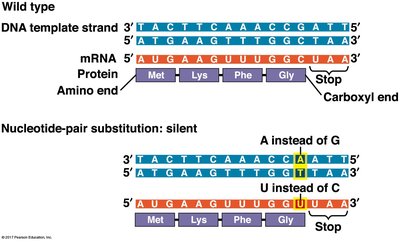
The genetic code is the set of rules by which nucleotide sequences in mRNA are translated into amino acid sequences in proteins. The code is universal, degenerate, and includes start and stop signals.
Codon: A sequence of three nucleotides that specifies an amino acid.
Degeneracy: Most amino acids are encoded by multiple codons.
Start codon: AUG (methionine) signals the beginning of translation.
Stop codons: UGA, UAA, UAG signal termination of translation.
Silent mutations: Changes in the third codon position often do not alter the amino acid.
Missense mutations: Changes in the first or second position can substitute one amino acid for another.
Frameshift mutations: Insertions or deletions shift the reading frame, altering downstream amino acids.
Translation: From mRNA to Protein
Transfer RNA (tRNA) and Amino Acid Attachment
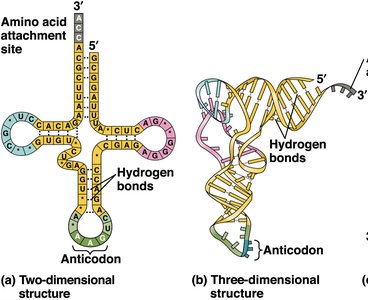
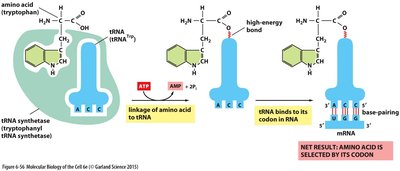
Translation is the process by which ribosomes synthesize proteins using mRNA as a template. Transfer RNA (tRNA) molecules carry specific amino acids and recognize codons via their anticodon loop.
tRNA: Adaptor molecule that matches an amino acid to its codon in mRNA.
Aminoacyl-tRNA synthetase: Enzyme that attaches the correct amino acid to tRNA.
Anticodon: Three-nucleotide sequence in tRNA complementary to the mRNA codon.
ATP: Required for amino acid activation and attachment to tRNA.
Ribosome Structure and Function
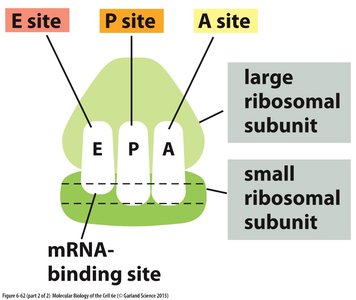
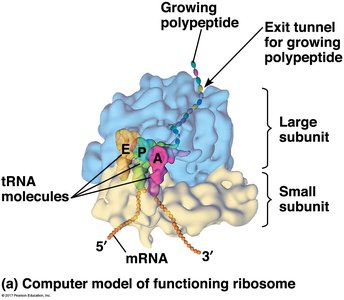
The ribosome is a large RNA-protein complex with three sites for tRNA binding: A (acceptor), P (peptidyl), and E (exit). Translation proceeds through cycles of initiation, elongation, and termination, facilitated by GTPases.
A site: Accepts incoming aminoacyl-tRNA.
P site: Holds the tRNA with the growing polypeptide chain.
E site: Releases the tRNA after its amino acid has been added.
Peptide bond formation: Catalyzed by ribosomal RNA in the large subunit.
Coupling of Transcription and Translation in Prokaryotes
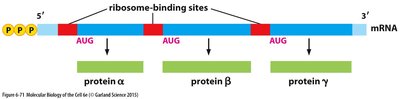
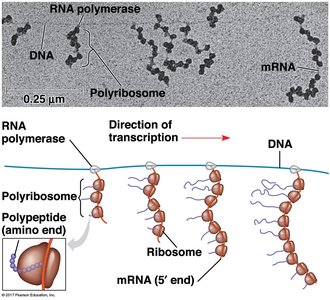
In prokaryotes, transcription and translation are coupled, meaning that ribosomes begin translating mRNA while it is still being synthesized by RNA polymerase.
Polyribosome: Multiple ribosomes translating a single mRNA simultaneously.
Efficiency: Coupling allows rapid protein synthesis in bacteria.
Summary Table: Types of Mutations and Their Effects
Mutation Type | Codon Position | Effect | Example |
|---|---|---|---|
Silent | 3rd | No change in amino acid | GGC to GGU (both code for Gly) |
Missense | 1st or 2nd | Change in amino acid | GGC to AGC (Gly to Ser) |
Nonsense | Any | Creates stop codon | UAC to UAA (Tyr to Stop) |
Frameshift | Any | Shifts reading frame | Insertion or deletion |
Key Equations
Number of possible codons:
Peptide bond formation:
Amino acid activation:
Aminoacyl-tRNA formation:
----------------------------------------
