 Indietro
General Biology: Atoms, Molecules, and Water Properties Study Guide
Guida di studio - Note intelligenti
 Appunti personalizzati basati sui tuoi materiali, ampliati con definizioni chiave, esempi e contesto.
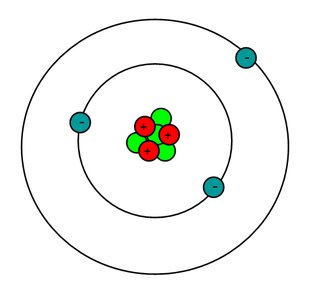
Q5. Label the electrons, protons, neutrons, and atomic nucleus in the model of Lithium.
Background
Topic: Atomic Structure
This question tests your understanding of the basic structure of an atom, including the location and identity of subatomic particles (protons, neutrons, electrons) and the atomic nucleus.
Key Terms:
Proton: Positively charged particle found in the nucleus.
Neutron: Neutrally charged particle found in the nucleus.
Electron: Negatively charged particle found in electron shells around the nucleus.
Atomic Nucleus: The central part of the atom containing protons and neutrons.
Step-by-Step Guidance
Identify the central cluster in the diagram—this is the atomic nucleus, which contains both protons and neutrons.
Look for the symbols or colors that distinguish protons (often shown as red with a + sign) and neutrons (often green or another color, with no sign).
Locate the small particles on the rings (shells) around the nucleus—these are the electrons, usually marked with a - sign.
Label each part: protons, neutrons, electrons, and the nucleus.
Try solving on your own before revealing the answer!
Final Answer:
Protons: Red circles with a + sign in the nucleus
Neutrons: Green circles in the nucleus
Electrons: Blue circles with a - sign on the outer rings
Atomic Nucleus: The central cluster containing both protons and neutrons
This model visually represents the arrangement of subatomic particles in a lithium atom, with electrons in shells and protons/neutrons in the nucleus.
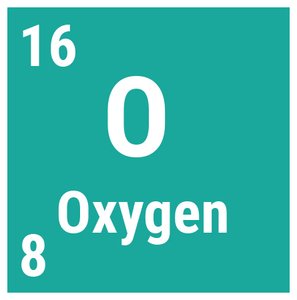
Q6. What is the atomic number of Oxygen? What is the mass number? How many electrons does Oxygen have? How many neutrons?
Background
Topic: Atomic Number, Mass Number, and Subatomic Particles
This question tests your ability to interpret information from the periodic table and relate it to the structure of an atom.
Key Terms and Formulas:
Atomic Number (Z): Number of protons in the nucleus of an atom.
Mass Number (A): Total number of protons and neutrons in the nucleus.
Number of Neutrons:
Number of Electrons: In a neutral atom, equals the atomic number.
Step-by-Step Guidance
Find the atomic number for oxygen on the periodic table (usually the smaller number, often at the top left of the element box).
Find the mass number for oxygen (usually the larger number, often at the top or bottom of the element box).
Recall that the number of electrons in a neutral atom equals the atomic number.
Calculate the number of neutrons using the formula:
Try solving on your own before revealing the answer!
Final Answer:
Atomic number: 8
Mass number: 16
Electrons: 8 (for a neutral atom)
Neutrons: 8 (16 - 8 = 8)
These values are determined directly from the periodic table and basic atomic structure rules.
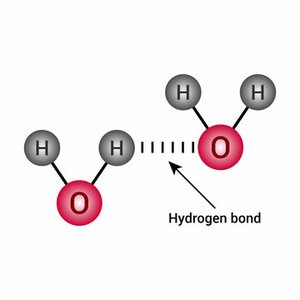
Q11. Draw two water molecules. Label the atoms, show the bonds between them (label polar covalent and hydrogen bonds), and show the shape of the molecule. Which element is most electronegative (Oxygen or Hydrogen)? Why is water considered a polar molecule?
Background
Topic: Molecular Structure and Polarity of Water
This question tests your understanding of water's molecular geometry, the types of bonds present, and the concept of electronegativity and polarity.
Key Terms:
Polar Covalent Bond: A covalent bond in which electrons are shared unequally, resulting in partial charges.
Hydrogen Bond: A weak bond between a hydrogen atom in one molecule and an electronegative atom (like oxygen) in another molecule.
Electronegativity: The tendency of an atom to attract electrons in a bond.
Bent Shape: The V-shaped geometry of a water molecule due to the two lone pairs on oxygen.
Step-by-Step Guidance
Draw two water molecules, each with one oxygen atom (O) and two hydrogen atoms (H) arranged in a bent (V) shape.
Label the bonds within each water molecule as polar covalent bonds (between O and H).
Show a dotted line between the hydrogen of one molecule and the oxygen of another to represent a hydrogen bond.
Indicate which atom (O or H) is more electronegative and explain why water is polar (due to the difference in electronegativity and the bent shape).
Try solving on your own before revealing the answer!
Final Answer:
Oxygen is more electronegative than hydrogen.
Water is a polar molecule because oxygen attracts electrons more strongly, creating partial negative (on O) and partial positive (on H) charges, and the bent shape prevents these charges from canceling out.
Within each molecule, O-H bonds are polar covalent; between molecules, the dotted line is a hydrogen bond.
This structure and bonding explain water's unique properties, such as cohesion and high specific heat.
