 Indietro
General Biology: DNA, RNA, and Cell Cycle Study Guide
Guida di studio - Note intelligenti
 Appunti personalizzati basati sui tuoi materiali, ampliati con definizioni chiave, esempi e contesto.
Q1. DNA is always synthesized in the _____ direction.
Background
Topic: DNA Replication
This question tests your understanding of the directionality of DNA synthesis during replication, which is fundamental to molecular biology.
Key Terms and Concepts:
DNA polymerase: The enzyme that synthesizes new DNA strands.
Directionality: DNA is synthesized by adding nucleotides to the 3' end of the growing strand.
Step-by-Step Guidance
Recall that DNA strands have directionality, labeled 5' (five prime) and 3' (three prime) ends.
DNA polymerase can only add nucleotides to the free 3' hydroxyl group of the growing DNA strand.
Therefore, new DNA strands are always synthesized in a specific direction relative to the template strand.
Consider which answer choice matches this directionality (think about the 5' and 3' ends).
Try solving on your own before revealing the answer!
Final Answer: D. 5’ → 3’
DNA is always synthesized in the 5’ to 3’ direction because DNA polymerase adds nucleotides to the 3’ end of the growing strand.
Q2. What amino acid is coded for by the codon AAG?
Background
Topic: Genetic Code and Translation
This question tests your ability to use the genetic code to determine which amino acid is specified by a particular mRNA codon.
Key Terms and Concepts:
Codon: A sequence of three nucleotides in mRNA that codes for a specific amino acid.
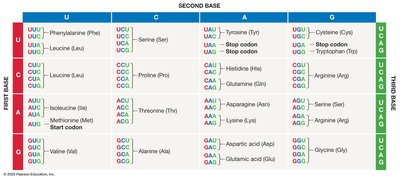
Genetic code table: Used to translate codons into amino acids.
Step-by-Step Guidance
Identify the codon in question: AAG.
Locate the first base (A), second base (A), and third base (G) on the genetic code table.
Find the intersection of these bases to determine the corresponding amino acid.
Compare your result to the answer choices provided.
Try solving on your own before revealing the answer!
Final Answer: D. Lysine
The codon AAG codes for the amino acid Lysine (Lys).
Q3. Which of the following is a missense mutation?
Background
Topic: Types of Mutations
This question tests your understanding of different types of point mutations and their effects on protein coding.
Key Terms and Concepts:
Missense mutation: A point mutation that results in a codon that codes for a different amino acid.
Silent mutation: A mutation that does not change the amino acid sequence.
Nonsense mutation: A mutation that introduces a stop codon.
Step-by-Step Guidance
Review each codon change and determine if the new codon codes for a different amino acid.
Use the genetic code table to check the amino acid for each codon.
Identify which option results in a different amino acid (missense), a stop codon (nonsense), or the same amino acid (silent).
Try solving on your own before revealing the answer!
Final Answer: D. CGA → CAA
This change results in a different amino acid, making it a missense mutation.
Q4. If the top strand of this DNA is the template strand, which rNTP will be the last added to the RNA transcribed from this template?
Background
Topic: Transcription and Base Pairing
This question tests your understanding of how RNA is synthesized from a DNA template and the rules of base pairing.
Key Terms and Concepts:
Template strand: The DNA strand used by RNA polymerase to synthesize RNA.
rNTP: Ribonucleoside triphosphate, the building block of RNA.
Base pairing: A pairs with U (in RNA), T with A, C with G, and G with C.
Step-by-Step Guidance
Identify the template strand (top strand) and the direction of transcription (RNA is synthesized 5’ to 3’).
Find the last nucleotide on the template strand (3’ end).
Determine the complementary RNA base that will be added opposite this DNA base.
Match the DNA base to the correct rNTP (A, U, C, or G).
Try solving on your own before revealing the answer!
Final Answer: B. C
The last base on the template strand is G, so the last rNTP added is C (cytosine).
Q5. In which direction is the RNA molecule being transcribed?
Background
Topic: Transcription Directionality
This question tests your understanding of the direction in which RNA polymerase synthesizes RNA from a DNA template.
Key Terms and Concepts:
RNA polymerase: Enzyme that synthesizes RNA from a DNA template.
Directionality: RNA is synthesized in the 5’ to 3’ direction.
Step-by-Step Guidance
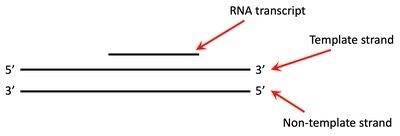
Identify the template strand and the direction of its 3’ and 5’ ends.
Recall that RNA is synthesized in the 5’ to 3’ direction, using the template strand as a guide.
Determine which direction (left to right or right to left) corresponds to 5’ to 3’ synthesis on the RNA strand.
Try solving on your own before revealing the answer!
Final Answer: B. Left to right
RNA is synthesized in the 5’ to 3’ direction, which in this diagram is left to right.
