 Indietro
General Biology: Enzyme Kinetics and Regulation Study Guide
Guida di studio - Note intelligenti
 Appunti personalizzati basati sui tuoi materiali, ampliati con definizioni chiave, esempi e contesto.
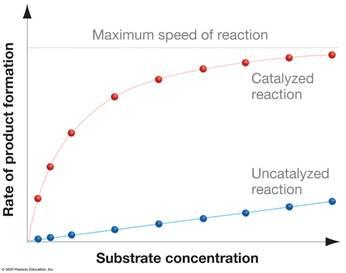
Q2. Why do enzyme-catalyzed reactions increase in rate very rapidly at low substrate concentrations but plateau at higher substrate concentrations?
Background
Topic: Enzyme Kinetics (Michaelis-Menten Kinetics)
This question tests your understanding of how enzymes interact with substrates and how reaction rates change as substrate concentration increases. The graph provided is a classic representation of enzyme-catalyzed versus uncatalyzed reactions, showing how the rate of product formation depends on substrate concentration.
Key Terms and Concepts:
Enzyme: A biological catalyst that speeds up chemical reactions in cells.
Substrate: The reactant that an enzyme acts upon.
Active Site: The region on the enzyme where the substrate binds.
Vmax (Maximum Velocity): The maximum rate of the reaction when the enzyme is saturated with substrate.
Michaelis-Menten Kinetics: Describes how reaction rate varies with substrate concentration for enzyme-catalyzed reactions.
Key Formula:
= rate of product formation
= maximum rate of reaction
= substrate concentration
= Michaelis constant (substrate concentration at which the reaction rate is half of )
Step-by-Step Guidance
Consider what happens at low substrate concentrations: Most enzyme active sites are available, so adding more substrate increases the chance of enzyme-substrate collisions, rapidly increasing the reaction rate.
As substrate concentration continues to rise, more enzyme active sites become occupied, and the rate of product formation increases but starts to slow down.
At high substrate concentrations, nearly all enzyme active sites are occupied (enzyme saturation). The enzyme is working at its maximum capacity (), and adding more substrate does not further increase the reaction rate.
Think about what the plateau in the graph represents and why the catalyzed reaction cannot exceed this maximum rate, regardless of how much substrate is present.
Try solving on your own before revealing the answer!
Final Answer:
At high substrate concentrations, all available enzyme molecules are working at maximal speed (saturated), so the rate of reaction plateaus and cannot increase further. This is because the enzyme's active sites are fully occupied, and the reaction is proceeding at .
This explains why the graph levels off at high substrate concentrations for the catalyzed reaction, while the uncatalyzed reaction continues to increase linearly but much more slowly.
