 Indietro
General Biology Exam 1 Study Guidance: Information Flow in Biological Systems
Guida di studio - Note intelligenti
 Appunti personalizzati basati sui tuoi materiali, ampliati con definizioni chiave, esempi e contesto.
Q1. Which of these molecules are polar and which are non-polar? Write the numbers below.
Background
Topic: Molecular Polarity
This question tests your understanding of how to distinguish between polar and non-polar molecules based on their structure and functional groups.
Key Terms:
Polar molecule: A molecule with an uneven distribution of charge, resulting in positive and negative ends.
Non-polar molecule: A molecule with an even distribution of charge, so there are no distinct poles.
Step-by-Step Guidance
Examine each molecular structure for the presence of highly electronegative atoms (like O or N) and asymmetry, which often indicate polarity.
Check for functional groups such as hydroxyl (-OH), amino (-NH2), or phosphate groups, which usually make a molecule polar.
Identify molecules that are mostly hydrocarbons (C and H only) and have symmetrical structures; these are typically non-polar.
Sort the molecules into two groups: those with polar features and those without.
Try solving on your own before revealing the answer!
Final Answer:
Polar: 1, 2, 4, 5, 6, 8 Non-polar: 3, 7
Polar molecules have uneven charge distribution due to electronegative atoms or functional groups, while non-polar molecules are more symmetrical and lack these features.
Q2. Which of these molecules contains ribose?
Background
Topic: Nucleic Acid Structure
This question tests your ability to recognize the sugar component of nucleotides, specifically ribose, which is found in RNA.
Key Terms:
Ribose: A five-carbon sugar with the formula C5H10O5, found in RNA.
Deoxyribose: A similar sugar found in DNA, lacking one oxygen atom compared to ribose.
Step-by-Step Guidance
Look for a five-membered ring with hydroxyl (-OH) groups on both the 2' and 3' carbons; this is characteristic of ribose.
Compare the structures to see which one matches the ribose configuration.
Try solving on your own before revealing the answer!
Final Answer:
Molecule 4 contains ribose.
Ribose is identified by its five-carbon ring and the presence of hydroxyl groups at both the 2' and 3' positions.
Q3. Which of these molecules is required to form a protein?
Background
Topic: Protein Structure
This question tests your knowledge of the building blocks of proteins, which are amino acids.
Key Terms:
Amino acid: The monomer unit of proteins, containing an amino group, carboxyl group, hydrogen, and a variable R group.
Step-by-Step Guidance
Identify the molecule with both an amino group (-NH2) and a carboxyl group (-COOH) attached to a central carbon.
Check for the presence of a side chain (R group), which is unique to amino acids.
Try solving on your own before revealing the answer!
Final Answer:
Molecule 6 is required to form a protein.
Amino acids are the building blocks of proteins, and their structure includes both an amino and a carboxyl group.
Q4. Are any of these molecules a purine? How can you tell?
Background
Topic: Nucleic Acid Bases
This question tests your ability to distinguish purines from pyrimidines based on their ring structure.
Key Terms:
Purine: A nitrogenous base with a two-ring structure (adenine and guanine).
Pyrimidine: A nitrogenous base with a single-ring structure (cytosine, thymine, uracil).
Step-by-Step Guidance
Look for a molecule with two fused rings containing nitrogen atoms; this is the hallmark of a purine.
Compare the structures to see which one fits this description.
Try solving on your own before revealing the answer!
Final Answer:
Molecule 4 is a purine because it has two carbon-nitrogen rings in its structure.
Purines are larger than pyrimidines due to their double-ring system.
Q5. Which of these molecules would be a good signaling molecule? Explain why.
Background
Topic: Cell Signaling and Molecular Properties
This question tests your understanding of what makes a molecule suitable for signaling, such as polarity and functional groups.
Key Terms:
Signaling molecule: A molecule that can transmit information between cells, often requiring specific chemical properties to interact with receptors.
Step-by-Step Guidance
Identify molecules with polar regions or functional groups that can interact with cellular receptors.
Consider the importance of solubility and the ability to be recognized by proteins or other molecules in the cell.
Try solving on your own before revealing the answer!
Final Answer:
Molecules 4 and 6 would be good signaling molecules due to their polarity and the presence of useful functional groups.
Polarity and functional groups allow these molecules to interact effectively with cellular receptors and participate in signaling pathways.
Q6. Which groups will you find on a nucleotide?
Background
Topic: Nucleotide Structure
This question tests your knowledge of the components that make up a nucleotide, the building block of nucleic acids.
Key Terms:
Nucleotide: Consists of a phosphate group, a five-carbon sugar (ribose or deoxyribose), and a nitrogenous base.
Step-by-Step Guidance
Recall the three main components of a nucleotide: phosphate, sugar, and base.
Match the groups listed in the options to these components.
Try solving on your own before revealing the answer!
Final Answer:
The correct answer is C) 1, 2.
These groups represent the phosphate and sugar components found in nucleotides.
Q7. Which groups would you find on a strong negatively charged signaling molecule?
Background
Topic: Functional Groups and Charge
This question tests your understanding of which functional groups confer a negative charge to molecules, making them suitable for certain signaling roles.
Key Terms:
Phosphate group: A functional group with a strong negative charge, common in nucleotides and signaling molecules like ATP.
Step-by-Step Guidance
Identify which group among the options is known for carrying a negative charge.
Recall that phosphate groups are highly negatively charged and often involved in signaling.
Try solving on your own before revealing the answer!
Final Answer:
The correct answer is A) 1.
The phosphate group is strongly negatively charged and is commonly found in signaling molecules.
Q8. Which group has the strongest bond when bound together with itself?
Background
Topic: Chemical Bond Strength
This question tests your knowledge of which functional groups form the strongest covalent bonds when paired with themselves.
Key Terms:
Disulfide bond: A strong covalent bond formed between two sulfur atoms, often found in proteins (cysteine residues).
Step-by-Step Guidance
Recall which functional group is capable of forming disulfide bonds.
Match the group number to the correct functional group known for strong self-bonding.
Try solving on your own before revealing the answer!
Final Answer:
The correct answer is C) 5.
Sulfhydryl groups (–SH) form strong disulfide bonds when paired, which are important for protein structure.
Q9. Using the groups above, build an RNA nucleotide. One group that is unique to RNA is not shown above. Name and correctly place them in their proper place on the diagram.
Background
Topic: RNA Structure
This question tests your ability to assemble the components of an RNA nucleotide and recognize what makes RNA unique compared to DNA.
Key Terms:
RNA nucleotide: Contains a ribose sugar, a phosphate group, and a nitrogenous base. RNA is unique because its ribose sugar has a hydroxyl group at the 2' position.
Step-by-Step Guidance
Identify the three main parts: phosphate group, ribose sugar, and nitrogenous base.
Recall that the 2' hydroxyl group is unique to RNA (not found in DNA).
Label the diagram with the correct groups in their respective positions.
Try solving on your own before revealing the answer!
Final Answer:
The unique group is the 2' hydroxyl (–OH) on the ribose sugar. Place the phosphate at the 5' position, the base at the 1' position, and the 2' hydroxyl at the 2' carbon of the sugar.
This 2' hydroxyl makes RNA more reactive and less stable than DNA.
Q10. What two characteristics of RNA make it a good messenger (signaling molecule)?
Background
Topic: RNA Function
This question tests your understanding of the structural and functional properties of RNA that make it suitable for transmitting genetic information.
Key Terms:
Single-stranded: RNA is usually single-stranded, allowing it to move easily within the cell.
2' hydroxyl group: This group increases RNA's reactivity and makes it less stable, which is useful for temporary signaling roles.
Step-by-Step Guidance
Recall that RNA is single-stranded, which allows it to be flexible and mobile.
Remember that the extra hydroxyl group at the 2' position makes RNA more reactive and less stable, so signals can be quickly turned off.
Try solving on your own before revealing the answer!
Final Answer:
RNA is a good messenger because it is single-stranded and has an extra 2' hydroxyl group, making it easy to move and unstable (so signals can end quickly).
Q11. Where in this cell does translation take place?
Background
Topic: Prokaryotic Cell Structure and Function
This question tests your knowledge of where protein synthesis (translation) occurs in prokaryotic cells.
Key Terms:
Translation: The process of synthesizing proteins from mRNA, which occurs on ribosomes.
Cytosol: The fluid portion of the cytoplasm where ribosomes are found in prokaryotes.
Step-by-Step Guidance
Recall that prokaryotes lack membrane-bound organelles, so translation cannot occur in a separate compartment.
Identify the location of ribosomes in the prokaryotic cell diagram.
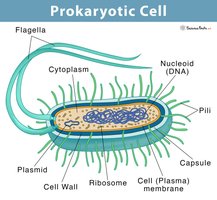
Try solving on your own before revealing the answer!
Final Answer:
Translation takes place in the cytosol of the prokaryotic cell.
Ribosomes are free in the cytosol, where they translate mRNA into protein.
Q12. Where is DNA transcribed to RNA in this cell?
Background
Topic: Prokaryotic Gene Expression
This question tests your understanding of where transcription occurs in prokaryotic cells.
Key Terms:
Transcription: The process of making RNA from a DNA template.
Cytosol: In prokaryotes, both DNA and the transcription machinery are found in the cytosol.
Step-by-Step Guidance
Recall that prokaryotes do not have a nucleus, so DNA is located in the nucleoid region of the cytosol.
Transcription occurs wherever the DNA is found, which is in the cytosol.
Try solving on your own before revealing the answer!
Final Answer:
DNA is transcribed to RNA in the cytosol of the prokaryotic cell.
Both DNA and RNA polymerase are present in the cytosol, so transcription occurs there.
Q13. Which structure is made of the same proteins as muscle cells?
Background
Topic: Cell Structure and Function
This question tests your knowledge of the composition of cellular structures, specifically those containing proteins similar to those in muscle cells.
Key Terms:
Flagella: Long, whip-like structures used for movement, made of the protein flagellin in prokaryotes and tubulin in eukaryotes; related to actin/myosin in muscle cells.
Step-by-Step Guidance
Recall which cellular structures are involved in movement and are protein-based.
Identify the structure in the diagram that matches this description.
Try solving on your own before revealing the answer!
Final Answer:
The flagella are made of proteins similar to those in muscle cells.
Flagella are composed of protein subunits that are structurally related to those found in muscle fibers.
Q14. Which structure is made of carbohydrates (sugars)?
Background
Topic: Cell Wall Composition
This question tests your knowledge of which cell structures are primarily composed of carbohydrates.
Key Terms:
Cell wall: A rigid structure outside the cell membrane, made of polysaccharides like cellulose (plants) or peptidoglycan (bacteria).
Step-by-Step Guidance
Recall which cell structure provides rigidity and is made of sugar polymers.
Identify this structure in the cell diagram.
Try solving on your own before revealing the answer!
Final Answer:
The cell wall is made of carbohydrates (sugars).
In bacteria, the cell wall is composed of peptidoglycan, a sugar-protein complex.
Q15. Would you find these cells in a human being (think carefully)?
Background
Topic: Microbiology and Human Health
This question tests your understanding of the presence of prokaryotic cells (bacteria) in and on the human body.
Key Terms:
Prokaryote: A cell without a nucleus, such as bacteria, many of which live in or on humans.
Step-by-Step Guidance
Recall that the human microbiome consists of many prokaryotic cells.
Consider whether the structures shown are consistent with bacteria found in humans.
Try solving on your own before revealing the answer!
Final Answer:
Yes, these cells (bacteria) are found in and on humans.
The human body hosts trillions of prokaryotic cells as part of its normal microbiome.
