 Indietro
General Biology Exam 2 Study Guide: Chapters 6–10
Guida di studio - Note intelligenti
 Appunti personalizzati basati sui tuoi materiali, ampliati con definizioni chiave, esempi e contesto.
Chapter 6: A Tour of the Cell
Prokaryotes vs. Eukaryotes
Cells are classified as either prokaryotic or eukaryotic based on structural differences.
Prokaryotes: Lack a nucleus and membrane-bound organelles; DNA is found in the nucleoid region. Examples: Bacteria and Archaea.
Eukaryotes: Have a true nucleus enclosed by a nuclear envelope and possess membrane-bound organelles. Examples: Plants, Animals, Fungi, Protists.
The Endomembrane System
The endomembrane system is a group of membranes and organelles in eukaryotic cells that work together to modify, package, and transport lipids and proteins.
Includes: Nuclear envelope, Endoplasmic reticulum (ER), Golgi apparatus, Lysosomes, Vacuoles, Plasma membrane.
Key Organelles and Their Functions
Nucleus: Stores genetic material (DNA); site of transcription.
Endoplasmic Reticulum (ER): Rough ER synthesizes proteins; Smooth ER synthesizes lipids and detoxifies chemicals.
Golgi Apparatus: Modifies, sorts, and packages proteins and lipids for storage or transport.
Lysosomes: Contain digestive enzymes to break down waste.
Central Vacuole (plants): Stores water, nutrients, and waste; maintains turgor pressure.
Mitochondria: Site of cellular respiration and ATP production.
Cell Membrane: Regulates entry and exit of substances.
Cytoskeleton Fibers
The cytoskeleton provides structural support and facilitates cell movement.
Microtubules: Largest; hollow tubes; maintain cell shape, aid in chromosome movement and organelle transport.
Intermediate Filaments: Medium size; provide mechanical support.
Microfilaments (Actin Filaments): Smallest; involved in cell movement and muscle contraction.
Cell Wall vs. Extracellular Matrix (ECM)
Cell Wall: Found in plants, fungi, and some protists; provides structural support and protection.
ECM: Found in animal cells; network of proteins and carbohydrates outside the cell membrane that provides support and anchorage.
Cell Connections
Gap Junctions: Channels that allow molecules to pass between animal cells.
Tight Junctions: Seal cells together to prevent leakage.
Desmosomes: Anchor cells together, providing mechanical stability.
Plasmodesmata: Channels between plant cells for transport and communication; functionally similar to gap junctions in animals.
Chapter 7: Membrane Structure and Function
Phospholipids and Membrane Properties
Hydrophobic: Water-fearing; fatty acid tails of phospholipids.
Hydrophilic: Water-loving; phosphate heads of phospholipids.
Role of Cholesterol in Membranes
Cholesterol maintains membrane fluidity.
In hot temperatures: Stabilizes membrane, making it less fluid.
In cold temperatures: Prevents membrane from becoming too rigid.
Membrane Proteins
Integral Proteins: Span the membrane; include transmembrane proteins.
Peripheral Proteins: Attached to the membrane surface.
Transport Proteins: Facilitate movement of substances; include carrier and channel proteins (facilitated diffusion).
Glycolipids and Glycoproteins
Glycolipids: Lipids with carbohydrate chains; found on the extracellular surface of the membrane.
Glycoproteins: Proteins with carbohydrate chains; involved in cell recognition.
Transport Mechanisms
Passive Diffusion: Movement from high to low concentration; no energy required.
Osmosis: Diffusion of water across a membrane.
Osmotic Conditions:
Hypertonic: Higher solute concentration outside; cell loses water.
Hypotonic: Lower solute concentration outside; cell gains water.
Isotonic: Equal solute concentration; no net water movement.
Active Transport: Movement against concentration gradient; requires energy (ATP).
Bulk Transport: Endocytosis (phagocytosis, pinocytosis, receptor-mediated) and exocytosis for large molecules.
Chapter 8: An Introduction to Metabolism
Metabolism Overview
Metabolism: All chemical reactions in an organism.
Catabolic Pathways: Break down molecules, releasing energy (e.g., cellular respiration).
Anabolic Pathways: Build complex molecules, consuming energy (e.g., protein synthesis).
Thermodynamics in Biology
First Law: Energy cannot be created or destroyed, only transformed.
Second Law: Every energy transfer increases the entropy (disorder) of the universe.
Free Energy and Reaction Types
ΔG (Gibbs Free Energy): Indicates spontaneity of a reaction.
ΔG < 0: Spontaneous (exergonic); ΔG > 0: Non-spontaneous (endergonic).
Exergonic: Releases energy; Endergonic: Requires energy input.
Enzymes and Catalysis
Enzyme: Biological catalyst that speeds up reactions by lowering activation energy.
Names end in -ase (e.g., sucrase).
Bind substrates at the active site.
Enzyme activity affected by temperature, pH, and substrate concentration.
Cofactors: Inorganic helpers (e.g., metal ions); Coenzymes: Organic helpers (e.g., vitamins).
Competitive Inhibitors: Bind active site, blocking substrate.
Non-competitive Inhibitors: Bind elsewhere, changing enzyme shape.
Allosteric Site: Site other than active site for regulation.
Feedback Inhibition: End product inhibits pathway to regulate production.
Chapter 9: Cellular Respiration and Fermentation
Redox Reactions
Reduction: Gain of electrons (or hydrogen).
Oxidation: Loss of electrons (or hydrogen).
Stages of Cellular Respiration
Glycolysis: Occurs in cytoplasm; glucose → 2 pyruvate, 2 ATP, 2 NADH.
Krebs Cycle (Citric Acid Cycle): Occurs in mitochondrial matrix; acetyl CoA → CO2, NADH, FADH2, 2 ATP.
Electron Transport Chain (ETC): Occurs in inner mitochondrial membrane; electrons from NADH and FADH2 power ATP synthesis.
ATP Production
Most ATP is produced during oxidative phosphorylation (ETC and chemiosmosis).
Substrate-level phosphorylation: Direct transfer of phosphate to ADP during glycolysis and Krebs cycle.
Oxidative phosphorylation: ATP synthesis powered by redox reactions in the ETC.
Chemiosmosis and the Electron Transport Chain
The ETC creates a proton gradient across the inner mitochondrial membrane, driving ATP synthesis via ATP synthase.
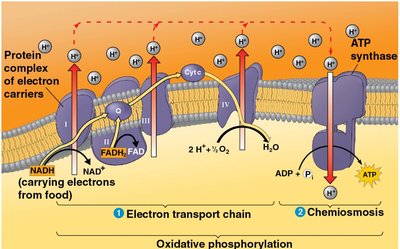
Fermentation
Lactic Acid Fermentation: Pyruvate is reduced to lactic acid (e.g., in muscle cells).
Alcohol Fermentation: Pyruvate is converted to ethanol and CO2 (e.g., in yeast).
Chapter 10: Photosynthesis
Autotrophs and Chemotrophs
Autotrophs: Organisms that produce their own food (e.g., plants via photosynthesis).
Chemotrophs: Obtain energy from chemicals (e.g., some bacteria).
Key Plant Structures and Terms
Stomata: Pores for gas exchange.
Chlorophyll: Pigment that absorbs light energy.
Thylakoid: Membranous sacs in chloroplasts where light reactions occur.
Photosynthesis Equation
The overall redox equation for photosynthesis is:
Light Reactions and Calvin Cycle
Light Reactions: Occur in thylakoid membranes; convert light energy to chemical energy (ATP, NADPH); O2 is a byproduct.
Calvin Cycle: Occurs in stroma; uses ATP and NADPH to convert CO2 to G3P (glyceraldehyde-3-phosphate), a sugar precursor.
G3P: The carbohydrate product of the Calvin cycle.
Types of Plants: C3, C4, and CAM
C3 Plants: Use the Calvin cycle directly; most common type.
C4 Plants: Minimize photorespiration by separating initial CO2 fixation and Calvin cycle in different cell types.
CAM Plants: Open stomata at night to reduce water loss; fix CO2 at night and use it during the day.
