 Indietro
General Biology Exam I Study Guide: Foundations, Chemistry of Life, Macromolecules, and Cell Structure
Guida di studio - Note intelligenti
 Appunti personalizzati basati sui tuoi materiali, ampliati con definizioni chiave, esempi e contesto.
Introduction to Biology and the Cell Theory
Cell Theory
The cell theory is a fundamental concept in biology that describes the properties of cells, the basic unit of life.
All living organisms are composed of one or more cells.
All cells arise from pre-existing cells.
This theory disproved earlier ideas such as spontaneous generation, which suggested that life could arise from non-living matter.
Spontaneous Generation and Pasteur’s Experiment
Spontaneous generation was the hypothesis that life could arise from non-living material.
Louis Pasteur’s experiment used swan-neck flasks to show that microorganisms only grew in broth when exposed to pre-existing cells, disproving spontaneous generation.
The Central Dogma of Molecular Biology
The central dogma describes the flow of genetic information within a biological system:
DNA is transcribed into RNA, which is then translated into protein.

Theory vs. Hypothesis: A theory is a broad, well-supported explanation for a range of phenomena, while a hypothesis is a testable, specific prediction.
Basic Chemistry of Life: Elements, Atoms, and Bonds
Atoms, Elements, and Compounds
Understanding the chemical context of life is essential for biology.
Element: A substance that cannot be broken down into other substances by chemical means (e.g., O, C, H).
Compound: A substance formed from two or more elements in a fixed ratio (e.g., H2O).
Molecule: Two or more atoms held together by covalent bonds (e.g., O2).
Ionic Compound: Formed by the transfer of electrons (e.g., NaCl).
Structure of the Atom
Atomic number identifies the element (number of protons).
Valence electrons are involved in bond formation and determine chemical reactivity.
Chemical Bonds and Interactions
Atoms interact through various types of bonds, influenced by electronegativity (an atom’s attraction for electrons).
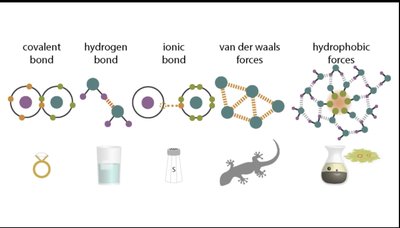
Covalent Bonds: Atoms share electrons. Can be non-polar (equal sharing) or polar (unequal sharing).
Hydrogen Bonds: Weak attractions between a hydrogen atom and an electronegative atom (e.g., O or N).
Ionic Bonds: Electrons are transferred from one atom to another, creating charged ions.
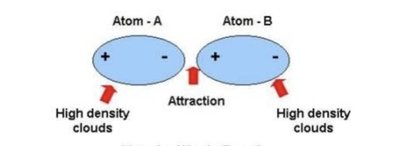
Van der Waals Interactions: Weak attractions due to transient charge differences.
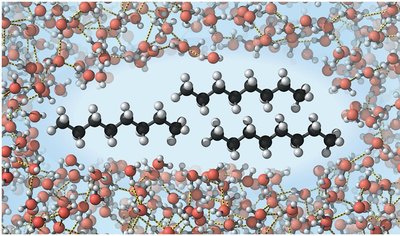
Hydrophobic Interactions: Nonpolar molecules aggregate to avoid water.

Water and Life
Polarity and Hydrogen Bonding
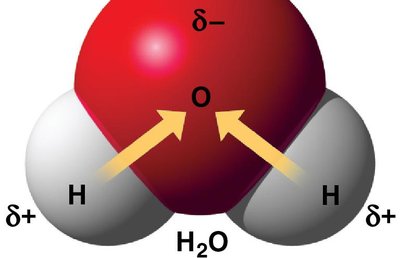
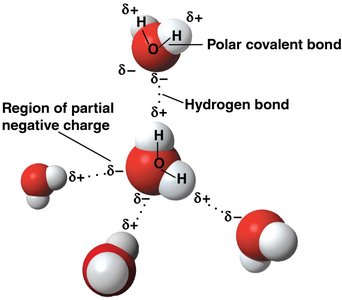
Water’s unique properties arise from its polar covalent bonds and ability to form hydrogen bonds.
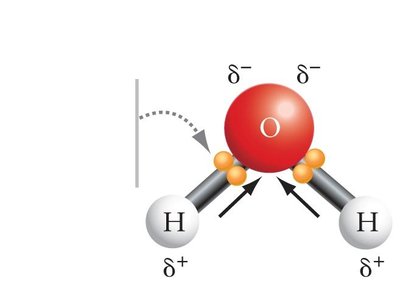
Polar covalent bonds within water molecules create partial charges (δ+ on H, δ− on O).
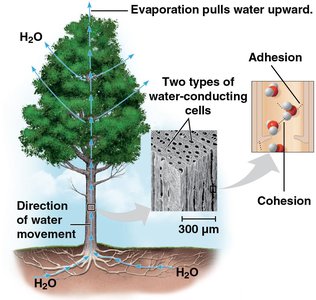
Hydrogen bonds form between water molecules, leading to cohesion and other properties.
Properties of Water
Cohesion: Water molecules stick to each other via hydrogen bonds.
Adhesion: Water molecules stick to other substances.
High Specific Heat: Water resists temperature changes due to hydrogen bonding.
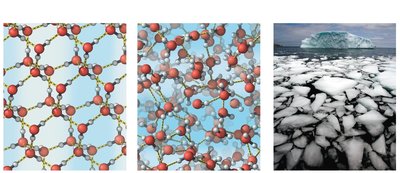
Ice Floats: Solid water is less dense than liquid water because of the crystal lattice structure.
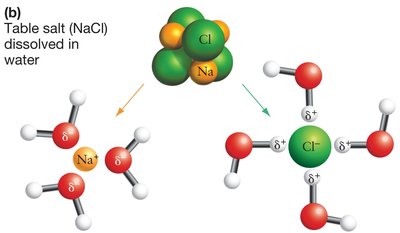
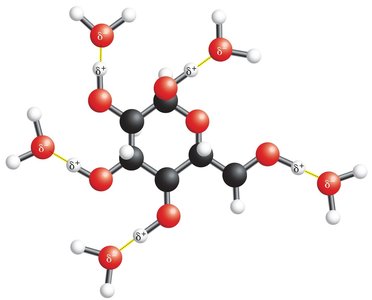
Solvent Properties: Water dissolves ions and polar molecules (hydrophilic), but not nonpolar molecules (hydrophobic).

Property | Cause | Biological Consequence |
|---|---|---|
Solvent for charged or polar compounds | Electrostatic attractions between partial charges on water and opposite charges on other molecules or ions | Facilitates chemical reactions in cells |
Denser as a liquid than a solid | Crystal lattice in ice makes it less dense | Ice floats, insulating aquatic life |
High specific heat | Hydrogen bonds absorb heat | Stabilizes temperature in organisms and environments |
High heat of vaporization | Lots of energy needed to break hydrogen bonds | Evaporative cooling (sweating, transpiration) |
Macromolecules: Carbohydrates, Proteins, Nucleic Acids, and Lipids
Carbohydrates
Carbohydrates are polymers made of monosaccharide monomers. They serve as energy sources and structural materials.
Monosaccharides: Simple sugars (e.g., glucose, fructose).
Disaccharides: Two monosaccharides joined by a glycosidic bond.
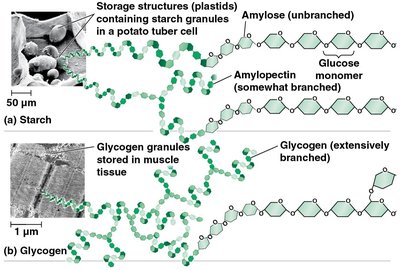
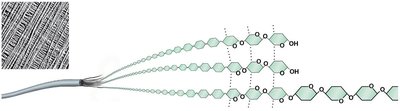
Polysaccharides: Long chains of monosaccharides (e.g., starch, glycogen, cellulose, peptidoglycan).
Dehydration (condensation) reaction: Builds polymers by removing water.
Hydrolysis: Breaks polymers by adding water.
Polymer | Monomer | Bond | Example |
|---|---|---|---|
Polysaccharide | Monosaccharide | Glycosidic | Starch, Glycogen, Cellulose |
Protein | Amino acid | Peptide | Hemoglobin, Enzymes |
Nucleic Acid | Nucleotide | Phosphodiester | DNA, RNA |
Proteins
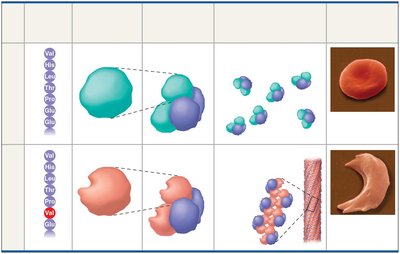
Proteins are polymers of amino acids, with structure determining function.
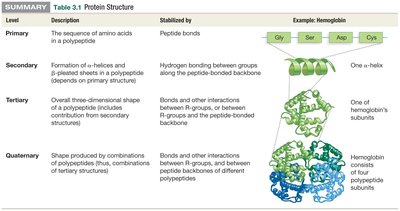
Primary structure: Linear sequence of amino acids (peptide bonds).
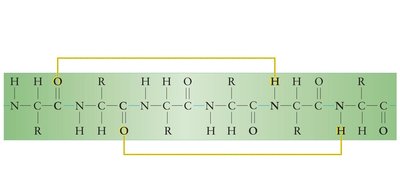
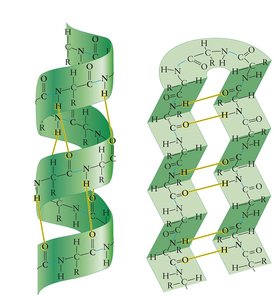
Secondary structure: Alpha helices and beta sheets (hydrogen bonds).
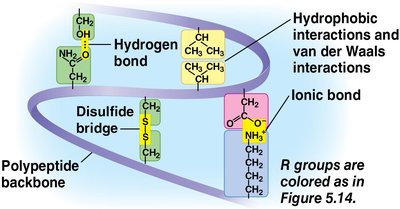
Tertiary structure: 3D folding due to R-group interactions (hydrogen, ionic, disulfide, hydrophobic, van der Waals).
Quaternary structure: Multiple polypeptide chains interact.
Level | Description | Stabilized by | Example |
|---|---|---|---|
Primary | Sequence of amino acids | Peptide bonds | Gly-Ser-Asp-Cys |
Secondary | Alpha helices, beta sheets | Hydrogen bonds | One alpha helix |
Tertiary | 3D shape | R-group interactions | Hemoglobin subunit |
Quaternary | Multiple polypeptides | R-group and backbone interactions | Hemoglobin (4 subunits) |
Nucleic Acids
Nucleic acids (DNA and RNA) store and transmit genetic information.
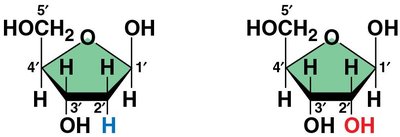
Nucleotide structure: Phosphate group, 5-carbon sugar, nitrogenous base.
DNA: Double-stranded, deoxyribose sugar, bases A, T, G, C.
RNA: Single-stranded, ribose sugar, bases A, U, G, C.
Phosphodiester bonds link nucleotides (3' hydroxyl to 5' phosphate).
Base pairing: A-T (or A-U in RNA), C-G.
Antiparallel strands: DNA strands run in opposite directions (5' to 3').

Lipids, Membranes, and Transport
Lipids and Membrane Structure
Lipids are hydrophobic molecules, essential for membrane structure and energy storage.
Amphipathic: Phospholipids have hydrophilic heads and hydrophobic tails, forming bilayers in water.
Saturated vs. Unsaturated: Saturated fatty acids have no double bonds (solid at room temp); unsaturated have double bonds (liquid at room temp).
Fluid Mosaic Model: Membranes are dynamic, with proteins floating in a lipid bilayer.
Membrane Transport
Simple diffusion: Small, nonpolar molecules pass through the bilayer.
Facilitated diffusion: Polar or charged molecules move via membrane proteins (no energy required).
Active transport: Movement against a gradient, requires energy (ATP).
Osmosis: Diffusion of water across a selectively permeable membrane.
Tonicity: Hypotonic (cell swells), isotonic (no net movement), hypertonic (cell shrinks).
Cell Structure and Function
Features Common to All Cells
Plasma membrane: Selectively permeable boundary.
Cytoplasm: Internal fluid environment.
Ribosomes: Sites of protein synthesis (not membrane-bound).
Genetic material: DNA as hereditary molecule.
Prokaryotic vs. Eukaryotic Cells
Prokaryotes: Bacteria and Archaea; lack membrane-bound organelles; DNA in nucleoid; cell wall (peptidoglycan in bacteria).
Eukaryotes: Animals, plants, fungi, protists; have membrane-bound organelles; DNA in nucleus; cell wall in plants/fungi (cellulose/chitin).
Plant vs. Animal Cells
Plant cells: Have chloroplasts, cell wall, large central vacuole, plasmodesmata.
Animal cells: Lack cell wall, have extracellular matrix (ECM), specialized junctions (tight, desmosomes, gap junctions).
Organelles and Their Functions
Nucleus: Contains DNA, site of transcription.
Endomembrane system: Includes rough/smooth ER, Golgi apparatus, lysosomes; involved in protein and lipid synthesis, modification, and transport.
Mitochondria: Site of cellular respiration; double membrane; own DNA and ribosomes (endosymbiosis theory).
Chloroplasts: Site of photosynthesis in plants; double membrane; own DNA and ribosomes.
Cytoskeleton: Provides structure, movement, and transport within cells (focus on microtubules).
Surface Area to Volume Ratio
Limits cell size; as cells grow, volume increases faster than surface area, limiting exchange with the environment.
Formula:
Endosymbiosis Theory: Mitochondria and chloroplasts originated from prokaryotic cells engulfed by ancestral eukaryotes. Evidence: double membranes, own DNA, ribosomes, circular chromosomes.
