 Indietro
General Biology: Exploring Life and the Chemical Basis of Life
Guida di studio - Note intelligenti
 Appunti personalizzati basati sui tuoi materiali, ampliati con definizioni chiave, esempi e contesto.
Biology: Exploring Life
What is Biology?
Biology is the scientific study of life and living organisms. It seeks to understand the characteristics, behaviors, and interactions of life forms within their environments.
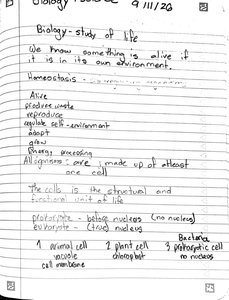
Alive: An organism is considered alive if it exhibits certain characteristics such as growth, reproduction, response to environment, and metabolism.
Homeostasis: The ability of an organism to maintain stable internal conditions despite changes in the external environment.
Characteristics of Living Things
Produce waste: All living things generate waste products from metabolic processes.
Reproduction: The ability to produce offspring, ensuring the continuation of the species.
Adaptation to environment: Living organisms can adjust to environmental changes.
Growth: Increase in size and complexity.
Energy processing: Organisms obtain and use energy for their activities.
Cell Theory
All organisms are made up of at least one cell. The cell is the fundamental structural and functional unit of life.
Prokaryotic cells: Cells without a nucleus (e.g., bacteria).
Eukaryotic cells: Cells with a nucleus (e.g., plant and animal cells).
Cell Type | Key Features |
|---|---|
Animal Cell | Cell membrane, nucleus |
Plant Cell | Cell membrane, nucleus, chloroplast |
Bacterial Cell | Cell membrane, no nucleus (prokaryotic) |
Classification of Life
Bacteria and Archaea
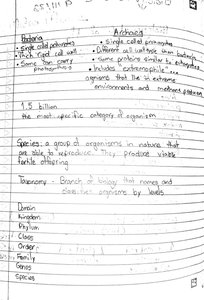
Bacteria and Archaea are two domains of single-celled prokaryotes. They differ in their cellular structures and environments.
Bacteria: Single-celled prokaryotes, found in diverse environments.
Archaea: Single-celled prokaryotes, often found in extreme environments such as hot springs and salt lakes.
Species and Taxonomy
A species is a group of organisms in nature that are able to reproduce and produce viable, fertile offspring. Taxonomy is the branch of biology that names and classifies organisms by levels.
Taxonomic Rank | Description |
|---|---|
Domain | Highest level of classification |
Kingdom | Major groups within domains |
Phylum | Groups within kingdoms |
Class | Groups within phyla |
Order | Groups within classes |
Family | Groups within orders |
Genus | Groups within families |
Species | Most specific category |
The Chemical Basis of Life
Matter and Atoms
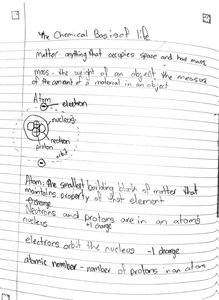
Matter is anything that occupies space and has mass. The mass is the weight of an object, and the measure of the amount of material in an object.
Atom: The smallest building block of matter that retains the properties of an element.
Atomic structure: Atoms consist of a nucleus (containing protons and neutrons) and electrons orbiting the nucleus.
Subatomic Particles
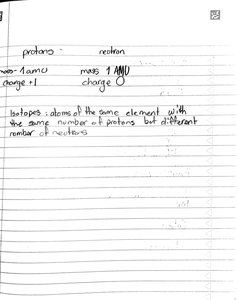
Proton: Mass = 1 amu, Charge = +1
Neutron: Mass = 1 amu, Charge = 0
Electron: Negligible mass, Charge = -1
Atomic Number and Isotopes
Atomic number: The number of protons in an atom, which determines the element.
Isotopes: Atoms of the same element with the same number of protons but different numbers of neutrons.
Additional info:
Atomic mass is often measured in atomic mass units (amu).
Isotopes can be stable or unstable (radioactive).
