 Indietro
General Biology: Foundations, Cell Structure, and Biochemistry Study Notes
Guida di studio - Note intelligenti
 Appunti personalizzati basati sui tuoi materiali, ampliati con definizioni chiave, esempi e contesto.
Domains of Life
Classification of Life
The domain is the highest taxonomic rank in the classification of organisms. There are three domains:
Bacteria: Prokaryotic organisms without a nucleus.
Archaea: Prokaryotic organisms, distinct from bacteria, also lacking a nucleus.
Eukarya: Eukaryotic organisms with a true nucleus (includes animals, plants, fungi, and protists).
Prokaryotes include Bacteria and Archaea, while Eukaryotes are found in the domain Eukarya.
Cell Structure and Organelles
Animal Cell Structure and Organelle Functions
Cells contain specialized structures called organelles, each with unique functions essential for cell survival and activity.
Nucleus: Stores genetic material (DNA); controls cell activities; round/oval shape.
Mitochondria: Site of ATP (energy) production; bean-shaped with inner folds (cristae).
Endoplasmic Reticulum (ER): Synthesizes proteins (rough ER) and lipids (smooth ER).
Golgi Apparatus: Modifies, sorts, and packages proteins and lipids for transport; stack of flattened sacs.
Lysosome: Digests cellular waste and foreign material; spherical.
Chloroplast (plants only): Site of photosynthesis; oval with internal stacks (thylakoids).
Ribosome: Site of protein synthesis; small, round particles.
Vacuole: Storage of water, nutrients, and waste; large and central in plant cells.
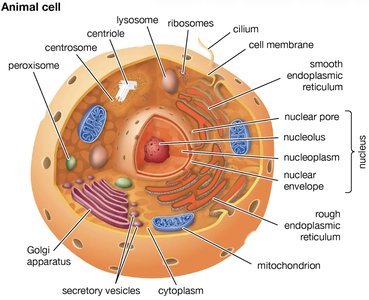
Additional info: The cytoplasm is the fluid matrix filling the cell, and the cell membrane encloses the cell, controlling movement of substances in and out.
Hierarchy of Living Organisms
Levels of Biological Organization
Living systems are organized in a hierarchy from smallest to largest:
Atom → Molecule → Organelle → Cell → Tissue → Organ → Organ System → Organism → Population → Community → Ecosystem → Biosphere
This hierarchy reflects increasing complexity and integration at each level.
Cell Size and Surface Area
Surface Area-to-Volume Ratio
As a cell increases in size, its volume grows faster than its surface area. This decrease in surface area-to-volume ratio limits efficient exchange of materials (e.g., nutrients, gases, waste), which is why cells remain small or adapt shapes to maximize surface area.
Microscopy
Types and Uses of Microscopes
Light Microscopy: Views live cells and tissues; limited resolution.
Transmission Electron Microscopy (TEM): Views internal cell structures at high resolution.
Scanning Electron Microscopy (SEM): Views cell surfaces in detail (3D appearance).
Dissecting Microscope: Used for larger specimens and 3D views.
Elements of Life
Most Abundant Elements in the Human Body
Oxygen (O)
Carbon (C)
Hydrogen (H)
Nitrogen (N)
These elements form the basis of biomolecules essential for life.
Reductionism
Importance in Biology
Reductionism is the approach of studying complex systems by breaking them into simpler parts. This allows scientists to understand the function of individual components, which helps explain the behavior of the whole system.
DNA: The Genetic Material
Importance of DNA
DNA stores genetic information, directs protein synthesis, and enables inheritance from one generation to the next. It is the molecular basis of heredity.
Chemical Bonds
Types of Bonds and Examples
Ionic Bond: Formed by transfer of electrons; strong in dry conditions. Example: Sodium chloride (NaCl, table salt).
Covalent Bond: Formed by sharing electrons; very strong. Example: Water (H2O).
Hydrogen Bond: Weak attraction between hydrogen and an electronegative atom; important in water and DNA. Example: Between water molecules or between DNA strands.
Polarity of Molecules
Polar vs. Nonpolar Molecules
Polar Molecule: Uneven distribution of charge due to differences in electronegativity and molecular shape (e.g., water).
Nonpolar Molecule: Even distribution of charge (e.g., oxygen gas O2).
Ions and Ionic Bonds
Interactions of Charged Elements
Negatively charged elements (anions) attract positively charged elements (cations), forming ionic bonds.
pH and Acidity
pH Scale
Acidic: pH < 7
Neutral: pH = 7
Basic (Alkaline): pH > 7
The Scientific Method
Steps in Scientific Investigation
Observation
Question
Hypothesis
Experiment
Data Collection
Analysis
Conclusion
Homeostasis
Maintaining Internal Stability
Homeostasis is the maintenance of stable internal conditions in an organism despite changes in the external environment.
Examples: Regulation of body temperature, blood pH, and glucose levels.
Elements vs. Molecules
Definitions
Element: Pure substance consisting of one type of atom (e.g., O2).
Molecule: Two or more atoms bonded together (e.g., H2O).
Characteristics of Living vs. Nonliving Things
Shared and Distinct Features
Living things: Organization, metabolism, responsiveness, growth, development, reproduction, adaptation.
Nonliving things: May have structure but lack metabolism, growth, and reproduction.
Radioisotope Technology
Importance and Applications
Radioisotopes are used in medicine and research for imaging, tracing, and treatment.
Example: PET scans use radioactive tracers to visualize metabolic processes.
Formation of Ions
How Atoms Change Charge
Atoms gain electrons to become negatively charged (anions).
Atoms lose electrons to become positively charged (cations).
Diffusion
Movement of Molecules
Diffusion is the passive movement of molecules from an area of higher concentration to an area of lower concentration, driven by the concentration gradient.
ATP Production in the Electron Transport Chain
Protein Complex Responsible for ATP Synthesis
Most ATP during the electron transport chain is produced by the protein complex ATP synthase, which uses the proton gradient across the mitochondrial membrane to synthesize ATP from ADP and inorganic phosphate.
Plasma Membrane Permeability
What Can and Cannot Pass
Can pass: Small, nonpolar molecules (e.g., O2, CO2), some small polar molecules (e.g., water).
Cannot pass easily: Large molecules, ions, and most polar molecules without transport proteins.
Active Transport
Movement Against the Gradient
Active transport is the movement of substances across the plasma membrane against their concentration gradient, requiring energy (usually ATP).
Isotonic Solutions
Effect on Cells
An isotonic solution has the same solute concentration as the cell, resulting in no net movement of water and maintaining cell shape.
Glycolysis
PURPOSE
The main purpose of glycolysis is to break down glucose into pyruvate, producing ATP and NADH as energy sources for the cell.
Electron Carriers in the Citric Acid Cycle
Types and Electron Sources
NAD+ and FAD are the main electron carriers.
They gain electrons during the oxidation of substrates in the citric acid cycle, becoming NADH and FADH2.
Plasma Membrane Structure
Components
The plasma membrane consists of a phospholipid bilayer with embedded proteins, cholesterol, and carbohydrates, providing selective permeability and fluidity.
Connective Tissues
Types and Locations
Loose connective tissue: Under skin, supports organs.
Dense connective tissue: Tendons, ligaments.
Adipose tissue: Stores fat, under skin, around organs.
Cartilage: Joints, ear, nose.
Bone: Skeleton.
Blood: Circulatory system.
Muscle in the Stomach
Type of Muscle Tissue
The stomach contains smooth muscle, which is responsible for involuntary contractions that mix and propel food.
Tissue Types and Functions
Overview
Epithelial tissue: Covers surfaces, lines cavities, forms glands.
Connective tissue: Supports, binds, and protects organs.
Muscle tissue: Movement (skeletal, cardiac, smooth).
Nervous tissue: Transmits electrical signals.
Cell Junctions
Types
Tight junctions: Seal cells together, prevent leakage.
Desmosomes: Anchor cells together, provide strength.
Gap junctions: Allow communication between cells.
Table: Glycolysis vs. Electron Transport Chain
Process | Main Location | Main Inputs | Main Outputs | ATP Yield |
|---|---|---|---|---|
Glycolysis | Cytoplasm | Glucose, 2 ATP, 2 NAD+ | 2 Pyruvate, 4 ATP (net 2), 2 NADH | 2 ATP (net) |
Electron Transport Chain | Inner mitochondrial membrane | NADH, FADH2, O2 | H2O, NAD+, FAD, ~32-34 ATP | ~32-34 ATP |
Additional info: The electron transport chain uses the energy from electrons carried by NADH and FADH2 to pump protons and drive ATP synthesis via ATP synthase.
