 Indietro
General Biology: Foundations, Macromolecules, and Cell Structure
Guida di studio - Note intelligenti
 Appunti personalizzati basati sui tuoi materiali, ampliati con definizioni chiave, esempi e contesto.
Evolution and the Foundations of Biology
Unifying Themes in Biology
Biology is organized around several unifying themes that help make sense of the diversity and complexity of life. These themes include organization, information, energy and matter, interactions, and evolution.
Organization: Life is structured in a hierarchy from molecules to the biosphere.
Information: Genetic information is stored and transmitted primarily through DNA.
Energy and Matter: Life requires the transfer and transformation of energy and matter.
Interactions: Organisms interact with each other and their environment.
Evolution: Evolution explains both the unity and diversity of life.
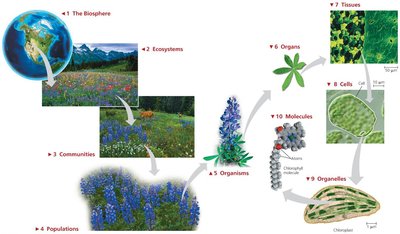
Emergent Properties
Emergent properties arise from the arrangement and interaction of parts within a system. These properties are not present at the preceding level of organization but emerge at higher levels.
Example: A functioning bicycle emerges only when all necessary parts are correctly assembled.
Structure and Function
At every level of the biological hierarchy, there is a correlation between structure and function. Understanding the structure of a biological component provides insight into its function.
The Cell: Basic Unit of Life
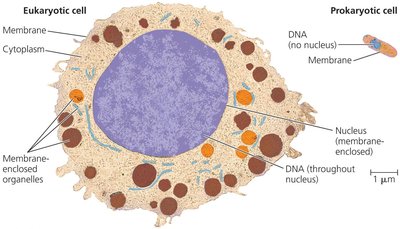
The cell is the smallest unit of life capable of performing all life activities. Cells are classified as prokaryotic or eukaryotic.
Prokaryotic cells: Lack a nucleus and membrane-bound organelles; generally smaller.
Eukaryotic cells: Contain a nucleus and membrane-bound organelles; generally larger and more complex.
DNA: The Genetic Material
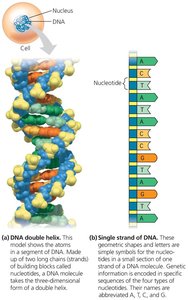
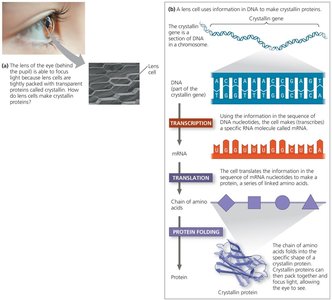
DNA (deoxyribonucleic acid) is the hereditary material in all living organisms. It is composed of two long chains forming a double helix, with each chain made up of nucleotides (A, T, C, G).
Genes: Units of inheritance that encode information for building proteins.
Gene Expression: The process by which information from a gene is used to synthesize a functional protein, often via an RNA intermediary.
Energy Flow and Chemical Cycling
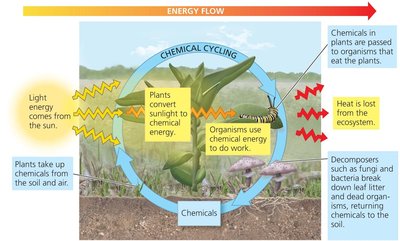
Life depends on the transfer and transformation of energy and matter. Energy flows through ecosystems, entering as sunlight and exiting as heat, while chemical elements are recycled.
Producers: Convert sunlight into chemical energy (e.g., plants).
Consumers: Obtain energy by feeding on other organisms.
Classifying Life: The Three Domains
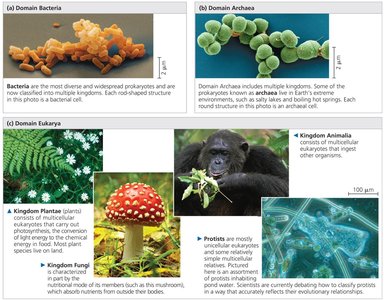
Life is classified into three domains based on genetic and cellular differences: Bacteria, Archaea, and Eukarya.
Bacteria: Prokaryotic, diverse, and widespread.
Archaea: Prokaryotic, often found in extreme environments.
Eukarya: Eukaryotic, includes plants, animals, fungi, and protists.
Evolution and Natural Selection
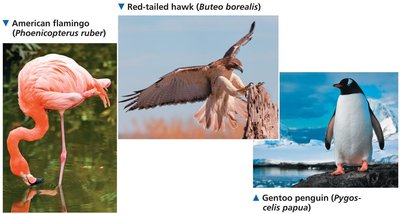
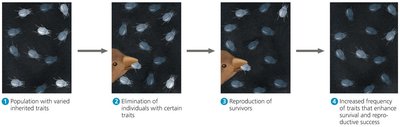
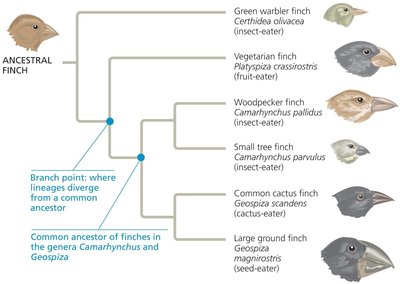
Evolution is the process by which species change over time through descent with modification. Charles Darwin proposed natural selection as the primary mechanism of evolution.
Natural Selection: Individuals with advantageous traits are more likely to survive and reproduce, increasing the frequency of those traits in the population.
Macromolecules: The Chemical Basis of Life
Carbon Compounds and Life
Living organisms are primarily composed of carbon-based molecules. Four major classes of macromolecules are carbohydrates, lipids, proteins, and nucleic acids.
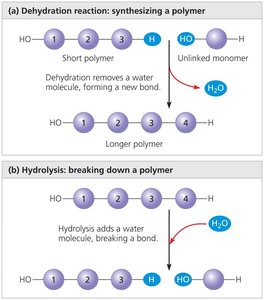
Synthesis and Breakdown of Polymers
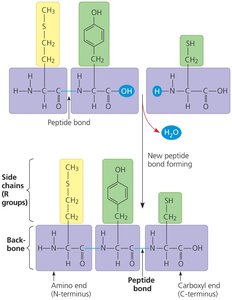
Polymers are synthesized by dehydration reactions (removal of water) and broken down by hydrolysis (addition of water).
Carbohydrates
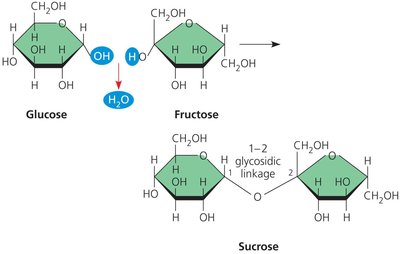
Carbohydrates serve as fuel and building material. They include monosaccharides (simple sugars), disaccharides, and polysaccharides.
Monosaccharides: Simple sugars like glucose (C6H12O6).
Disaccharides: Formed by joining two monosaccharides (e.g., sucrose).
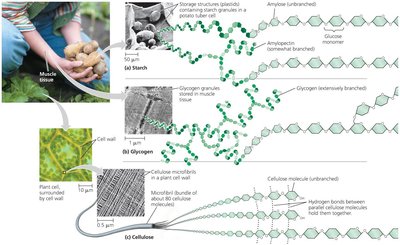
Polysaccharides: Long chains of monosaccharides; can be storage (starch, glycogen) or structural (cellulose, chitin).
Lipids
Lipids are hydrophobic molecules that include fats, phospholipids, and steroids. They do not form true polymers.
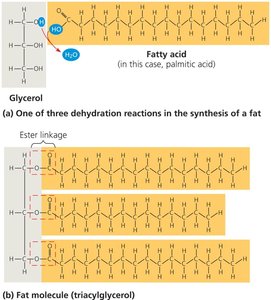
Fats: Composed of glycerol and fatty acids; function in energy storage.
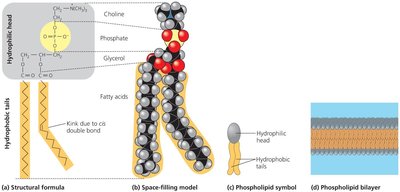
Phospholipids: Major component of cell membranes, with hydrophilic heads and hydrophobic tails.
Steroids: Characterized by four fused rings; cholesterol is an important steroid in animal membranes.
Proteins
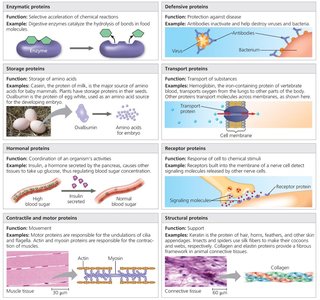
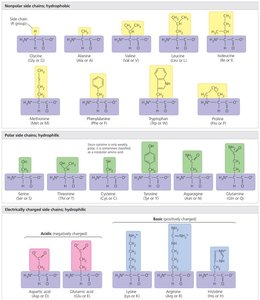
Proteins are polymers of amino acids and perform a wide range of functions, including catalysis, defense, transport, and support.
Amino acids: Building blocks of proteins, each with a unique side chain (R group).
Polypeptides: Chains of amino acids linked by peptide bonds.
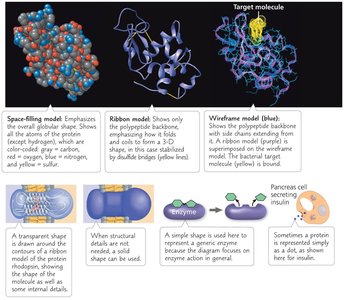
Protein structure: Four levels—primary, secondary, tertiary, and quaternary—determine protein function.
Nucleic Acids
Nucleic acids (DNA and RNA) store, transmit, and help express hereditary information. They are polymers of nucleotides, each consisting of a nitrogenous base, a pentose sugar, and phosphate group(s).
DNA: Double helix, stores genetic information.
RNA: Single-stranded, involved in protein synthesis.
Cell Structure and Function
Endomembrane System and Energy Organelles
The endomembrane system includes organelles such as the endoplasmic reticulum, Golgi apparatus, lysosomes, and vesicles. Mitochondria and chloroplasts are energy-transforming organelles, with mitochondria responsible for cellular respiration and chloroplasts for photosynthesis.
Endosymbiont Theory
Mitochondria and chloroplasts are thought to have originated from prokaryotic cells engulfed by ancestral eukaryotes, supported by their double membranes, own DNA, and ribosomes.
The Cytoskeleton
The cytoskeleton is a network of fibers that organizes cell structure and activities. It includes microtubules, microfilaments, and intermediate filaments.
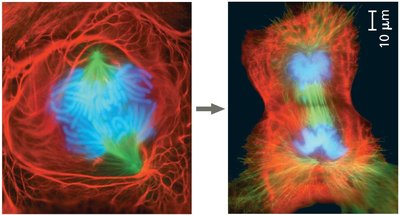
Microtubules: Shape the cell, guide organelle movement, and separate chromosomes during cell division.
Microfilaments: Bear tension and are involved in cell movement.
Intermediate filaments: Reinforce cell shape and anchor organelles.
Component | Structure | Function |
|---|---|---|
Microtubules | Hollow tubes of tubulin | Cell shape, organelle movement, chromosome separation |
Microfilaments | Actin filaments | Cell shape, muscle contraction, cell division |
Intermediate filaments | Fibrous proteins | Cell shape, anchorage of organelles |
Cell Junctions and the Extracellular Matrix
Cells interact and communicate through specialized junctions and extracellular structures. Plant cells have cell walls and plasmodesmata; animal cells have an extracellular matrix and junctions such as tight junctions, desmosomes, and gap junctions.
Membrane Structure and Function
Fluid Mosaic Model
The plasma membrane is a fluid mosaic of lipids, proteins, and carbohydrates. Its structure allows selective permeability, enabling the cell to regulate its internal environment.
Lipids: Form the bilayer, providing fluidity and barrier function.
Proteins: Integral and peripheral proteins serve in transport, signaling, and cell recognition.
Carbohydrates: Involved in cell-cell recognition and adhesion.
Transport Across Membranes
Passive Transport: Movement of substances down their concentration gradient without energy input (includes diffusion, osmosis, and facilitated diffusion).
Active Transport: Movement against the concentration gradient, requiring energy (e.g., sodium-potassium pump).
Bulk Transport: Large molecules are transported via vesicles (exocytosis and endocytosis).
Osmosis and Water Balance
Osmosis is the diffusion of water across a selectively permeable membrane. Water moves from areas of lower solute concentration to higher solute concentration until equilibrium is reached.
Membrane Potential and Cotransport
Membrane potential is the voltage across a membrane, created by differences in ion distribution. Cotransport uses the energy of one solute's movement down its gradient to drive the transport of another solute against its gradient.
Endocytosis and Exocytosis
Cells use endocytosis to take in large molecules and exocytosis to expel them. Types of endocytosis include phagocytosis, pinocytosis, and receptor-mediated endocytosis.
Additional info: This guide covers foundational topics from the first weeks of a General Biology course, including the chemical and cellular basis of life, macromolecules, and membrane structure and function. For further study, refer to the relevant textbook chapters for more detail and examples.
