 Indietro
General Biology: Membranes, Transport, Enzymes, and Cellular Respiration Study Guide
Guida di studio - Note intelligenti
 Appunti personalizzati basati sui tuoi materiali, ampliati con definizioni chiave, esempi e contesto.
Q2. Which of the following best describes the output of the sodium-potassium pump?
Background
Topic: Membrane Transport (Active Transport)
This question tests your understanding of how the sodium-potassium pump (Na+/K+ ATPase) moves ions across the plasma membrane, which is essential for maintaining cellular ion gradients.
Key Terms and Concepts:
Sodium-potassium pump (Na+/K+ ATPase): A membrane protein that uses ATP to transport sodium and potassium ions against their concentration gradients.
Active transport: Movement of molecules against their concentration gradient, requiring energy (usually from ATP).
Step-by-Step Guidance
Recall that the sodium-potassium pump moves both sodium (Na+) and potassium (K+) ions across the membrane using ATP.
Think about the direction: Does the pump move Na+ into or out of the cell? What about K+?
Remember the ratio: For each cycle, how many Na+ ions are moved, and how many K+ ions?
Match the correct direction and number of ions to the answer choices, but do not select the final answer yet.
Try solving on your own before revealing the answer!
Final Answer: b) 3 Na+ out, 2 K+ in
The sodium-potassium pump exports 3 sodium ions out of the cell and imports 2 potassium ions into the cell per ATP hydrolyzed. This maintains the electrochemical gradients essential for many cellular processes.
Q3. Order the following molecules/ions based on increasing rate of transport across a membrane: large polar, small polar, small nonpolar, free ions.
Background
Topic: Membrane Permeability
This question tests your understanding of how different types of molecules cross the lipid bilayer and which factors affect their rate of transport.
Key Terms and Concepts:
Membrane permeability: The ability of molecules to pass through the lipid bilayer.
Polarity and size: Nonpolar and small molecules cross more easily than polar or large molecules.
Ions: Charged particles that generally require channels or transporters to cross the membrane.
Step-by-Step Guidance
Recall the general rule: Small, nonpolar molecules cross membranes fastest; large, polar molecules and ions cross slowest.
Arrange the four types (large polar, small polar, small nonpolar, free ions) from slowest to fastest based on their ability to cross the lipid bilayer.
Consider that ions, despite being small, are charged and have difficulty crossing the hydrophobic core of the membrane.
Compare your arrangement to the answer choices, but do not select the final answer yet.
Try solving on your own before revealing the answer!
Final Answer: d) free ions < large polar < small polar < small nonpolar
Free ions cross the membrane the slowest, followed by large polar molecules, then small polar molecules, and small nonpolar molecules cross the fastest due to their compatibility with the hydrophobic core of the membrane.
Q4. Glucose diffuses slowly through artificial phospholipid bilayers. The cells lining the small intestine, however, rapidly move large quantities of glucose from the glucose-rich food into their glucose-poor cytoplasm. Which transport mechanism is most probably functioning in the intestinal cells?
Background
Topic: Membrane Transport Mechanisms
This question tests your understanding of how cells move glucose across membranes, especially when the rate is higher than simple diffusion would allow.
Key Terms and Concepts:
Simple diffusion: Passive movement of molecules from high to low concentration without assistance.
Facilitated diffusion: Passive transport using membrane proteins (channels or carriers) to help specific molecules cross.
Active transport: Movement against a concentration gradient, requiring energy.
Step-by-Step Guidance
Consider why glucose would move slowly through a pure phospholipid bilayer (think about its size and polarity).
Think about what would allow glucose to move rapidly into cells, even when it is large and polar.
Recall the types of membrane proteins that can assist in glucose transport and whether they require energy.
Match the correct transport mechanism to the scenario described, but do not select the final answer yet.
Try solving on your own before revealing the answer!
Final Answer: c) Facilitated diffusion
Glucose is transported rapidly into intestinal cells via facilitated diffusion, using specific carrier proteins (like GLUT transporters) that do not require energy but increase the rate of transport.
Q5. True or False: Ions can easily cross the lipid bilayer.
Background
Topic: Membrane Permeability
This question tests your understanding of the properties of the lipid bilayer and which types of molecules can cross it easily.
Key Terms and Concepts:
Lipid bilayer: The hydrophobic core of the membrane that acts as a barrier to most polar and charged molecules.
Ions: Charged particles that interact poorly with the hydrophobic interior of the membrane.
Step-by-Step Guidance
Recall the structure of the lipid bilayer and its hydrophobic core.
Think about how charged particles (ions) interact with hydrophobic environments.
Decide whether ions can cross the membrane without assistance, but do not select the final answer yet.
Try solving on your own before revealing the answer!
Final Answer: b) FALSE
Ions cannot easily cross the lipid bilayer due to their charge and the hydrophobic nature of the membrane's interior. They require specific channels or transporters.
Q6. What would happen to blood cells in a hypertonic solution?
Background
Topic: Osmosis and Tonicity
This question tests your understanding of how cells respond to solutions with different solute concentrations.
Key Terms and Concepts:
Hypertonic solution: A solution with a higher solute concentration than the cell's cytoplasm.
Osmosis: The movement of water across a semipermeable membrane from low to high solute concentration.
Step-by-Step Guidance
Recall what happens to water movement when a cell is placed in a hypertonic solution.
Think about the direction of water flow and the effect on the cell's volume.
Consider the possible outcomes for the cell (normal, lyse, shrivel, etc.), but do not select the final answer yet.
Try solving on your own before revealing the answer!
Final Answer: c) They would shrivel up
In a hypertonic solution, water leaves the cell, causing it to shrink or shrivel (crenate).
Q7. If a protein has a NLS and NES tag, what is the final destination of the protein?
Background
Topic: Protein Targeting and Transport
This question tests your understanding of nuclear localization signals (NLS) and nuclear export signals (NES) and how they direct protein movement between the nucleus and cytosol.
Key Terms and Concepts:
NLS (Nuclear Localization Signal): A sequence that directs proteins to the nucleus.
NES (Nuclear Export Signal): A sequence that directs proteins out of the nucleus to the cytosol.
Step-by-Step Guidance
Recall what each signal (NLS and NES) does for protein transport.
Think about what happens if a protein has both signals—will it be restricted to one compartment or move between them?
Consider the dynamic transport of proteins with both tags, but do not select the final answer yet.
Try solving on your own before revealing the answer!
Final Answer: c) It will be transported between the cytosol and the nucleus
Proteins with both NLS and NES can shuttle between the nucleus and cytosol, as both import and export signals are present.
Q8. Which of the following amino acids are UNLIKELY to be found in the interior of an aquaporin? (Choose all that apply.)
Background
Topic: Protein Structure and Membrane Channels
This question tests your understanding of the properties of amino acids and how they relate to the function of membrane channels like aquaporins.
Key Terms and Concepts:
Aquaporin: A channel protein that facilitates water transport across the membrane.
Hydrophilic vs. hydrophobic amino acids: The interior of aquaporins is typically lined with hydrophilic (polar or charged) amino acids to allow water passage.
Step-by-Step Guidance
Recall which amino acids are hydrophobic (nonpolar) and which are hydrophilic (polar or charged).
Think about the environment inside an aquaporin channel and which types of amino acids would be compatible with water transport.
Identify which amino acids from the list are unlikely to be found in the channel's interior, but do not select the final answer yet.
Try solving on your own before revealing the answer!
Final Answer: a) Valine and d) Methionine
Valine and methionine are hydrophobic amino acids and are unlikely to be found lining the interior of an aquaporin, which needs to be hydrophilic to facilitate water passage.
Q9. You notice a cell that is unable to resist tension, does not have an anchored nucleus, lacks rigidity, and has some physical damage. What is the most likely reason?
Background
Topic: Cytoskeleton Structure and Function
This question tests your understanding of the roles of different cytoskeletal elements in maintaining cell structure and integrity.
Key Terms and Concepts:
Intermediate filaments: Provide mechanical strength, anchor the nucleus, and help cells resist tension.
Microfilaments (actin): Involved in cell movement and shape changes.
Step-by-Step Guidance
Recall the main functions of intermediate filaments, microfilaments, and other cytoskeletal components.
Think about which component is responsible for resisting tension and anchoring the nucleus.
Match the described defects to the most likely dysfunctional cytoskeletal element, but do not select the final answer yet.
Try solving on your own before revealing the answer!
Final Answer: a) The intermediate filaments are dysfunctional
Intermediate filaments provide structural support, resist tension, and anchor the nucleus. Dysfunction leads to the described symptoms.
Q10. What will happen to a protein that has a NLS tag and is currently in the Golgi apparatus to receive a M6P tag?
Background
Topic: Protein Sorting and Targeting
This question tests your understanding of how proteins are sorted in the cell based on their signal sequences and tags.
Key Terms and Concepts:
NLS (Nuclear Localization Signal): Directs proteins to the nucleus.
M6P (Mannose-6-phosphate) tag: Directs proteins to lysosomes.
Step-by-Step Guidance
Recall the function of the NLS and M6P tags in protein targeting.
Think about what happens to proteins in the Golgi that have an NLS but are also being processed for an M6P tag.
Consider the possible fates of the protein based on the tags and the organelle's recognition mechanisms, but do not select the final answer yet.
Try solving on your own before revealing the answer!
Final Answer: d) The protein will be ejected to the cytosol, where an importin will recognize the NLS tag and transport the protein to the nucleus
The Golgi does not recognize the NLS for nuclear import; the protein must first be in the cytosol for importin to recognize the NLS and transport it to the nucleus.
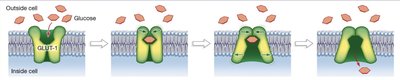
Q11. Why does GLUT-1 not need ATP to transport glucose?
Background
Topic: Facilitated Diffusion and Membrane Transport Proteins
This question tests your understanding of how carrier proteins like GLUT-1 move glucose across the membrane without using ATP.
Key Terms and Concepts:
GLUT-1: A glucose transporter that facilitates passive movement of glucose down its concentration gradient.
Facilitated diffusion: Passive transport using a protein carrier, no energy required.
Step-by-Step Guidance
Recall how facilitated diffusion works and whether it requires energy input.
Think about the mechanism by which GLUT-1 transports glucose across the membrane.
Consider the role of conformational changes in the transporter and whether ATP is involved, but do not select the final answer yet.
Try solving on your own before revealing the answer!
Final Answer: d) Glucose causes a conformational change by binding to GLUT-1, allowing it to transport across the membrane
GLUT-1 uses facilitated diffusion, where glucose binding induces a conformational change in the transporter, allowing glucose to move down its concentration gradient without ATP.
Q12. You would expect to see these organelles in their respective cells except:
Background
Topic: Cell Structure and Function
This question tests your knowledge of which organelles are present in different types of cells and their functions.
Key Terms and Concepts:
Organelles: Specialized structures within cells that perform specific functions (e.g., ER, chloroplast, nucleus).
Cell types: Different cells have different organelles based on their function (e.g., plant vs. animal, muscle vs. nerve).
Step-by-Step Guidance
Recall which organelles are found in plant cells, animal cells, and specialized cells (e.g., testis, nerve, pancreatic).
Think about which cell type would not normally have the organelle listed in the answer choices.
Match the organelle to the cell type and identify the exception, but do not select the final answer yet.
Try solving on your own before revealing the answer!
Final Answer: c) Nerve cell: Multiple nuclei
Nerve cells (neurons) typically have a single nucleus, not multiple nuclei. The other organelle-cell type pairings are correct.
Q13. In cotransport, what happens to the secondary active transporter if it does not acquire ATP?
Background
Topic: Membrane Transport (Cotransport/Secondary Active Transport)
This question tests your understanding of how secondary active transporters function and their energy requirements.
Key Terms and Concepts:
Primary active transport: Uses ATP directly to move ions against their gradient.
Secondary active transport (cotransport): Uses the gradient established by primary active transport to move other substances, not ATP directly.
Step-by-Step Guidance
Recall the difference between primary and secondary active transport.
Think about whether secondary active transporters require ATP directly or rely on another gradient.
Consider what would happen if ATP is not available to the secondary transporter itself, but do not select the final answer yet.
Try solving on your own before revealing the answer!
Final Answer: c) It continues to function normally
Secondary active transporters do not use ATP directly; they rely on the gradient established by primary active transporters.
Q14. Suppose all proteins dynamically transported between the nucleus and cytosol carry an overall negative charge. What would happen to the transport of water between the nucleus and cytosol if exportin were damaged?
Background
Topic: Nuclear Transport and Osmosis
This question tests your understanding of how protein transport affects osmotic balance and water movement between cellular compartments.
Key Terms and Concepts:
Exportin: A protein that mediates export of proteins from the nucleus to the cytosol.
Osmosis: Water moves toward areas of higher solute concentration (hypertonic regions).
Step-by-Step Guidance
Recall what happens if exportin is damaged—proteins cannot leave the nucleus efficiently.
Think about the effect of accumulating negatively charged proteins in the nucleus on osmotic balance.
Consider the direction water would move in response to this change, but do not select the final answer yet.
Try solving on your own before revealing the answer!
Final Answer: a) There would be a build-up of proteins inside the nucleus, so water would travel to the hypertonic nucleus
Damaged exportin leads to protein accumulation in the nucleus, making it hypertonic and causing water to move into the nucleus by osmosis.
Q15. What would happen to the transport of K+ ions between the nucleus and cytosol if exportin were damaged?
Background
Topic: Ion Transport and Nuclear Pore Complex
This question tests your understanding of how changes in protein distribution affect ion movement across the nuclear envelope.
Key Terms and Concepts:
Electrochemical gradient: The combined effect of concentration and electrical gradients on ion movement.
Nuclear pore complex: Allows passive diffusion of small ions and molecules between nucleus and cytosol.
Step-by-Step Guidance
Recall that a build-up of negatively charged proteins in the nucleus would affect the electrochemical gradient for K+ ions.
Think about the direction K+ ions would move in response to a more negative nucleus.
Consider whether K+ would move into or out of the nucleus, but do not select the final answer yet.
Try solving on your own before revealing the answer!
Final Answer: a) K+ ions would go down their electrochemical gradient into the nucleus
The accumulation of negative charge in the nucleus would attract K+ ions, causing them to move into the nucleus down their electrochemical gradient.
Q16. You observe that kinesin and dynein are both traveling to the minus end on actin filaments in a Martian eukaryotic cell. Why is this unusual?
Background
Topic: Cytoskeletal Motor Proteins
This question tests your understanding of the normal functions and tracks of motor proteins like kinesin and dynein in eukaryotic cells.
Key Terms and Concepts:
Kinesin: Typically moves toward the plus end of microtubules.
Dynein: Typically moves toward the minus end of microtubules.
Actin filaments: Usually associated with myosin, not kinesin or dynein.
Step-by-Step Guidance
Recall which cytoskeletal filaments kinesin and dynein normally travel on (microtubules, not actin).
Think about the directionality of movement for each motor protein.
Identify what is unusual about both proteins moving to the minus end on actin filaments, but do not select the final answer yet.
Try solving on your own before revealing the answer!
Final Answer: b) Kinesin should be moving towards the plus end, and BOTH kinesin and dynein should be on microtubules because they facilitate intracellular transport
In typical eukaryotic cells, kinesin and dynein move on microtubules, not actin filaments, and kinesin moves toward the plus end.
Q17. Choose ALL statements that are true about the cytoskeleton.
Background
Topic: Cytoskeleton Structure and Function
This question tests your knowledge of the different components of the cytoskeleton and their roles in the cell.
Key Terms and Concepts:
Actin filaments: Resist tension, involved in cell movement and cytokinesis.
Microtubules: Resist compression, involved in cell movement via cilia/flagella, made of tubulin dimers.
Intermediate filaments: Provide structural support, anchor the nucleus and organelles, resist tension.
Step-by-Step Guidance
Review the functions of actin filaments, microtubules, and intermediate filaments.
Identify which statements accurately describe the roles and properties of each cytoskeletal component.
Choose all correct statements, but do not select the final answer yet.
Try solving on your own before revealing the answer!
Final Answer: a), b), and d) are true
Statements a, b, and d accurately describe the functions and properties of the cytoskeletal elements. Statement c is incorrect because actin filaments do not have dynein for intracellular transport.
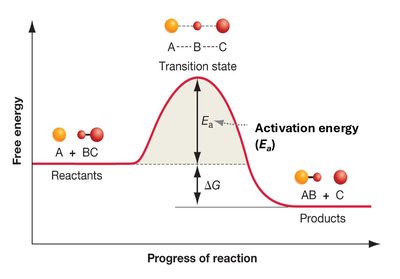
Q18. Imagine if glutamic acid in an enzyme's active site is changed to valine. The enzyme can no longer bind the reactants depicted in the free energy diagram. What change would you expect in the free energy diagram?
Background
Topic: Enzyme Structure and Function
This question tests your understanding of how changes in the active site affect enzyme activity and the energy profile of a reaction.
Key Terms and Concepts:
Active site: The region of an enzyme where substrate binding and catalysis occur.
Activation energy (Ea): The energy barrier that must be overcome for a reaction to proceed.
ΔG (Gibbs free energy change): The overall energy change of the reaction.
Step-by-Step Guidance
Recall the role of the active site in lowering the activation energy of a reaction.
Think about what happens if the active site is altered so the enzyme can no longer bind the substrate.
Consider how this would affect the activation energy barrier (Ea) and the overall ΔG of the reaction, but do not select the final answer yet.
Try solving on your own before revealing the answer!
Final Answer: b) The Ea barrier would increase
If the enzyme cannot bind the substrate, it cannot lower the activation energy, so the Ea barrier increases. The overall ΔG of the reaction does not change.
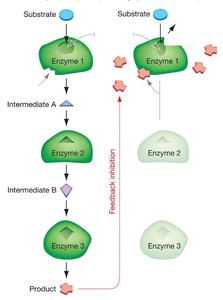
Q19. Look at the metabolic pathway depicted. Suppose enzyme 2 is unable to bind Intermediate A. Would you expect feedback inhibition on enzyme 1 to occur?
Background
Topic: Metabolic Pathways and Feedback Inhibition
This question tests your understanding of how feedback inhibition works in metabolic pathways.
Key Terms and Concepts:
Feedback inhibition: The end product of a pathway inhibits an earlier enzyme to regulate pathway activity.
Metabolic pathway: A series of enzyme-catalyzed reactions leading to a final product.
Step-by-Step Guidance
Recall how feedback inhibition works—usually the end product inhibits the first enzyme.
Think about what happens if enzyme 2 cannot bind its substrate (Intermediate A).
Consider whether the end product will still be produced and able to inhibit enzyme 1, but do not select the final answer yet.
Try solving on your own before revealing the answer!
Final Answer: d) No, because the product can no longer be made to allosterically inhibit enzyme 1
If enzyme 2 cannot bind Intermediate A, the pathway stops and the end product is not made, so feedback inhibition cannot occur.
Q20. An enzyme-catalyzed reaction has ΔG of -20 kcal/mol. If you double the amount of enzyme, what will be the new ΔG?
Background
Topic: Enzyme Catalysis and Thermodynamics
This question tests your understanding of how enzymes affect the free energy change (ΔG) of a reaction.
Key Terms and Concepts:
ΔG (Gibbs free energy change): The overall energy change of a reaction, which determines spontaneity.
Enzyme: A catalyst that speeds up the rate of a reaction by lowering activation energy, but does not change ΔG.
Step-by-Step Guidance
Recall what ΔG represents and what factors can change it.
Think about the role of enzymes in catalysis—do they affect ΔG or just the rate of reaction?
Consider what happens to ΔG if you change the amount of enzyme, but do not select the final answer yet.
Try solving on your own before revealing the answer!
Final Answer: b) -20 kcal/mol
Doubling the enzyme increases the reaction rate but does not change the ΔG of the reaction.
Q21. If an enzyme solution is saturated with substrate, the most effective way to obtain a faster yield of products is to:
Background
Topic: Enzyme Kinetics
This question tests your understanding of how enzyme concentration and substrate concentration affect reaction rate.
Key Terms and Concepts:
Enzyme saturation: All active sites are occupied by substrate; increasing substrate further does not increase rate.
Reaction rate: The speed at which product is formed.
Step-by-Step Guidance
Recall what it means for an enzyme to be saturated with substrate.
Think about what would increase the rate of product formation when all active sites are already occupied.
Consider the effect of adding more enzyme, substrate, heat, or inhibitors, but do not select the final answer yet.
Try solving on your own before revealing the answer!
Final Answer: a) Add more of the enzyme
When the enzyme is saturated, adding more enzyme increases the number of available active sites, increasing the reaction rate.
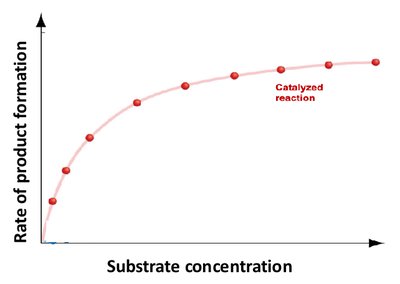
Q22. This is a graph of a cyclin-dependent kinase's activity at pH 7 (y-axis) vs. substrate concentration (x-axis). What would you expect this graph to look like if the cyclin-dependent kinase's activity was measured at pH 8?
Background
Topic: Enzyme Activity and pH
This question tests your understanding of how pH affects enzyme activity and the shape of enzyme kinetics graphs.
Key Terms and Concepts:
Enzyme activity: The rate at which an enzyme catalyzes a reaction, which can be affected by pH.
Optimal pH: Each enzyme has a pH at which it is most active; activity decreases above or below this pH.
Step-by-Step Guidance
Recall the concept of optimal pH for enzyme activity.
Think about what happens to enzyme activity if the pH is changed away from the optimum.
Predict how the activity curve would shift at pH 8 compared to pH 7, but do not select the final answer yet.
Try solving on your own before revealing the answer!
Final Answer: b) The new activity curve at pH 8 would be drawn below the one depicted in the picture
Enzyme activity typically decreases when pH moves away from the optimum, so the curve would be lower at pH 8 than at pH 7.
Q23. This is a graph of a cyclin-dependent kinase's activity at pH 7 (y-axis) vs. substrate concentration (x-axis). Suppose I introduce a co-factor for the cyclin-dependent kinase. What would the new graph look like?
Background
Topic: Enzyme Cofactors and Kinetics
This question tests your understanding of how cofactors affect enzyme activity and the resulting kinetics graph.
Key Terms and Concepts:
Cofactor: A non-protein molecule required for enzyme activity, which can increase the rate of product formation.
Enzyme kinetics: The relationship between substrate concentration and reaction rate.
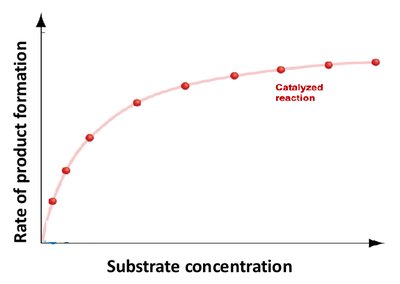
Step-by-Step Guidance
Recall the role of cofactors in enzyme activity.
Think about how the presence of a cofactor would affect the rate of product formation at different substrate concentrations.
Predict how the graph would change with a cofactor, but do not select the final answer yet.
Try solving on your own before revealing the answer!
Final Answer: c) The new activity curve would have a higher rate of product formation at all substrate concentrations, except for when the point of saturation is reached
A cofactor increases enzyme activity, so the curve would be higher at all substrate concentrations until saturation is reached.
Q24. The overall equation for cellular respiration is C6H12O6 + 6 O2 → 6 CO2 + 6 H2O. Is this process exergonic or endergonic? Why?
Background
Topic: Cellular Respiration and Thermodynamics
This question tests your understanding of the energy changes involved in cellular respiration.
Key Terms and Concepts:
Exergonic reaction: Releases energy (ΔG is negative).
ΔH (enthalpy change): Heat released or absorbed.
ΔS (entropy change): Change in disorder.
Step-by-Step Guidance
Recall whether cellular respiration releases or requires energy.
Think about the signs of ΔH and ΔS for this process.
Match the correct combination to the answer choices, but do not select the final answer yet.
Try solving on your own before revealing the answer!
Final Answer: a) Exergonic; ΔH is -, ΔS is +
Cellular respiration is exergonic (releases energy), with a negative ΔH (heat released) and positive ΔS (increased disorder).
Q25. The overall equation for cellular respiration is C6H12O6 + 6 O2 → 6 CO2 + 6 H2O. What is being oxidized, and what is being reduced?
Background
Topic: Redox Reactions in Cellular Respiration
This question tests your understanding of oxidation and reduction in the context of cellular respiration.
Key Terms and Concepts:
Oxidation: Loss of electrons.
Reduction: Gain of electrons.
Step-by-Step Guidance
Recall which molecule loses electrons (is oxidized) and which gains electrons (is reduced) in cellular respiration.
Think about the changes in oxidation state for glucose and oxygen.
Match the correct molecules to oxidation and reduction, but do not select the final answer yet.
Try solving on your own before revealing the answer!
Final Answer: a) C6H12O6 is oxidized, O2 is reduced
Glucose is oxidized to CO2, and oxygen is reduced to H2O during cellular respiration.
Q26. Why is ATP hydrolysis coupled to endergonic reactions?
Background
Topic: Energy Coupling in Metabolism
This question tests your understanding of how ATP hydrolysis drives non-spontaneous (endergonic) reactions in cells.
Key Terms and Concepts:
ATP hydrolysis: The exergonic breakdown of ATP to ADP and Pi, releasing energy.
Endergonic reaction: Requires energy input (ΔG is positive).
Step-by-Step Guidance
Recall why endergonic reactions need to be coupled to an energy source.
Think about how ATP hydrolysis affects the free energy of reactants/intermediates.
Match the correct explanation to the answer choices, but do not select the final answer yet.
Try solving on your own before revealing the answer!
Final Answer: c) ATP hydrolysis increases the free energy of reactants/intermediates in a reaction, allowing the endergonic process to become exergonic
ATP hydrolysis provides the energy needed to drive endergonic reactions by coupling, making the overall process exergonic.
