 Indietro
General Biology Midterm Review: Scientific Investigation, Cells, Diffusion & Osmosis, Enzymes, Photosynthesis, and Mitosis
Guida di studio - Note intelligenti
 Appunti personalizzati basati sui tuoi materiali, ampliati con definizioni chiave, esempi e contesto.
Scientific Investigation
The Scientific Method
The scientific method is a systematic approach used to investigate natural phenomena, formulate hypotheses, and test predictions. It is foundational to biological inquiry and ensures that experiments are objective and reproducible.
Hypothesis: A testable and falsifiable statement that predicts an outcome. Example: "If the bulb is burned out, then replacing the bulb will fix the problem."
Prediction: A specific outcome expected if the hypothesis is true. Must be stated before the experiment.
Variables:
Independent Variable: The factor manipulated by the experimenter.
Dependent Variable: The factor measured or counted.
Controlled Variables: Factors kept constant between groups.
Groups:
Experimental Group: Receives the new treatment.
Control Group: Receives standard or no treatment.
Results: Hypotheses can be rejected or not rejected, but never "proved" or "confirmed" absolutely.
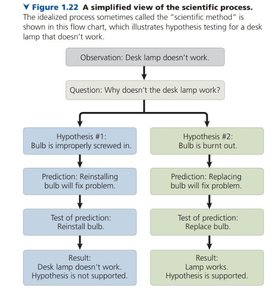
Example: Butterfly Experiments
Hypothesis: Infected female butterflies preferentially lay eggs on anti-parasitic milkweed.
Prediction: Infected females lay more eggs on anti-parasitic plants; uninfected females lay eggs evenly.
Variables: Controlled (number/type of plants, time), Dependent (number of eggs), Independent (infection status).
Groups: Experimental (infected), Control (uninfected).
Additional info: The scientific method is used to test hypotheses in all areas of biology, from ecology to molecular biology.
Microscopes and Cells
Microscope Concepts
Microscopes are essential tools for studying cells and their structures. Compound microscopes use multiple lenses and visible light to magnify specimens.
Objective Lenses: Low (4x), Medium (10x), High (40x).
Total Magnification: Product of objective lens and ocular (eyepiece) lens magnification.
Field of View (FOV): Area visible at one time; decreases with higher magnification.
Depth of Field (DOF): Thickness of specimen in focus; decreases with higher magnification.
Resolution: Smallest distance at which two objects are distinguishable as separate.
Resolution Formula
Resolution depends on the wavelength of light and the numerical aperture (N.A.) of the lens:
d: Resolution (nm); smaller d means higher resolution.
λ: Wavelength of light; shorter λ means higher resolution.
N.A.: Numerical aperture; calculated as (where n is the refractive index and Θ is the angle of light entering the lens).
Resolution equation:
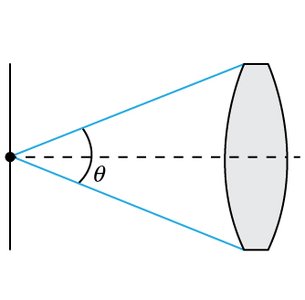
Additional info: Higher N.A. and shorter wavelengths improve resolution, allowing finer details to be observed.
Diffusion and Osmosis
Concepts of Diffusion and Osmosis
Diffusion and osmosis are fundamental processes for movement of molecules and water across membranes.
Diffusion: Spontaneous movement of molecules down a concentration gradient.
Osmosis: Diffusion of water across a selectively permeable membrane, from higher to lower free water concentration.
Tonicity:
Isotonic: No change in cell volume.
Hypotonic: Cells gain water.
Hypertonic: Cells lose water (shrivel in animals, plasmolyze in plants).
Water Potential (Ψ)
Water potential () is the potential energy of water, measured in megapascals (MPa). It determines the direction of water movement.
Formula:
: Solute potential (osmotic potential); always 0 or negative.
: Pressure potential; can be positive or negative.
Pure water: MPa
Net water movement: From regions of higher to lower .
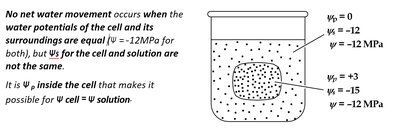
Example: Potato cells in isotonic sucrose solution do not change mass, indicating equal water potential between cell and solution.
Enzymes
Enzyme Concepts
Enzymes are mainly proteins that catalyze biological reactions by lowering activation energy. They are highly specific for their substrates.
Example: α-Amylase from pancreas acts on starch to produce maltose and maltotriose.
Optimal Conditions: Amylase is most active at neutral pH (~7) and body temperature (37°C).
Enzyme Activity Exercises
Temperature: Enzyme activity is measured by the time for starch disappearance at different temperatures. Fastest breakdown indicates optimal temperature.
pH: Enzyme activity is measured at different pH levels. Fastest breakdown indicates optimal pH.
Troubleshooting: No color change may indicate no substrate or enzyme, or improper timing.
Additional info: Enzyme denaturation cannot be confirmed solely by lack of activity; other factors may be involved.
Photosynthesis
Photosynthesis Concepts
Photosynthesis is the process by which plants convert light energy into chemical energy, producing carbohydrates and oxygen.
Equation:
Absorption Spectrum: Measures how much light of different wavelengths is absorbed by pigments.
Spectrophotometer: Instrument used to measure light absorbance of solutions.
Paper Chromatography: Separates pigments based on solubility in polar (stationary) and nonpolar (mobile) phases.
Photosynthesis Exercises
Paper Chromatography: Used to isolate pigments for absorbance measurements.
Absorbance Spectrum: Pigments have characteristic spectra; blue and red light drive photosynthesis efficiently, green is less effective.
Additional info: Chromatography and spectrophotometry are key techniques for studying plant pigments and their roles in photosynthesis.
The Mitotic Cell Cycle
Mitotic Cell Cycle Concepts
Mitosis is a type of cell division that produces two genetically identical daughter cells. It is essential for growth, repair, and maintenance in multicellular organisms.
Phases:
Interphase: G1 (growth), S (DNA synthesis), G2 (preparation for division)
Prophase: Chromatin condenses, nuclear envelope dissolves
Metaphase: Chromosomes align at cell equator
Anaphase: Sister chromatids separate
Telophase/Cytokinesis: Chromosomes decondense, cell plate forms in plants, cells separate
Chromatid: One half of a duplicated chromosome
Chromosome: Structure containing DNA and associated proteins
Cell Cycle Numbers
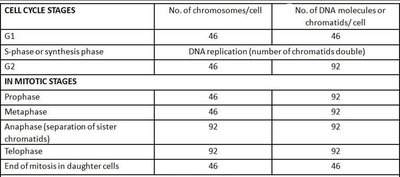
The number of chromosomes and DNA molecules changes during the cell cycle and mitosis. The following table summarizes these changes:
Cell Cycle Stages | No. of chromosomes/cell | No. of DNA molecules or chromatids/cell |
|---|---|---|
G1 | 46 | 46 |
S-phase or synthesis phase | DNA replication (number of chromatids double) | |
G2 | 46 | 92 |
Prophase | 46 | 92 |
Metaphase | 46 | 92 |
Anaphase (separation of sister chromatids) | 92 | 92 |
Telophase | 92 | 92 |
End of mitosis in daughter cells | 46 | 46 |
Calculating Cell Cycle Phase Length
The length of each cell cycle phase can be estimated by the frequency of cells observed in that stage, multiplied by the total cell cycle duration.
Formula: Frequency of cells in stage × 960 minutes (total cell cycle time)

Additional info: This calculation is useful for understanding cell cycle dynamics in laboratory settings.
