 Indietro
General Biology Midterm Study Guide: Scientific Method, Chemistry, Biomolecules, Cells, Membranes, Respiration, and Photosynthesis
Guida di studio - Note intelligenti
 Appunti personalizzati basati sui tuoi materiali, ampliati con definizioni chiave, esempi e contesto.
Scientific Method, Experimental Design, and Lab Skills
Overview of the Scientific Method
The scientific method is a systematic approach to investigating questions and testing hypotheses in biology. It ensures that scientific claims are reliable and reproducible.
Observation and Question: Identify a phenomenon and pose a question.
Hypothesis: Formulate a testable explanation that predicts an outcome.
Experiment: Design and conduct tests to gather data.
Data Analysis: Interpret results using statistical and logical methods.
Conclusion: Draw inferences based on data.
Peer Review and Publication: Share findings for validation by the scientific community.
Prediction is the expected outcome, hypothesis is a testable explanation, and theory is a broad, well-supported explanation. Hypotheses and theories can be falsified but never proven.
Variables and Controls
Independent variable: Factor changed by the scientist.
Dependent variable: Factor measured in response.
Controlled variables: Factors kept constant.
Negative control: No effect expected; guards against false positives.
Positive control: Known response expected; guards against false negatives.
Lab Safety and Measurement
Know safety equipment locations and procedures.
Use appropriate tools for measuring volume and mass.
Conversions: 1 L = 1,000 mL; 1 mL = 1,000 µL; 1 g = 1,000 mg.
Density = mass ÷ volume.
Significant figures: rules for counting digits in measurements.
Basic Chemistry and Water
Atoms and Elements
Life is composed mainly of a few elements, and water's unique properties are essential for biological processes.
Atom: Smallest unit of an element; consists of protons, neutrons, and electrons.
CHNOPS: Carbon, Hydrogen, Nitrogen, Oxygen, Phosphorus, Sulfur (~97% of living mass).
Atomic number: Number of protons; Mass number: Protons + neutrons.
Isotopes: Same element, different neutrons; radioactive isotopes decay and emit energy.
Half-life: Time for half a sample to decay.
Chemical Bonds
Nonpolar covalent: Electrons shared equally (e.g., H2).
Polar covalent: Electrons shared unequally (e.g., O–H in water).
Ionic: Electrons transferred; cation and anion attract (e.g., Na+ Cl-).
Hydrogen bond: Partial positive H attracted to electronegative atom (e.g., between water molecules).
Van der Waals: Weak, temporary attractions.
Water's Properties
Cohesion/Adhesion: Water sticks to itself and other surfaces.
High specific heat: Stabilizes temperature.
High heat of vaporization: Cooling effect (sweating).
Ice floats: Less dense than liquid water.
Universal solvent: Dissolves ions and polar molecules.
Acids, Bases, pH, and Buffers
Acid: Increases [H+], lowers pH.
Base: Decreases [H+] or adds OH-, raises pH.
pH scale: 0–14; 7 is neutral.
Buffer: Resists pH change (e.g., blood bicarbonate buffer).
Carbon and Functional Groups
Organic molecules: Contain carbon bonded to hydrogen.
Functional groups: Hydroxyl (–OH), Carbonyl (C=O), Carboxyl (–COOH), Amino (–NH2), Phosphate (–PO4), Sulfhydryl (–SH), Methyl (–CH3).
Biomolecules and Food Macromolecules
Overview of Biomolecules
Three classes of biomolecules are polymers built from monomers; lipids are the exception.
Dehydration synthesis: Joins monomers, releases H2O.
Hydrolysis: Breaks polymers, adds H2O.
Carbohydrates
Monosaccharide: Simple sugar (e.g., glucose).
Disaccharide: Two monosaccharides (e.g., maltose).
Polysaccharide: Many monosaccharides (e.g., starch, glycogen, cellulose, chitin).
Roles: Energy storage and structural support.
Lipids
Hydrophobic: Do not form polymers.
Saturated fatty acids: Only single bonds, solid at room temperature.
Unsaturated fatty acids: Double bonds, liquid at room temperature.
Triglyceride: Glycerol + 3 fatty acids.
Phospholipid: Hydrophilic head + hydrophobic tails; forms cell membranes.
Steroids: Four fused rings (e.g., cholesterol).
Waxes: Waterproofing.
Proteins
Amino acid: Central carbon + amino group + carboxyl group + H + R-group.
Levels of structure: Primary (sequence), Secondary (α-helix, β-sheet), Tertiary (3D shape), Quaternary (multiple polypeptides).
Denaturation: Loss of structure and function due to pH, temperature, or salt changes.
Chaperones: Help proteins fold/refold.
Nucleic Acids
Nucleotide: Phosphate + pentose sugar + nitrogenous base.
DNA: Deoxyribose, bases A, T, C, G; double helix.
RNA: Ribose, bases A, U, C, G; single-stranded.
Roles: Store and transmit genetic information.
Lab Tests for Macromolecules
Test | Detects | Negative | Positive |
|---|---|---|---|
Benedict's | Reducing sugars | Blue | Green/yellow/orange/red |
Iodine | Starch | Yellow-brown | Blue-black |
Biuret | Protein | Blue | Violet/purple |
Brown-paper | Lipids | Spot dries | Grease spot stays |
Cells, Microscopy, and Subcellular Structures
Microscopes
Light microscope: Uses visible light.
Electron microscope: Uses electron beams; higher resolution.
SEM: 3D surfaces; TEM: 2D internal structures.
Compound microscope: Ocular lens × objective lens = total magnification.
Prokaryotic vs. Eukaryotic Cells
Feature | Prokaryotes | Eukaryotes |
|---|---|---|
Nucleus | None | Membrane-bound |
DNA shape | Circular | Linear |
Organelles | No membrane-bound | Many membrane-bound |
Ribosomes | 70S | 80S |
Size | ~1–10 µm | ~10–100 µm |
Division | Binary fission | Mitosis + cytokinesis |
Organelles and Their Functions
Nucleus: Holds DNA.
Nucleolus: Assembles ribosomes.
Ribosome: Builds proteins.
Rough ER: Folds/modifies proteins.
Smooth ER: Makes lipids, detoxifies.
Golgi apparatus: Modifies, sorts, ships proteins.
Lysosome: Digests/recycles.
Peroxisome: Breaks down H2O2 and fatty acids.
Central vacuole: Stores water, pigments, wastes.
Mitochondrion: Cellular respiration → ATP.
Chloroplast: Photosynthesis.
Cell wall: Rigid support.
Centrioles: Organize microtubules.
Endosymbiotic Theory
Mitochondria and chloroplasts originated from engulfed bacteria.
Evidence: own DNA, 70S ribosomes, double membranes, binary fission.
Cytoskeleton and Cell Junctions
Microfilaments: Actin; cell shape, movement.
Intermediate filaments: Keratin; tension, anchoring.
Microtubules: Tubulin; tracks, cilia/flagella, spindle.
Tight junctions: Seal cells.
Desmosomes: Anchor cells.
Gap junctions: Allow ion passage.
Plasmodesmata: Connect plant cells.
Membranes, Energy, Respiration, and Signaling
Membranes and Transport
Fluid mosaic model: Phospholipid bilayer with proteins, cholesterol, carbohydrates.
Selective permeability: Only certain molecules pass easily.
Transport | Energy? | Direction | Example |
|---|---|---|---|
Simple diffusion | No | High → low | O2, CO2 |
Facilitated diffusion | No | High → low (channel/carrier) | Glucose, aquaporins |
Osmosis | No | Water toward higher solute | Water |
Active transport | Yes (ATP) | Low → high | Na+/K+ pump |
Endocytosis/Exocytosis | Yes | Bulk in/out | Phagocytosis, secretion |
Tonicity: Hypotonic (water enters), hypertonic (water leaves), isotonic (no net movement).
Energy, Metabolism, and Enzymes
Anabolic: Build molecules, use energy.
Catabolic: Break down molecules, release energy.
Kinetic energy: Motion; Potential energy: Stored.
Exergonic: Release energy (); Endergonic: Require energy ().
First law of thermodynamics: Energy is conserved.
Second law: Entropy increases.
ATP: Adenine + ribose + 3 phosphates; hydrolysis releases energy ().
Enzymes: Protein catalysts; lower activation energy; sensitive to pH and temperature.
Inhibitors: Competitive (active site), noncompetitive (allosteric site).
Feedback inhibition: End product shuts off pathway.
Cellular Respiration
Cellular respiration converts glucose and oxygen into carbon dioxide, water, and ATP.
Overall equation:
Stage | Location | Key Outputs |
|---|---|---|
Glycolysis | Cytoplasm | 2 pyruvate, 2 ATP, 2 NADH |
Pyruvate oxidation | Mitochondrial matrix | Acetyl CoA, CO2, NADH |
Citric acid cycle | Mitochondrial matrix | CO2, NADH, FADH2, 2 ATP |
Electron transport chain + chemiosmosis | Inner mitochondrial membrane | ~26–34 ATP, H2O |
Total: ~30–32 ATP per glucose.
Fermentation regenerates NAD+ without O2 (lactic acid or alcohol + CO2).
Cell Communication
Reception: Ligand binds receptor.
Transduction: Relay, often phosphorylation cascade.
Response: Cellular change.
Internal receptors: Bind hydrophobic ligands.
Cell-surface receptors: Bind polar ligands.
Signal types: Paracrine, endocrine, autocrine, synaptic.
Photosynthesis
Overview and Equation
Photosynthesis converts light energy into chemical energy stored in glucose. It is a redox reaction and nearly the reverse of cellular respiration.
Overall equation:
Leaf and Chloroplast Anatomy
Mesophyll: Cells packed with chloroplasts.
Stomata: Pores for gas exchange.
Chloroplast: Outer/inner membranes, thylakoids (grana), stroma.
Phloem: Transports sugar.
Light and Pigments
Light: Photons; shorter wavelength = more energy.
Chlorophyll a: Main pigment; absorbs blue/red, reflects green.
Accessory pigments: Chlorophyll b, carotenoids.
Absorption spectrum: Light absorbed by pigment.
Action spectrum: Rate of photosynthesis at each wavelength.
Photosystem: Light-harvesting complexes in thylakoid membrane.
Light Reactions and Calvin Cycle
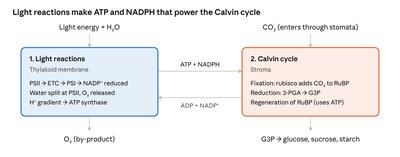
The two stages of photosynthesis are interconnected: light reactions generate ATP and NADPH, which power the Calvin cycle.
Light reactions (thylakoid membrane):
Photosystem II absorbs light, energizes electrons; water split, O2 released.
Electron transport chain pumps H+ into thylakoid space.
Photosystem I re-energizes electrons.
NADP+ reduced to NADPH.
H+ flows through ATP synthase, making ATP (chemiosmosis).
Calvin cycle (stroma):
Carbon fixation: Rubisco attaches CO2 to RuBP, forming 3-PGA.
Reduction: ATP and NADPH convert 3-PGA to G3P.
Regeneration: G3P rearranged to regenerate RuBP.
G3P used to make glucose, sucrose, starch.
Photosynthesis Labs
Elodea + phenol red: CO2 uptake changes pH and color.
Floating leaf disks: O2 production causes disks to float; rate depends on light color.
Starch test: Iodine stains regions that photosynthesized.
Comparison: Both photosynthesis and respiration ETC build H+ gradient and use ATP synthase.
Practice Problems
Atomic structure, isotopes, and half-life calculations.
Experimental design: identifying variables and controls.
Unit conversions and density calculations.
Microscope magnification and focus.
Macromolecule detection in food samples.
Cell classification and structure identification.
Photosynthesis and respiration pathways and products.
Osmosis and tonicity effects on cells.
Lab experiment interpretation and analysis.
Additional info: These notes expand on brief points from the original review guide, providing definitions, examples, and context for each topic. The included diagram visually reinforces the relationship between light reactions and the Calvin cycle in photosynthesis.
