 Indietro
General Biology Study Guide: Atoms, Molecules, Bonds, and Water
Guida di studio - Note intelligenti
 Appunti personalizzati basati sui tuoi materiali, ampliati con definizioni chiave, esempi e contesto.
Q1. Define the following terms:
Background
Topic: Basic Chemistry Concepts in Biology
This question tests your understanding of fundamental terms related to atoms, molecules, and chemical bonding, which are foundational for studying biological molecules and processes.
Key Terms:
Molecule: Combination of two or more atoms bonded together.
Atomic Number: Number of protons in an atom.
Atomic Mass: Total mass of an atom (protons + neutrons).
Valence Electron: Electron in the outermost shell.
Ionic Bonds: Attraction between oppositely charged ions.
Compound: Substance of two or more different elements in a fixed ratio.
Surface Tension: Difficulty in stretching/breaking the surface of a liquid.
Electronegativity: Tendency of an atom to attract shared electrons.
Buffer: Minimizes changes in H+ and OH- concentrations.
Solute: Substance dissolved.
Solvent: Dissolving agent.
Step-by-Step Guidance
Review each term and its definition, focusing on how it relates to biological systems.
Consider examples for each term (e.g., water as a molecule and compound, sodium chloride as an ionic bond).
Think about why these concepts are important for understanding cell structure and function.
Try to connect these terms to real biological processes, such as how buffers maintain pH in blood.
Try solving on your own before revealing the answer!
Final Answer:
See the definitions provided above for each term. These concepts are essential for understanding the chemical basis of life, including how atoms interact to form molecules and compounds, and how properties like surface tension and electronegativity affect biological systems.
Q2. What four elements make up 96% of all living matter?
Background
Topic: Elements Essential for Life
This question tests your knowledge of the most abundant elements in living organisms, which are crucial for forming biological molecules.
Key Terms:
Essential Elements: Elements required in large amounts for life.
Step-by-Step Guidance
Recall the main elements found in proteins, carbohydrates, lipids, and nucleic acids.
Think about which elements are most common in these macromolecules.
List the four elements that are present in the highest quantities in living matter.
Try solving on your own before revealing the answer!
Final Answer: Carbon, Oxygen, Hydrogen, and Nitrogen
These four elements are the primary building blocks of life, making up about 96% of living matter.
Q3. What are radioactive isotopes? Provide an example of one and one biological application.
Background
Topic: Isotopes and Their Biological Uses
This question tests your understanding of isotopes, especially radioactive ones, and their applications in biology.
Key Terms:
Isotope: Atoms of the same element with different numbers of neutrons.
Radioactive Isotope: Isotope with an unstable nucleus that decays, emitting energy.
Step-by-Step Guidance
Define what makes an isotope radioactive.
Think of a common example (e.g., Carbon-14).
Consider a biological application, such as medical imaging or dating fossils.
Try solving on your own before revealing the answer!
Final Answer:
Radioactive isotopes have unstable nuclei that decay, emitting particles and energy. Carbon-14 is an example, used in radiocarbon dating and as a tracer in biological research.
Q4. What is the difference between an essential element and a trace element? Give an example of each.
Background
Topic: Elemental Requirements for Life
This question tests your understanding of the distinction between elements needed in large versus small amounts.
Key Terms:
Essential Element: Needed in large amounts for survival.
Trace Element: Needed in small amounts.
Step-by-Step Guidance
Recall the definition of essential and trace elements.
Think of examples for each (e.g., oxygen for essential, iodine for trace).
Consider why trace elements are still important despite their low abundance.
Try solving on your own before revealing the answer!
Final Answer:
Essential elements are required in large amounts (e.g., oxygen), while trace elements are needed in small amounts (e.g., iodine). Both are vital for life.
Q5. Does an electron shell further away from the nucleus of an atom have a higher or lower potential energy?
Background
Topic: Atomic Structure and Energy Levels
This question tests your understanding of how electron energy changes with distance from the nucleus.
Key Terms:
Electron Shell: Energy levels where electrons reside.
Potential Energy: Stored energy due to position.
Step-by-Step Guidance
Recall that electrons closer to the nucleus have lower potential energy.
Electrons further away have higher potential energy due to their position.
Think about how this affects chemical reactivity.
Try solving on your own before revealing the answer!
Final Answer: Higher potential energy
Electrons farther from the nucleus have more potential energy.
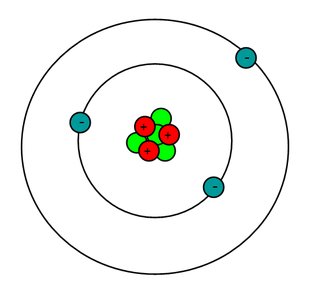
Q6. Below is a model of Lithium. Label electrons, protons, neutrons, and atomic nucleus.
Background
Topic: Atomic Structure
This question tests your ability to identify subatomic particles and their locations in an atom.
Key Terms:
Electron: Negatively charged particle in shells.
Proton: Positively charged particle in nucleus.
Neutron: Neutral particle in nucleus.
Atomic Nucleus: Center of atom containing protons and neutrons.
Step-by-Step Guidance
Identify the blue circles as electrons in the outer shells.
Identify the red circles as protons in the nucleus.
Identify the green circles as neutrons in the nucleus.
Label the central cluster as the atomic nucleus.
Try solving on your own before revealing the answer!
Final Answer:
Electrons are the blue circles in the shells, protons are the red circles in the nucleus, neutrons are the green circles in the nucleus, and the atomic nucleus is the central cluster.
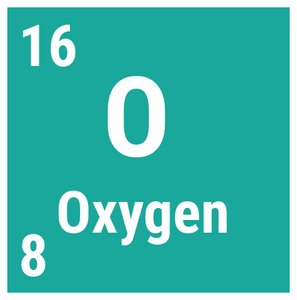
Q7. What is the atomic number of Oxygen? What is the mass number? How many electrons does Oxygen have? How many neutrons?
Background
Topic: Atomic Structure and Periodic Table
This question tests your ability to interpret atomic information from the periodic table.
Key Terms:
Atomic Number: Number of protons.
Mass Number: Protons + neutrons.
Electrons: Equal to protons in a neutral atom.
Neutrons: Mass number minus atomic number.
Step-by-Step Guidance
Find the atomic number for oxygen (look at the periodic table).
Find the mass number for oxygen.
Calculate the number of electrons (atomic number, if neutral).
Calculate the number of neutrons (mass number minus atomic number).
Try solving on your own before revealing the answer!
Final Answer:
Atomic number: 8; Mass number: 16; Electrons: 8; Neutrons: 8.
Q8. Which subatomic particle determines the atom's identity? Which subatomic particle is directly involved in chemical reactions between atoms?
Background
Topic: Subatomic Particles and Chemical Reactions
This question tests your understanding of the roles of protons and electrons in atomic identity and chemical reactivity.
Key Terms:
Proton: Determines atomic identity.
Electron: Involved in chemical reactions.
Step-by-Step Guidance
Recall that the number of protons defines the element.
Recall that electrons in the outer shell participate in chemical reactions.
Think about how these particles affect the atom's properties.
Try solving on your own before revealing the answer!
Final Answer:
Protons determine the atom's identity; electrons are directly involved in chemical reactions.
Q9. Name one thing that could affect the rate of a chemical reaction.
Background
Topic: Chemical Reaction Rates
This question tests your understanding of factors that influence how quickly reactions occur.
Key Terms:
Reaction Rate: Speed at which reactants are converted to products.
Step-by-Step Guidance
Think about factors like concentration, temperature, and presence of catalysts.
Consider how increasing reactant concentration might speed up a reaction.
Consider how temperature affects molecular movement and reaction rate.
Try solving on your own before revealing the answer!
Final Answer:
Concentration of reactants, concentration of products, and temperature can affect the rate of a chemical reaction.
Q10. Based on the definitions of a molecule and a compound, fill in the table below:
Background
Topic: Molecules vs. Compounds
This question tests your ability to distinguish between molecules and compounds and apply molecular formulas.
Key Terms:
Molecule: Two or more atoms bonded together.
Compound: Two or more different elements bonded together.
Step-by-Step Guidance
Review the definitions of molecule and compound.
Apply these definitions to water, carbon dioxide, methane, and oxygen.
Fill in the table with Y/N for molecule and compound, and write the molecular formula.
Try solving on your own before revealing the answer!
Final Answer:
Water: Y, Y, H₂O; Carbon Dioxide: Y, Y, CO₂; Methane: Y, Y, CH₄; Oxygen: Y, N, O₂.
Q11. Explain the difference between nonpolar and polar covalent bonds.
Background
Topic: Chemical Bonding
This question tests your understanding of how electrons are shared in covalent bonds and the resulting charge distribution.
Key Terms:
Covalent Bond: Atoms share electrons.
Nonpolar Covalent Bond: Electrons shared equally.
Polar Covalent Bond: Electrons shared unequally.
Electronegativity: Atom's tendency to attract electrons.
Step-by-Step Guidance
Recall that covalent bonds involve sharing electrons.
Nonpolar bonds occur when atoms have similar electronegativity.
Polar bonds occur when one atom is more electronegative, causing unequal sharing.
Think about how this leads to partial charges in polar molecules.
Try solving on your own before revealing the answer!
Final Answer:
Nonpolar covalent bonds share electrons equally, resulting in no partial charges. Polar covalent bonds share electrons unequally, creating partial charges due to differences in electronegativity.
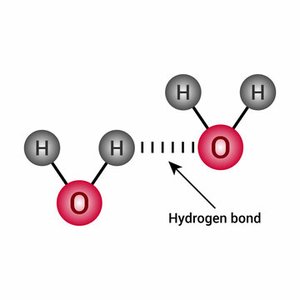
Q12. Draw two water molecules. Label the atoms, show the bonds between them (label polar covalent and hydrogen bonds) and show the shape of the molecule. Which element is most electronegative (Oxygen or Hydrogen)? Why is water considered a polar molecule?
Background
Topic: Water Structure and Polarity
This question tests your understanding of water's molecular structure, bond types, and polarity.
Key Terms:
Polar Covalent Bond: Unequal sharing of electrons.
Hydrogen Bond: Weak attraction between molecules.
Bent Shape: Water's molecular geometry.
Electronegativity: Oxygen is more electronegative than hydrogen.
Step-by-Step Guidance
Draw two water molecules, each with one oxygen and two hydrogen atoms.
Label the polar covalent bonds between oxygen and hydrogen within each molecule.
Show the hydrogen bond between the hydrogen of one molecule and the oxygen of another.
Indicate the bent shape of the water molecule.
Identify oxygen as the more electronegative element.
Explain why water is polar due to the difference in electronegativity.
Try solving on your own before revealing the answer!
Final Answer:
Water molecules are bent, oxygen is more electronegative, and water is polar because oxygen attracts electrons more strongly, creating partial charges.
Q13. What gives water its unique properties, such as cohesion, high specific heat, and high heat of vaporization?
Background
Topic: Properties of Water
This question tests your understanding of the molecular interactions responsible for water's unique characteristics.
Key Terms:
Hydrogen Bond: Attraction between water molecules.
Cohesion: Water molecules stick together.
Specific Heat: Amount of heat needed to change temperature.
Heat of Vaporization: Energy needed to convert liquid to gas.
Step-by-Step Guidance
Recall that hydrogen bonds form between water molecules.
Think about how these bonds affect water's physical properties.
Consider how cohesion, specific heat, and heat of vaporization are influenced by hydrogen bonding.
Try solving on your own before revealing the answer!
Final Answer:
Hydrogen bonding between water molecules gives water its unique properties, including cohesion, high specific heat, and high heat of vaporization.
Q14. What makes something an acid? What makes something a base?
Background
Topic: Acids and Bases
This question tests your understanding of how substances affect hydrogen ion concentration in solutions.
Key Terms:
Acid: Increases hydrogen ion concentration.
Base: Reduces hydrogen ion concentration.
Step-by-Step Guidance
Recall that acids donate H+ ions to a solution.
Bases accept H+ ions or donate OH- ions.
Think about how this affects pH.
Try solving on your own before revealing the answer!
Final Answer:
An acid increases hydrogen ion concentration; a base reduces it.
Q15. Calculate the molecular mass of ammonia (NH₃). (Nitrogen has an atomic mass of about 14 amu and Hydrogen has an atomic mass of about 1 amu)
Background
Topic: Molecular Mass Calculation
This question tests your ability to calculate the molecular mass of a compound using atomic masses.
Key Formula:
Where:
Nitrogen atomic mass = 14 amu
Hydrogen atomic mass = 1 amu
Step-by-Step Guidance
Identify the number of nitrogen and hydrogen atoms in ammonia (NH₃).
Multiply the atomic mass of nitrogen by the number of nitrogen atoms.
Multiply the atomic mass of hydrogen by the number of hydrogen atoms.
Add the results to get the total molecular mass.
Try solving on your own before revealing the answer!
Final Answer: 17 amu
Ammonia (NH₃) has one nitrogen (14 amu) and three hydrogens (3 x 1 amu = 3 amu), totaling 17 amu.
Q16. Compared to a basic solution with a pH of 7, how many times more hydrogen ions does an acidic solution with a pH of 5 have?
Background
Topic: pH Scale and Hydrogen Ion Concentration
This question tests your understanding of the logarithmic nature of the pH scale.
Key Formula:
Step-by-Step Guidance
Calculate the difference in pH units between 7 and 5.
Recall that each unit is a 10-fold change in hydrogen ion concentration.
Multiply the 10-fold change for each unit difference.
Try solving on your own before revealing the answer!
Final Answer: 100 times more hydrogen ions
A solution with pH 5 has 100 times more hydrogen ions than a solution with pH 7.
