 Indietro
General Biology Study Guide: Lipids, Membranes, Cellular Structure, Energy, and Cellular Respiration
Guida di studio - Note intelligenti
 Appunti personalizzati basati sui tuoi materiali, ampliati con definizioni chiave, esempi e contesto.
Chapter 6: Lipids, Membranes, and the First Cells
Functions and Structure of the Plasma Membrane
The plasma membrane is a fundamental cellular structure that defines the boundary of the cell and regulates its interactions with the environment. It is composed primarily of lipids and proteins, and its structure is essential for selective permeability, cell communication, and cell attachment.
Boundary Setting: The plasma membrane separates the internal contents of the cell from the external environment.
Selective Permeability: Controls the movement of substances in and out of the cell via diffusion and transport mechanisms.
Cell Recognition and Identity: Glycoproteins and glycolipids on the membrane surface allow cells to identify each other.
Cell Signaling: Membrane proteins facilitate communication by sensing and responding to external signals.
Cell Attachment: Membrane proteins and lipids enable cells to adhere and form tissues.
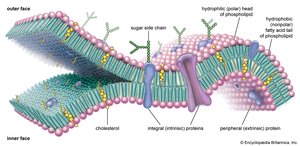
Hydrocarbon Chains, Fatty Acids, and Isoprenoids
Lipids are diverse molecules characterized by their hydrophobic hydrocarbon chains.
Hydrocarbon Chains: Composed of carbon (C) and hydrogen (H) atoms, forming nonpolar covalent bonds that are water-insoluble.
Fatty Acids: Long hydrocarbon chains with a carboxyl group; serve as energy storage and membrane components.
Isoprenoids: Built from isoprene units; function in cellular signaling and as precursors for vitamins and hormones.
Saturated vs. Unsaturated Fatty Acids: Saturated fatty acids have no double bonds, are solid at room temperature; unsaturated fatty acids have one or more double bonds, are liquid at room temperature.
Health Implications: Saturated fats are associated with cardiovascular risk, while unsaturated fats are considered healthier.
Types of Lipids: Steroids, Triglycerides, and Phospholipids
Lipids include several classes, each with distinct structures and functions.
Steroids: Four-ring structure; examples include cholesterol, testosterone, and estrogen. Steroids differ from fatty acids and isoprenoids in their ring structure.
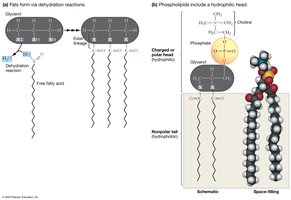
Triglycerides (Fats): Composed of three fatty acids linked to a glycerol backbone; primary energy storage molecules.
Phospholipids: Amphipathic molecules with hydrophilic heads and hydrophobic tails; form the basis of cell membranes.
Amphipathic Nature: Phospholipids have both polar (hydrophilic) and nonpolar (hydrophobic) regions, enabling bilayer formation.
Phospholipid Bilayer and Selective Permeability
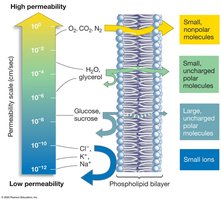
The phospholipid bilayer is the structural foundation of the plasma membrane, providing selective permeability.
Micelle: Spherical structure formed by phospholipids in water.
Bilayer: Double layer of phospholipids with hydrophobic tails inward and hydrophilic heads outward.
Permeability: Small, nonpolar molecules cross easily; ions and large molecules are restricted.
Cholesterol: Modulates membrane fluidity and permeability.
Membrane Proteins and Transport Mechanisms
Proteins embedded in the membrane facilitate transport, communication, and structural support.
Integral (Intrinsic) Proteins: Span the membrane and are involved in transport.
Peripheral (Extrinsic) Proteins: Attach to the membrane surface and assist in signaling and structure.
Fluid-Mosaic Model: Describes the dynamic arrangement of lipids and proteins in the membrane.
Transport Types:
Facilitated Diffusion: Passive transport via proteins; moves substances down their concentration gradient.
Active Transport: Requires energy (ATP); moves substances against their gradient.
Uniporter, Symporter, Antiporter: Types of transporters based on direction and number of substances moved.
Sodium-Potassium Pump: Uses ATP to exchange Na+ and K+ across the membrane.
Chapter 7: Inside the Cell
Prokaryotic Cell Structure
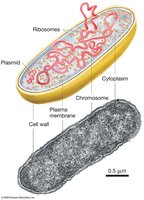
Prokaryotic cells lack membrane-bound organelles and are structurally simpler than eukaryotic cells.
Domains: Bacteria, Archaea, Eukarya; classified by 16S rRNA gene comparison.
Cell Parts: Chromosome, plasmid, ribosomes, plasma membrane, cell wall, cytoplasm.
Chromosome: Circular DNA molecule; contains genetic information.
Plasmid: Small, circular DNA; provides additional functions like antibiotic resistance.
Ribosomes: Protein synthesis machinery; composed of RNA and protein.
Cell Wall: Provides structural support; contains peptidoglycan in bacteria.
Flagella and Fimbriae: Motility and attachment structures.
Eukaryotic Cell Structure and Compartmentalization
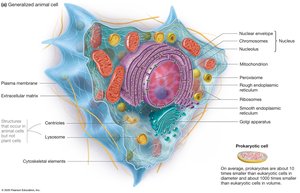
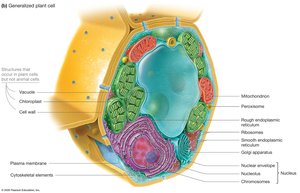
Eukaryotic cells contain membrane-bound organelles, allowing compartmentalization of functions.
Nucleus: Contains DNA; surrounded by nuclear envelope with pores.
Rough ER: Studded with ribosomes; synthesizes proteins.
Smooth ER: Lipid synthesis and detoxification.
Golgi Apparatus: Modifies, sorts, and packages proteins.
Lysosomes: Digestive organelles; contain hydrolytic enzymes.
Mitochondria: Site of ATP production; contains its own DNA and ribosomes.
Chloroplasts: Site of photosynthesis in plants; contains grana, thylakoids, and stroma.
Cytoskeleton: Actin, microtubules, intermediate filaments; provide structure and movement.
Chapter 8: Energy and Enzymes: An Introduction to Metabolism
Energy in Biological Systems
Energy is essential for cellular processes and exists in various forms.
Potential Energy: Stored in chemical bonds, especially nonpolar covalent bonds (C–H).
Kinetic Energy: Energy of motion.
First Law of Thermodynamics: Energy cannot be created or destroyed, only transformed.
Enthalpy (H): Total heat content of a system.
Entropy (S): Measure of disorder.
Free Energy (G): Energy available to do work.
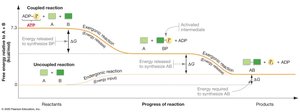
Exergonic Reactions: ; spontaneous, release energy.
Endergonic Reactions: ; nonspontaneous, require energy input.
Equilibrium: ; no net change.
ATP: The Energy Currency of the Cell
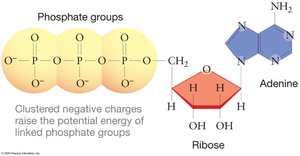
ATP (adenosine triphosphate) is the primary energy carrier in cells.
Structure: Three phosphate groups, ribose, adenine.
Function: Provides energy for cellular work via phosphorylation.
Phosphorylation: Addition of phosphate group increases reactivity of molecules.
Enzymes and Metabolic Pathways
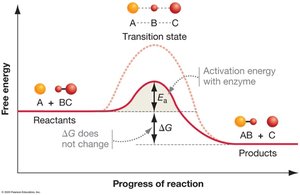
Enzymes are biological catalysts that speed up chemical reactions by lowering activation energy.
Active Site: Region where substrate binds.
Induced Fit: Enzyme changes shape to accommodate substrate.
Enzyme Saturation: Maximum rate when all active sites are occupied.
Cofactors, Coenzymes, Prosthetic Groups: Non-protein helpers for enzyme function.
Regulation: Competitive and non-competitive inhibition; allosteric activation/inhibition; phosphorylation.
Metabolic Pathways: Series of enzyme-catalyzed reactions; regulated by feedback inhibition.
Chapter 9: Cellular Respiration and Fermentation
Overview of Cellular Respiration
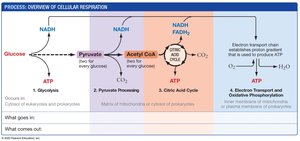
Cellular respiration is the process by which cells extract energy from glucose to produce ATP.
Metabolic Pathway: Series of reactions converting glucose to ATP.
Equation:
Phases: Glycolysis, Pyruvate Processing, Citric Acid Cycle, Electron Transport Chain/Oxidative Phosphorylation.
Glucose Storage: Plants store as starch; animals as glycogen.
Catabolism and Anabolism
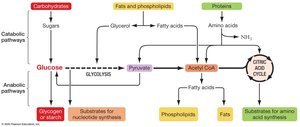
Catabolic pathways break down molecules to release energy, while anabolic pathways build molecules using energy.
Catabolism: Breakdown of carbohydrates, fats, and proteins.
Anabolism: Synthesis of macromolecules.
Glucose Oxidation: Glycolysis, Pyruvate Processing, Citric Acid Cycle
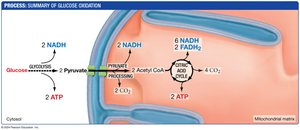
Glucose is oxidized in a series of steps to produce ATP, NADH, FADH2, and CO2.
Glycolysis: Occurs in cytosol; produces 2 ATP and 2 NADH.
Pyruvate Processing: Occurs in mitochondrial matrix; produces acetyl-CoA, CO2, NADH.
Citric Acid Cycle: Occurs in mitochondrial matrix; produces ATP, NADH, FADH2, CO2.
Electron Transport Chain and Chemiosmosis
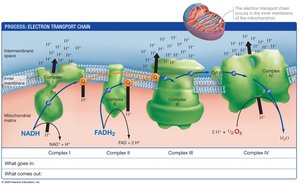
The electron transport chain (ETC) uses NADH and FADH2 to generate a proton gradient, driving ATP synthesis.
ETC: Located in inner mitochondrial membrane; transfers electrons to oxygen.
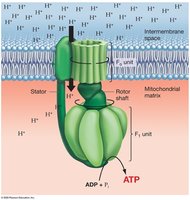
Chemiosmosis: Movement of protons across membrane generates ATP via ATP synthase.
Proton-Motive Force: Drives ATP production.
Fermentation
Fermentation occurs when oxygen is absent, allowing cells to regenerate NAD+ and produce ATP.
Lactic Acid Fermentation: Occurs in humans; pyruvate is reduced to lactate.
Alcohol Fermentation: Occurs in yeast; pyruvate is converted to ethanol and CO2.
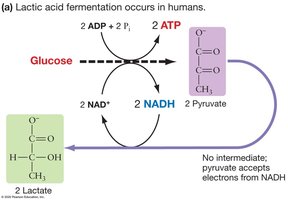
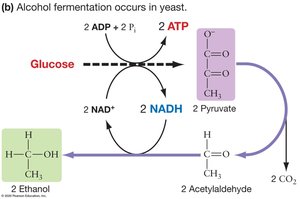
Table: Comparison of Cellular Respiration and Fermentation
Process | Oxygen Required | ATP Yield (per glucose) | End Products |
|---|---|---|---|
Cellular Respiration | Yes | ~30-32 | CO2, H2O |
Lactic Acid Fermentation | No | 2 | Lactate |
Alcohol Fermentation | No | 2 | Ethanol, CO2 |
Additional info: Some explanations and context were expanded for clarity and completeness, including definitions, examples, and comparisons.
