 Indietro
General Biology Study Guide: Membranes, Metabolism, Respiration, and Photosynthesis
Guida di studio - Note intelligenti
 Appunti personalizzati basati sui tuoi materiali, ampliati con definizioni chiave, esempi e contesto.
Q1. Describe the structure of a typical cell membrane.
Background
Topic: Cell Membrane Structure
This question tests your understanding of the basic architecture of biological membranes, which is fundamental to cell biology.
Key Terms and Concepts:
Phospholipid bilayer: The main structural component, consisting of two layers of phospholipids with hydrophilic heads facing outward and hydrophobic tails facing inward.
Proteins: Embedded within or attached to the bilayer, serving various functions.
Cholesterol: Interspersed within the bilayer, affecting fluidity and stability.
Carbohydrates: Attached to proteins or lipids on the extracellular surface, involved in cell recognition.
Step-by-Step Guidance
Start by identifying the two main components of the membrane: phospholipids and proteins.
Describe the arrangement of phospholipids in a bilayer, noting the orientation of hydrophilic heads and hydrophobic tails.
Explain the presence and roles of membrane proteins (integral and peripheral).
Mention the role of cholesterol and carbohydrates in the membrane structure.
Try solving on your own before revealing the answer!
Final Answer:
The typical cell membrane is composed of a phospholipid bilayer, with hydrophilic (water-attracting) heads facing outward and hydrophobic (water-repelling) tails facing inward. Embedded within this bilayer are proteins (integral and peripheral), cholesterol molecules that help regulate fluidity, and carbohydrates attached to proteins and lipids on the extracellular surface. This structure is often described as the "fluid mosaic model" because of the dynamic and varied arrangement of its components.
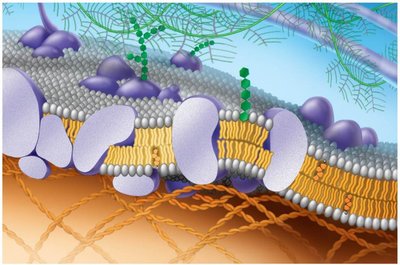
Q2. Know what the purpose is of each component of the membrane. Explain all of the features in the image below.
Background
Topic: Membrane Components and Their Functions
This question asks you to identify and explain the function of each major component of the cell membrane, as illustrated in a typical diagram.
Key Terms and Concepts:
Phospholipids: Form the basic structure and create a semi-permeable barrier.
Proteins: Serve as channels, carriers, receptors, enzymes, and structural supports.
Cholesterol: Modulates membrane fluidity and stability.
Carbohydrates: Involved in cell recognition and signaling.
Cytoskeleton: Provides structural support and helps maintain cell shape.
Step-by-Step Guidance
Identify the phospholipid bilayer and describe its role as a barrier and its selective permeability.
Point out the different types of proteins (integral and peripheral) and their functions (transport, signaling, etc.).
Locate cholesterol molecules and explain how they affect membrane fluidity.
Describe the role of carbohydrates attached to proteins and lipids (glycoproteins and glycolipids) in cell recognition.
Note the cytoskeletal elements and their connection to the membrane for structural support.
Try solving on your own before revealing the answer!
Final Answer:
Each component of the cell membrane has a specific function: phospholipids form the basic barrier; proteins act as channels, carriers, receptors, and enzymes; cholesterol maintains fluidity; carbohydrates are involved in cell recognition; and the cytoskeleton provides structural support. The image shows these components: the bilayer (yellow/orange), proteins (purple), cholesterol (green), carbohydrates (green chains), and cytoskeletal fibers (orange).
