 Indietro
General Biology Study Guide: Plant Hormones, Animal Physiology, and Digestive Adaptations
Guida di studio - Note intelligenti
 Appunti personalizzati basati sui tuoi materiali, ampliati con definizioni chiave, esempi e contesto.
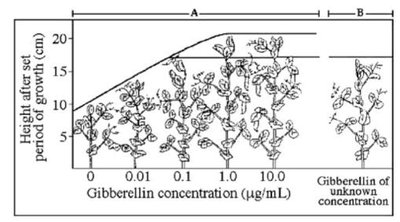
Q1. The results of this experiment, shown on the left of the graph in the figure (area A), may be used to...
Background
Topic: Plant Hormones – Gibberellins
This question is about how gibberellin concentration affects plant growth, as shown in the graph. Gibberellins are plant hormones that regulate growth and influence various developmental processes, including stem elongation.
Key Terms and Concepts:
Gibberellin: A plant hormone that promotes stem elongation, seed germination, and other growth processes.
Positive correlation: As gibberellin concentration increases, plant height increases up to a certain point.
Experimental control: The group with 0 gibberellin serves as a baseline for comparison.
Step-by-Step Guidance
Examine the x-axis (gibberellin concentration) and y-axis (plant height after a set period of growth) to understand what is being measured.
Observe the trend in area A: as gibberellin concentration increases, plant height also increases, up to a plateau.
Consider what this relationship suggests about the necessity of gibberellin for normal plant growth and development.
Think about what would happen to plant height if gibberellin were absent or present in excess, based on the graph.
To answer the question, focus on what the data in area A demonstrate about the role of gibberellin in plant growth.
Try solving on your own before revealing the answer!
Final Answer:
The results in area A show that gibberellin is necessary for normal plant growth, as increasing gibberellin concentration leads to increased plant height up to a certain point. This demonstrates a correlation between gibberellin concentration and plant height, supporting the idea that gibberellin is required for normal stem elongation and development.
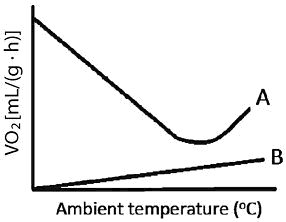
Q2. Researchers measure animals' oxygen consumption (VO2) as a way to quantify metabolic rate. A researcher measured the VO2 for two animals, A and B, as a function of ambient temperature and collected the data shown in the figure. One of the animals was an ectotherm, and one was an endotherm. Based on these data, which animal was the endotherm, and why?
Background
Topic: Animal Physiology – Thermoregulation
This question tests your understanding of how metabolic rate (measured as oxygen consumption) changes with temperature in ectotherms (cold-blooded animals) and endotherms (warm-blooded animals).
Key Terms and Concepts:
VO2: Volume of oxygen consumed per unit time, a measure of metabolic rate.
Endotherm: An animal that maintains a constant body temperature through internal metabolic processes (e.g., mammals, birds).
Ectotherm: An animal whose body temperature varies with the environment (e.g., reptiles, amphibians).
Thermoregulation: The process by which animals maintain their internal temperature.
Step-by-Step Guidance
Look at the trends for animals A and B as ambient temperature changes.
Recall that endotherms typically show a relatively constant metabolic rate over a range of moderate temperatures, but their metabolic rate increases at low temperatures to generate heat.
Ectotherms' metabolic rate usually increases with temperature, as their body temperature and metabolism depend on the environment.
Compare the patterns in the graph to these expectations to determine which animal is the endotherm.
Think about which animal's metabolic rate increases at low temperatures and why.
Try solving on your own before revealing the answer!
Final Answer:
Animal B is the endotherm because its metabolic rate increases at lower temperatures, reflecting the energy required to maintain a constant internal temperature. Animal A is the ectotherm, as its metabolic rate decreases with decreasing temperature, consistent with reliance on environmental heat.
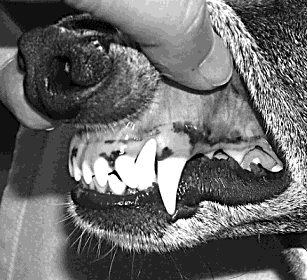
Q3. Examine the teeth of this organism. What type of organism is it?
Background
Topic: Comparative Anatomy – Dentition and Diet
This question asks you to identify the type of organism (herbivore, carnivore, or omnivore) based on the structure of its teeth. Teeth shape and arrangement are closely related to dietary habits.
Key Terms and Concepts:
Canines: Long, pointed teeth used for tearing flesh, characteristic of carnivores.
Molars: Flat teeth used for grinding plant material, characteristic of herbivores.
Incisors: Front teeth used for cutting food.
Omnivore: An animal with a combination of sharp and flat teeth for both animal and plant material.
Step-by-Step Guidance
Observe the shape and size of the teeth in the image, especially the canines and molars.
Recall that carnivores have large, sharp canines for capturing and killing prey, and cutting meat.
Herbivores typically have broad, flat molars for grinding plant material and reduced or absent canines.
Omnivores have a mix of sharp canines and flat molars for a varied diet.
Based on the prominent canines and tooth structure, consider which dietary category this animal fits into.
Try solving on your own before revealing the answer!
Final Answer:
This organism is a carnivore. The large, pointed canines are specialized for tearing meat, which is characteristic of carnivorous animals.
