 Indietro
General Biology Study Guide: Thermodynamics, Enzymes, Cell Cycle, Membranes, Respiration, and Photosynthesis
Guida di studio - Note intelligenti
 Appunti personalizzati basati sui tuoi materiali, ampliati con definizioni chiave, esempi e contesto.
Q1. Which of the following statements best describes the first law of thermodynamics?
Background
Topic: Thermodynamics in Biology
This question tests your understanding of the fundamental laws of energy conservation and transfer in biological systems.
Key Terms:
First Law of Thermodynamics: Also known as the law of conservation of energy.
Energy: The capacity to do work or cause change.
Step-by-Step Guidance
Recall what the first law of thermodynamics states about energy in a closed system.
Consider whether energy can be created, destroyed, or only transformed from one form to another.
Review each answer choice and eliminate those that contradict the law of conservation of energy.
Try solving on your own before revealing the answer!
Final Answer: A) Energy cannot be created or destroyed.
The first law of thermodynamics states that energy can be transferred and transformed, but it cannot be created or destroyed.
Q2. Which of the following statements best summarizes a consequence of the second law of thermodynamics?
Background
Topic: Thermodynamics in Biology
This question tests your understanding of entropy and how it changes in biological systems.
Key Terms:
Second Law of Thermodynamics: The entropy of the universe tends to increase over time.
Entropy (S): A measure of disorder or randomness in a system.
Step-by-Step Guidance
Recall what the second law of thermodynamics says about entropy in the universe.
Consider what happens to the entropy of the universe when a system becomes more ordered (decreases in entropy).
Eliminate answer choices that suggest the universe's entropy decreases or remains constant when a system's entropy changes.
Try solving on your own before revealing the answer!
Final Answer: C) If entropy of a system decreases, there must be a corresponding increase in the entropy of the universe.
The second law states that the total entropy of the universe always increases, so a local decrease must be offset by a greater increase elsewhere.
Q3. Which of the following terms best describes a chemical reaction for which ΔG is positive?
Background
Topic: Free Energy and Chemical Reactions
This question tests your understanding of the concept of Gibbs free energy and how it relates to reaction spontaneity.
Key Terms and Formula:
ΔG (Gibbs Free Energy): Indicates whether a reaction is spontaneous () or non-spontaneous ().
Endergonic: A reaction that requires energy input ().
Exergonic: A reaction that releases energy ().
Step-by-Step Guidance
Recall the definition of ΔG and what a positive value means for energy flow.
Match the terms (endergonic, exergonic, spontaneous, etc.) to their correct ΔG values.
Eliminate answer choices that do not fit the definition of a reaction with .
Try solving on your own before revealing the answer!
Final Answer: A) endergonic
Endergonic reactions have a positive ΔG and require an input of energy to proceed.
Q4. Which of the following statements best describes a system at chemical equilibrium?
Background
Topic: Chemical Equilibrium
This question tests your understanding of what it means for a system to be at equilibrium in terms of energy and work.
Key Terms:
Chemical Equilibrium: The point at which the forward and reverse reactions occur at the same rate.
Work: The ability to do work is related to the free energy difference from equilibrium.
Step-by-Step Guidance
Recall what happens to the rates of forward and reverse reactions at equilibrium.
Consider whether energy is being consumed or released at equilibrium.
Think about whether a system at equilibrium can perform work.
Try solving on your own before revealing the answer!
Final Answer: D) The system can do no work.
At equilibrium, there is no net change in free energy, so the system cannot do work.
Q5. When ATP is hydrolyzed to activate a target protein, what is often the fate of the inorganic phosphate that is released?
Background
Topic: ATP Hydrolysis and Phosphorylation
This question tests your understanding of how ATP hydrolysis is coupled to cellular processes.
Key Terms:
ATP Hydrolysis: The reaction where ATP is broken down into ADP and inorganic phosphate ().
Phosphorylated Intermediate: A molecule that has received a phosphate group, often activating it.
Step-by-Step Guidance
Recall what happens to the phosphate group released from ATP during hydrolysis.
Consider how phosphorylation can activate or change the function of proteins.
Eliminate answer choices that do not involve the phosphate being used in a cellular process.
Try solving on your own before revealing the answer!
Final Answer: C) It is used to form a phosphorylated intermediate.
The inorganic phosphate is often transferred to another molecule, creating a phosphorylated intermediate that is more reactive.
Q6. Enzymes accelerate a reaction by making the ΔG more favorable.
Background
Topic: Enzyme Function
This question tests your understanding of how enzymes affect chemical reactions, specifically regarding activation energy and free energy.
Key Terms:
Enzyme: A biological catalyst that speeds up reactions by lowering activation energy.
ΔG (Gibbs Free Energy): The change in free energy of a reaction; enzymes do not change ΔG.
Step-by-Step Guidance
Recall the role of enzymes in chemical reactions—do they change the free energy of the reaction or just the activation energy?
Consider whether the spontaneity of a reaction is affected by the presence of an enzyme.
Decide if the statement is true or false based on your understanding of enzyme function.
Try solving on your own before revealing the answer!
Final Answer: B) False
Enzymes lower the activation energy but do not change the ΔG of a reaction.
Q7. Mutations that alter specific amino acids localized to the active site of an enzyme would most likely result in which of the following?
Background
Topic: Enzyme Structure and Function
This question tests your understanding of how changes in the active site affect enzyme activity.
Key Terms:
Active Site: The region of an enzyme where substrate molecules bind and undergo a chemical reaction.
Substrate: The molecule upon which an enzyme acts.
Step-by-Step Guidance
Recall the function of the active site in substrate binding and catalysis.
Consider how a mutation in the active site could affect the enzyme's ability to bind substrates, products, or regulators.
Eliminate answer choices that do not directly relate to substrate binding at the active site.
Try solving on your own before revealing the answer!
Final Answer: C) A decreased ability of the enzyme to bind substrates.
Mutations in the active site typically reduce the enzyme's ability to bind its substrate.
Q8. If an enzyme in solution is saturated with substrate, the most effective way to obtain a faster yield of products is to____.
Background
Topic: Enzyme Kinetics
This question tests your understanding of how enzyme concentration and substrate concentration affect reaction rate.
Key Terms:
Saturated Enzyme: All active sites are occupied by substrate.
Reaction Rate: The speed at which product is formed.
Step-by-Step Guidance
Recall what it means for an enzyme to be saturated with substrate.
Consider what would increase the rate of product formation when all active sites are already occupied.
Eliminate options that would not increase the number of active sites available.
Try solving on your own before revealing the answer!
Final Answer: A) add more of the enzyme
Adding more enzyme increases the number of available active sites, allowing more substrate to be converted to product per unit time.
Q9. Which comes immediately after S phase in the cell cycle?
Background
Topic: Cell Cycle Phases
This question tests your knowledge of the order of events in the eukaryotic cell cycle.
Key Terms:
S phase: The phase where DNA is replicated.
G2 phase: The phase following DNA synthesis, where the cell prepares for mitosis.
Step-by-Step Guidance
Recall the sequence of cell cycle phases: G1, S, G2, M.
Identify which phase comes directly after DNA synthesis (S phase).
Eliminate options that do not fit the correct sequence.
Try solving on your own before revealing the answer!
Final Answer: B) G2
G2 phase follows S phase and precedes mitosis in the cell cycle.
Q10. What is happening to the chromosomes during prophase of mitosis?
Background
Topic: Mitosis Stages
This question tests your understanding of the events that occur during prophase of mitosis.
Key Terms:
Prophase: The first stage of mitosis where chromosomes condense and become visible.
Chromosome Condensation: The process by which chromatin fibers become tightly coiled and visible under a microscope.
Step-by-Step Guidance
Recall the sequence of events in mitosis, focusing on prophase.
Identify what happens to the chromosomes during this stage (condensation, visibility).
Eliminate options that describe events from other stages of mitosis.
Try solving on your own before revealing the answer!
Final Answer: A) Chromosomes condense and become visible
During prophase, chromatin condenses into visible chromosomes.
Q11. Cytokinesis accompanies which stage of mitosis?
Background
Topic: Mitosis and Cytokinesis
This question tests your understanding of when cytokinesis occurs relative to the stages of mitosis.
Key Terms:
Cytokinesis: The division of the cytoplasm to form two separate daughter cells.
Telophase: The final stage of mitosis, often accompanied by cytokinesis.
Step-by-Step Guidance
Recall the stages of mitosis and when the cell physically divides.
Identify which stage is typically associated with the completion of cytokinesis.
Eliminate options that occur before the cell is ready to divide its cytoplasm.
Try solving on your own before revealing the answer!
Final Answer: E) Telophase
Cytokinesis usually begins during telophase and completes after nuclear division.
Q12. Which of the following events characterizes metaphase of mitosis?
Background
Topic: Mitosis Stages
This question tests your understanding of the key events that occur during metaphase.
Key Terms:
Metaphase: The stage of mitosis where chromosomes align at the cell's equator.
Metaphase Plate: The imaginary plane where chromosomes line up during metaphase.
Step-by-Step Guidance
Recall the sequence of events in mitosis, focusing on metaphase.
Identify the main event that distinguishes metaphase from other stages.
Eliminate options that describe events from prophase, anaphase, or telophase.
Try solving on your own before revealing the answer!
Final Answer: A) Alignment of the chromosomes at the equator
During metaphase, chromosomes align at the metaphase plate (cell equator).
Q13. Which of the following pairs of molecules make up an active MPF?
Background
Topic: Cell Cycle Regulation
This question tests your understanding of the molecular components of the Maturation Promoting Factor (MPF).
Key Terms:
MPF (Maturation Promoting Factor): A complex that triggers the cell's entry into mitosis.
Cyclin: Regulatory protein whose levels fluctuate during the cell cycle.
Cyclin-dependent kinase (CDK): Enzyme that, when combined with cyclin, becomes active and can phosphorylate target proteins.
Step-by-Step Guidance
Recall the two components required for MPF activity.
Identify which answer choice lists both a cyclin and a kinase.
Eliminate options that do not include both components.
Try solving on your own before revealing the answer!
Final Answer: D) cyclin and a cyclin-dependent kinase
Active MPF is a complex of cyclin and CDK.
Q14. If you used a very fine glass needle to pull one chromosome away from the metaphase plate during metaphase, which checkpoint would not be passed until this was corrected?
Background
Topic: Cell Cycle Checkpoints
This question tests your understanding of the cell cycle checkpoints, especially the one that ensures proper chromosome alignment before division.
Key Terms:
M checkpoint (Spindle Checkpoint): Ensures all chromosomes are properly attached to the spindle before anaphase begins.
Step-by-Step Guidance
Recall the purpose of each cell cycle checkpoint (G1, G2, M, S).
Identify which checkpoint monitors chromosome alignment at the metaphase plate.
Eliminate checkpoints that occur before or after metaphase.
Try solving on your own before revealing the answer!
Final Answer: C) M checkpoint
The M checkpoint ensures all chromosomes are properly aligned before proceeding to anaphase.
Q15. If a plasma membrane were compared to a sandwich, ___ would be considered the filling.
Background
Topic: Membrane Structure
This question tests your understanding of the structure of biological membranes, specifically the arrangement of molecules within the lipid bilayer.
Key Terms:
Phospholipid Bilayer: The fundamental structure of cell membranes, with hydrophilic heads and hydrophobic tails.
Hydrophobic Tails: The nonpolar, water-repelling part of the phospholipid molecule, located in the interior of the membrane.
Step-by-Step Guidance
Recall the structure of the phospholipid bilayer and the orientation of its components.
Identify which part of the membrane would be analogous to the filling in a sandwich.
Eliminate options that are found on the exterior surfaces of the membrane.
Try solving on your own before revealing the answer!
Final Answer: D) Hydrophobic tails
The hydrophobic tails are sandwiched between the hydrophilic heads, forming the interior of the membrane.
Q16. Which of the following statements best describes a characteristic feature of integral membrane proteins?
Background
Topic: Membrane Proteins
This question tests your understanding of the properties and structure of integral membrane proteins.
Key Terms:
Integral Membrane Proteins: Proteins that are embedded within the lipid bilayer and often span the membrane.
Amphipathic: Molecules that have both hydrophobic and hydrophilic regions.
Step-by-Step Guidance
Recall the structure of integral membrane proteins and their interaction with the lipid bilayer.
Identify which property allows these proteins to be stably embedded in the membrane.
Eliminate options that describe only hydrophilic or only hydrophobic properties.
Try solving on your own before revealing the answer!
Final Answer: C) They are amphipathic, with at least one hydrophobic region.
Integral membrane proteins have both hydrophobic and hydrophilic regions, allowing them to span the membrane.
Q17. Which of the following molecules is most likely to passively diffuse across the plasma membrane?
Background
Topic: Membrane Permeability
This question tests your understanding of which types of molecules can cross the lipid bilayer without assistance.
Key Terms:
Passive Diffusion: Movement of molecules across the membrane without energy input, typically small and nonpolar molecules.
Step-by-Step Guidance
Recall the properties of molecules that can diffuse freely through the lipid bilayer (size, polarity, charge).
Identify which molecule in the list is small and nonpolar.
Eliminate options that are large, polar, or charged.
Try solving on your own before revealing the answer!
Final Answer: B) carbon dioxide
Small, nonpolar molecules like CO2 can diffuse across the membrane without assistance.
Q18. In which direction will there be net movement of water?
Background
Topic: Osmosis
This question tests your understanding of osmosis and the movement of water across a selectively permeable membrane.
Key Terms and Formula:
Osmosis: The diffusion of water across a selectively permeable membrane from a region of lower solute concentration to higher solute concentration.
Solute Concentration: The amount of dissolved substance in a solution.
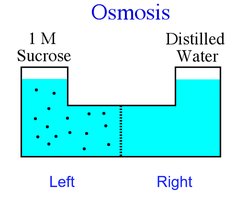
Step-by-Step Guidance
Identify which side of the membrane has a higher solute concentration (left: 1 M sucrose; right: distilled water).
Recall that water moves from areas of low solute concentration (high water potential) to high solute concentration (low water potential).
Determine the direction of net water movement based on the concentration gradient.
Try solving on your own before revealing the answer!
Final Answer: A) To the right
Water will move from the right (distilled water, lower solute) to the left (1 M sucrose, higher solute) by osmosis.
Q19. Which of the following statements best describes the normal tonicity conditions for typical plant and animal cells in their native environments?
Background
Topic: Tonicity and Cell Environment
This question tests your understanding of how plant and animal cells respond to different osmotic environments.
Key Terms:
Tonicity: The ability of a surrounding solution to cause a cell to gain or lose water.
Isotonic: No net movement of water.
Hypotonic: Solution has lower solute concentration than the cell.
Hypertonic: Solution has higher solute concentration than the cell.
Step-by-Step Guidance
Recall the ideal osmotic conditions for animal and plant cells (animal: isotonic; plant: hypotonic).
Identify which answer choice matches these conditions.
Eliminate options that do not fit the typical environments for these cell types.
Try solving on your own before revealing the answer!
Final Answer: D) The animal cell is in an isotonic solution, and the plant cell is in a hypotonic solution.
Animal cells prefer isotonic environments, while plant cells thrive in hypotonic environments due to turgor pressure.
Q20. The cytoplasm of a certain cell, such as a neuron, already has a high concentration of K+ ions. How can K+ ions continue to enter the cell?
Background
Topic: Membrane Transport
This question tests your understanding of how cells move ions against their concentration gradients.
Key Terms:
Active Transport: The movement of substances against their concentration gradient, requiring energy (usually ATP).
Step-by-Step Guidance
Recall the difference between passive and active transport.
Consider which process allows movement of ions into a cell against their concentration gradient.
Eliminate options that do not require energy input.
Try solving on your own before revealing the answer!
Final Answer: A) active transport
Active transport uses energy to move K+ ions into the cell against their concentration gradient.
Q21. Viruses are taken up by cells of the human immune system by which of the following processes?
Background
Topic: Endocytosis
This question tests your understanding of the mechanisms cells use to engulf large particles, such as viruses.
Key Terms:
Phagocytosis: A type of endocytosis where cells engulf large particles or organisms.
Step-by-Step Guidance
Recall the different types of endocytosis (phagocytosis, pinocytosis, receptor-mediated endocytosis).
Identify which process is used by immune cells to engulf viruses.
Eliminate options that do not involve engulfing large particles.
Try solving on your own before revealing the answer!
Final Answer: A) phagocytosis
Immune cells use phagocytosis to engulf and destroy viruses.
