 Indietro
General Biology Study Notes: Foundations, Chemistry, and Biological Molecules
Guida di studio - Note intelligenti
 Appunti personalizzati basati sui tuoi materiali, ampliati con definizioni chiave, esempi e contesto.
Characteristics of Life
Qualities of Living Things
Living organisms share a set of fundamental characteristics that distinguish them from non-living matter. These qualities are essential for defining life and are used to determine whether an entity is considered alive.
Cellular Organization: Must be made up of cells, the basic unit of life.
Order: Living things exhibit organized structure.
Reproduction: Ability to produce offspring, either sexually or asexually.
Growth and Development: Living things grow and develop according to specific instructions coded in their genes.
Response to Environment: Ability to respond to stimuli.
Energy Processing: Acquire and use energy for metabolism.
Regulation: Maintain internal balance (homeostasis).
Evolutionary Adaptation: Adaptations evolve to improve survival.
All living things must have all of these qualities (with rare exceptions).
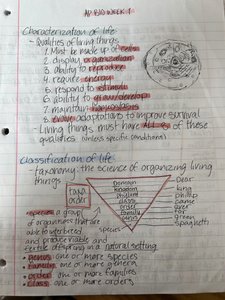
Classification of Life
Taxonomy: Organizing Living Things
Taxonomy is the science of classifying organisms based on shared characteristics. It helps organize the diversity of life into hierarchical groups.
Domain: Broadest category; includes Bacteria, Archaea, and Eukarya.
Kingdom: Next level; groups organisms with similar traits.
Phylum, Class, Order, Family, Genus, Species: Increasingly specific levels of classification.
Each organism is classified into a domain and then further into more specific categories.
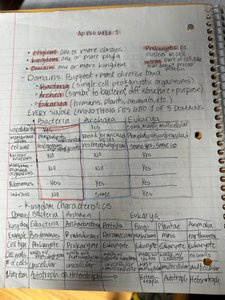
Domains and Kingdoms
Three Domains of Life
All living things are classified into three domains based on cell type and genetic differences:
Bacteria: Single-celled prokaryotes; no nucleus.
Archaea: Single-celled prokaryotes; distinct from bacteria, often found in extreme environments.
Eukarya: Organisms with complex cells containing a nucleus; includes plants, animals, fungi, and protists.
Kingdom Characteristics
Each domain contains several kingdoms, which are further classified by cell structure, mode of nutrition, and other traits.
Domain | Kingdom | Cell Type | Cell Wall | Nutrition |
|---|---|---|---|---|
Bacteria | Eubacteria | Prokaryotic | Yes | Autotrophic/Heterotrophic |
Archaea | Archaebacteria | Prokaryotic | Yes | Autotrophic/Heterotrophic |
Eukarya | Protista, Fungi, Plantae, Animalia | Eukaryotic | Varies | Varies |
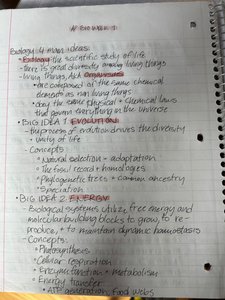
Biology: Four Main Ideas
Big Idea 1: Evolution
Evolution is the process by which populations of organisms change over time. It drives the diversity and unity of life.
Natural Selection: Mechanism for evolution; adaptation to environment.
Fossil Record: Evidence for evolutionary change.
Phylogenetic Trees: Show common ancestry.
Big Idea 2: Energy
Biological systems utilize free energy and molecular building blocks to grow, reproduce, and maintain homeostasis.
Photosynthesis: Conversion of light energy to chemical energy.
Cellular Respiration: Release of energy from food.
Metabolism: All chemical reactions in an organism.
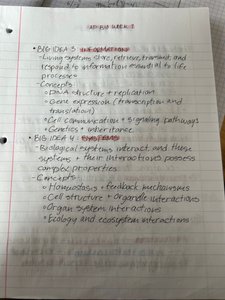
Big Idea 3: Information
Living systems store, retrieve, transmit, and respond to information essential to life processes.
DNA: Genetic material; replication and expression.
Gene Expression: Transcription and translation.
Cell Communication: Signaling pathways.
Big Idea 4: Systems
Biological systems interact and possess complex properties. These interactions occur at multiple levels, from cells to ecosystems.
Homeostasis: Feedback mechanisms maintain internal stability.
Organ System Interactions: Coordination among organs.
Ecology: Interactions within ecosystems.
Building Blocks of Matter
Atoms and Elements
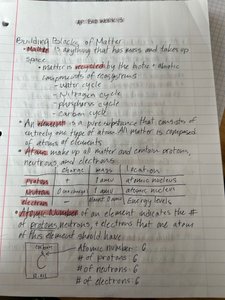
Atoms are the basic units of matter, composed of protons, neutrons, and electrons. Elements are pure substances consisting of only one type of atom.
Proton: Positively charged particle in the nucleus.
Neutron: Neutral particle in the nucleus.
Electron: Negatively charged particle orbiting the nucleus.
Particle | Charge | Location |
|---|---|---|
Proton | +1 | Nucleus |
Neutron | 0 | Nucleus |
Electron | -1 | Orbitals |
Chemical Bonds and Molecules
Types of Chemical Bonds
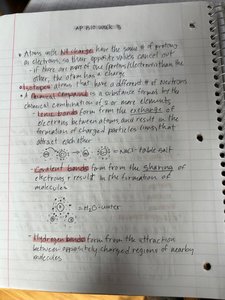
Atoms combine to form molecules through various types of chemical bonds:
Covalent Bonds: Formed by sharing electrons.
Ionic Bonds: Formed by transfer of electrons.
Hydrogen Bonds: Weak attractions between partially charged regions of molecules.
Chemical Reactions
Types and Examples
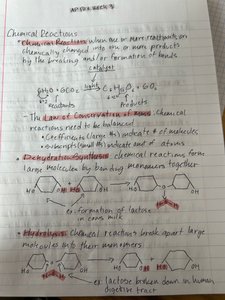
Chemical reactions involve the breaking and forming of bonds between atoms. They are essential for life processes.
Dehydration Synthesis: Formation of large molecules by joining smaller units.
Hydrolysis: Breaking down large molecules into smaller units.
Law of Conservation of Matter: Matter is neither created nor destroyed in chemical reactions.
Example equation:
Energy in Reactions
Endothermic and Exothermic Reactions
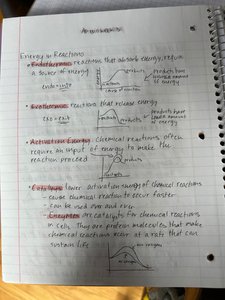
Chemical reactions can absorb or release energy. Activation energy is required to start most reactions.
Endothermic: Absorbs energy.
Exothermic: Releases energy.
Activation Energy: Minimum energy needed to initiate a reaction.
Enzymes: Biological catalysts that lower activation energy.
Enzymes and Their Function
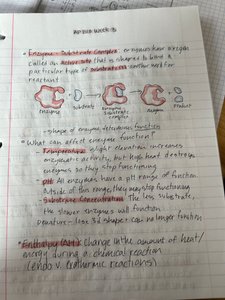
Enzyme-Substrate Complex
Enzymes are proteins that speed up chemical reactions by binding to substrates at their active sites.
Temperature: Affects enzyme activity; high temperatures can denature enzymes.
pH: Each enzyme has an optimal pH range.
Concentration: Substrate and enzyme concentration affect reaction rate.
Properties of Water
Water Cycle and Molecular Properties
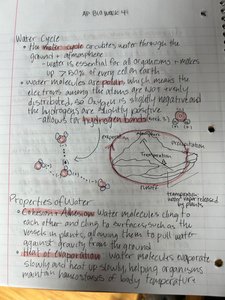
Water is essential for life, exhibiting unique properties due to its polarity and hydrogen bonding.
Cohesion: Water molecules stick together.
Adhesion: Water molecules stick to other surfaces.
High Specific Heat: Water resists temperature changes.
Polarity: Water molecules have positive and negative regions.
Carbon and Macromolecules
Organic Molecules and Macromolecules
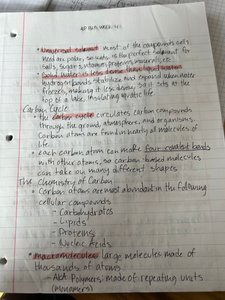
Carbon forms the backbone of organic molecules, which are essential for cellular structure and function.
Carbohydrates: Energy storage and structural support.
Lipids: Energy storage, insulation, and cell membranes.
Proteins: Structure, enzymes, and signaling.
Nucleic Acids: Genetic information storage and transfer.
Macromolecule Structure and Function
Carbohydrates, Lipids, Proteins, Nucleic Acids
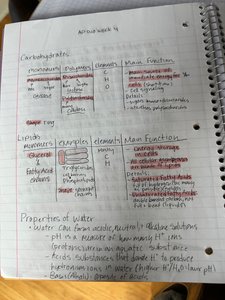
Macromolecules are large, complex molecules essential for life. Each type has unique monomers, elements, and functions.
Macromolecule | Monomer | Elements | Main Function |
|---|---|---|---|
Carbohydrates | Monosaccharides | C, H, O | Energy storage, structure |
Lipids | Fatty acids, glycerol | C, H, O | Energy storage, insulation |
Proteins | Amino acids | C, H, O, N | Structure, enzymes |
Nucleic Acids | Nucleotides | C, H, O, N, P | Genetic information |
Functional Groups in Organic Molecules
Structure and Properties
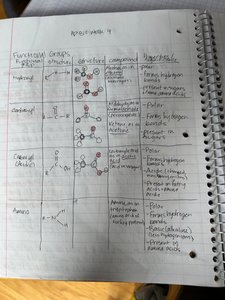
Functional groups are specific groups of atoms within molecules that determine their chemical properties and reactivity.
Functional Group | Structure | Compound | Properties/Significance |
|---|---|---|---|
Hydroxyl | -OH | Alcohols | Polar, forms hydrogen bonds |
Carbonyl | C=O | Aldehydes, Ketones | Polar, reactive |
Amino | -NH2 | Amines | Basic, forms hydrogen bonds |
Phosphate | -PO4 | Phosphates | Polar, energy transfer |
Methyl | -CH3 | Methylated compounds | Nonpolar, affects gene expression |
Polarity and Electronegativity
Determining Molecular Properties
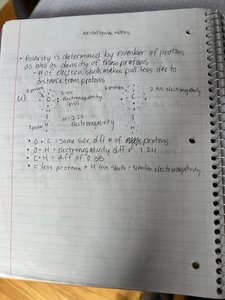
Polarity is determined by the difference in electronegativity between atoms. Electronegativity is the tendency of an atom to attract electrons.
Polar Bonds: Unequal sharing of electrons.
Nonpolar Bonds: Equal sharing of electrons.
Electronegativity: Higher values indicate stronger attraction for electrons.
Example: Oxygen is more electronegative than hydrogen, making water a polar molecule.
The Nature of Science and Scientific Method
Science and Scientific Inquiry
Science is a systematic approach to understanding the natural world. It involves observation, hypothesis formation, experimentation, and analysis.
Scientific Theory: Well-supported explanation of natural phenomena.
Scientific Law: Statement describing consistent natural phenomena.
Scientific Method: Steps include asking questions, forming hypotheses, conducting experiments, analyzing results, and drawing conclusions.
Experimental Design and Data Analysis
Variables and Data Types
Experiments involve manipulating variables and collecting data to test hypotheses.
Independent Variable: The factor manipulated by the experimenter.
Dependent Variable: The factor measured in response to changes in the independent variable.
Controlled Variables: Factors kept constant to ensure valid results.
Quantitative Data: Numerical measurements.
Qualitative Data: Descriptions and observations.
Data Representation
Bar Graph: Used for qualitative independent variables.
Scatter Plot: Used for quantitative independent variables.
Averages and Percentages: Used to summarize and analyze data.
Conclusion Writing
Restate question and hypothesis.
Summarize experimental design.
Provide clear answer and evidence.
Discuss inferences and elaboration.
Additional info: These notes cover foundational concepts from Ch.1 (Introduction: Evolution and the Foundations of Biology), Ch.2 (The Chemical Context of Life), and Ch.3 (Carbon and the Molecular Diversity of Life), as well as scientific method and experimental design, which are essential for General Biology students.
