 Indietro
General Biology Study Notes: Foundations of Life, Chemistry, Cells, and Macromolecules
Guida di studio - Note intelligenti
 Appunti personalizzati basati sui tuoi materiali, ampliati con definizioni chiave, esempi e contesto.
Evolution, the Themes of Biology, and Scientific Inquiry
Unifying Themes of Biology
Biology is the study of life, revealing several unifying themes that connect all living organisms. These include organization, information, energy and matter, interactions, and evolution.
Organization: Life is structured in a hierarchy from molecules to the biosphere. Each level exhibits emergent properties not found in the preceding level.
Information: Genetic information is stored in DNA and passed from parents to offspring, guiding cellular activities and organismal traits.
Energy & Matter: Living organisms transform energy and cycle matter to sustain life. Energy flows through ecosystems, while matter cycles within them.
Interactions: Organisms interact with each other and their environment, often through feedback mechanisms that regulate biological processes.
Evolution: Evolution explains the diversity and unity of life, as species adapt to their environments over generations.
Levels of Biological Organization
Biological organization ranges from the smallest chemical units to the entire biosphere:
Biosphere: All life and environments on Earth.
Ecosystem: Living and nonliving components in a specific area.
Community: Multiple species living together.
Population: Individuals of the same species in an area.
Organism: Individual living entity.
Organ: Structure with a specific function (e.g., leaf, heart).
Tissue: Group of cells with a common function.
Cell: Basic unit of life.
Organelle: Functional component within a cell.
Molecule: Chemical structure of two or more atoms.
Structure and Function
Analyzing biological structures provides insight into their functions. For example, the shape of a protein determines its role in the cell.
Cell Types
Prokaryotic Cells: Lack a nucleus and membrane-bound organelles; found in bacteria and archaea.
Eukaryotic Cells: Have a nucleus and membrane-bound organelles; found in plants, animals, fungi, and protists.
Information: DNA and Gene Expression
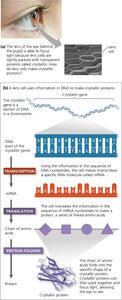
DNA encodes instructions for building molecules and establishing cell identity. Gene expression involves transcription (DNA to RNA) and translation (RNA to protein).
Genomics: Study of whole genomes.
Proteomics: Study of protein sets (proteomes).
Bioinformatics: Use of computers to analyze biological data.
Energy and Matter
Energy flows through ecosystems, entering as light and leaving as heat. Matter cycles within ecosystems, moving between organisms and the environment.
Interactions and Regulation
Feedback Regulation: Negative feedback reduces stimulus; positive feedback amplifies it.
Homeostasis: Maintenance of stable internal conditions (e.g., blood sugar regulation).
Scientific Inquiry and Method
Science involves forming and testing hypotheses through observation, experimentation, and analysis. Key concepts include control and experimental groups, variables, and reasoning (inductive and deductive).
The Chemical Context of Life
Matter, Elements, and Compounds
Matter is anything that takes up space and has mass. Elements are pure substances that cannot be broken down further; compounds are combinations of elements in fixed ratios.
Essential Elements: Needed for life (e.g., C, H, O, N).
Trace Elements: Required in minute quantities.
Atomic Structure
Atoms: Smallest unit of matter, composed of protons, neutrons, and electrons.
Isotopes: Variants of elements with different neutron numbers.
Radioactive Isotopes: Decay spontaneously, used in medicine and dating fossils.
Chemical Bonds
Covalent Bonds: Sharing of electrons between atoms.
Ionic Bonds: Attraction between oppositely charged ions.
Hydrogen Bonds: Weak attraction between hydrogen and electronegative atoms.
Van der Waals Interactions: Weak, transient attractions between molecules.
Chemical Reactions
Chemical reactions make and break bonds, rearranging atoms. Matter is conserved; reactions are reversible and reach equilibrium.
Water and Life
Properties of Water
Water is a polar molecule, forming hydrogen bonds that give rise to its unique properties:
Cohesion: Water molecules stick together.
Adhesion: Water molecules stick to other substances.
High Specific Heat: Water resists temperature changes.
Evaporative Cooling: Surface cools as water evaporates.
Ice Floats: Solid water is less dense than liquid.
Solvent of Life: Water dissolves many substances.
Acids, Bases, and pH
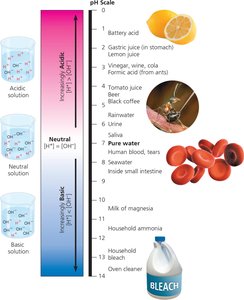
Acids increase H+ concentration; bases decrease it. The pH scale measures acidity and basicity.
pH < 7: Acidic
pH = 7: Neutral
pH > 7: Basic
Buffers: Substances that minimize pH changes.
The Structure and Function of Large Biological Molecules
Macromolecules: Polymers and Monomers
Macromolecules (carbohydrates, proteins, nucleic acids) are polymers built from monomers. Lipids are not true polymers.
Polymer: Long molecule of repeating units (monomers).
Monomer: Small building block molecule.
Dehydration and Hydrolysis Reactions
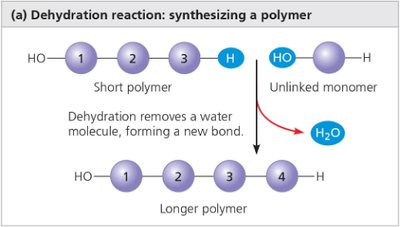
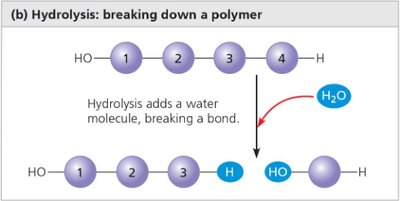
Polymers are synthesized by dehydration reactions (removal of water) and broken down by hydrolysis (addition of water).
Dehydration Reaction: Joins monomers, releases H2O.
Hydrolysis: Breaks polymers, adds H2O.
A Tour of the Cell
Internal Organization of Eukaryotic Cells
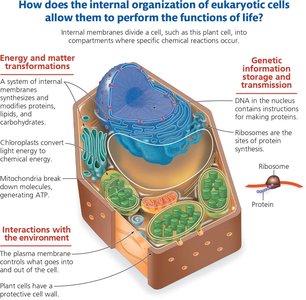
Eukaryotic cells are compartmentalized by internal membranes, allowing specialized functions in organelles.
Energy and Matter Transformations: Chloroplasts and mitochondria convert energy for cellular use.
Genetic Information Storage: DNA in the nucleus directs protein synthesis via ribosomes.
Interactions with Environment: Plasma membrane regulates exchange with surroundings.
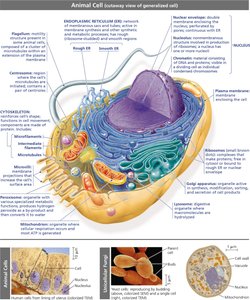
Animal Cell Structure
Animal cells contain various organelles, each with specific functions:
Nucleus: Stores genetic material.
Endoplasmic Reticulum (ER): Synthesizes proteins (rough ER) and lipids (smooth ER).
Golgi Apparatus: Modifies, sorts, and ships proteins.
Mitochondria: Site of cellular respiration and ATP production.
Lysosomes: Digest macromolecules.
Cytoskeleton: Provides structural support and facilitates movement.
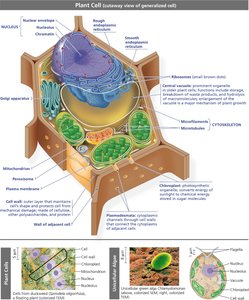
Plant Cell Structure
Plant cells share many organelles with animal cells but also have unique features:
Cell Wall: Provides structural support.
Chloroplasts: Site of photosynthesis.
Central Vacuole: Stores water and maintains cell turgor.
Plasmodesmata: Channels for communication between cells.
Additional info:
These notes cover foundational concepts from General Biology chapters 1–6, including cell structure, macromolecules, and basic chemistry relevant to life.
For equations, the pH of a solution is defined as .
Dehydration and hydrolysis reactions are central to the synthesis and breakdown of biological polymers.
Cellular compartmentalization is essential for efficient metabolic processes and genetic regulation.
