 Indietro
General Biology Study Notes: Photosynthesis, Cellular Respiration, and Metabolism
Guida di studio - Note intelligenti
 Appunti personalizzati basati sui tuoi materiali, ampliati con definizioni chiave, esempi e contesto.
Photosynthesis
Overview of Photosynthesis
Photosynthesis is the process by which autotrophic organisms convert light energy into chemical energy, producing glucose and oxygen from carbon dioxide and water. - Equation: - Location: Occurs in chloroplasts, specifically within the thylakoid membranes and stroma. - Importance: Provides energy and organic molecules for nearly all life forms. 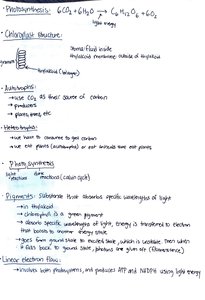
Chloroplast Structure
Chloroplasts are the site of photosynthesis in plant cells. - Stroma: Fluid matrix where the Calvin cycle occurs. - Thylakoid Membrane: Location of light-dependent reactions. - Grana: Stacks of thylakoids.
Light Reactions
Light reactions capture solar energy and convert it to chemical energy in the form of ATP and NADPH. - Occurs in: Thylakoid membranes - Inputs: Light, water, ADP, NADP+ - Outputs: Oxygen, ATP, NADPH - Photosystems: Complexes that absorb light and transfer electrons. 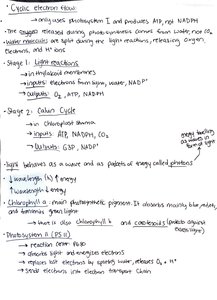
Calvin Cycle
The Calvin cycle uses ATP and NADPH to fix carbon dioxide and produce glucose. - Occurs in: Stroma of chloroplast - Inputs: CO2, ATP, NADPH - Outputs: Glucose, ADP, NADP+ - Key enzyme: Rubisco catalyzes the addition of CO2 to RuBP. 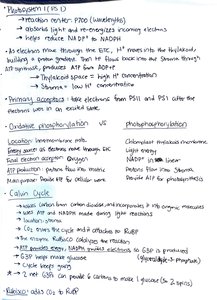
Pigments
Pigments absorb specific wavelengths of light, enabling photosynthesis. - Chlorophyll: Main pigment, absorbs blue and red light, reflects green. - Carotenoids: Accessory pigments, absorb additional wavelengths.
Electron Flow
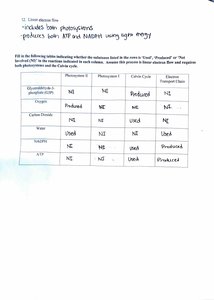
- Linear Electron Flow: Produces both ATP and NADPH using light energy. - Cyclic Electron Flow: Only uses Photosystem I, produces ATP but not NADPH.
Photorespiration
Photorespiration occurs when Rubisco incorporates O2 instead of CO2, reducing photosynthetic efficiency. - Minimization strategies: C4 and CAM plants have adaptations to minimize photorespiration. 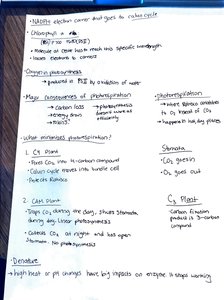
Summary Table: Photosynthesis Products and Reactants
Substance | Light Reactions | Calvin Cycle |
|---|---|---|
Oxygen | Produced | Not used |
Carbon Dioxide | Not used | Used |
ATP | Produced | Used |
NADPH | Produced | Used |
Glucose | Not produced | Produced |
Cellular Respiration
Overview of Cellular Respiration
Cellular respiration is the process by which cells extract energy from glucose, producing ATP, carbon dioxide, and water. - Equation: - Location: Cytoplasm and mitochondria 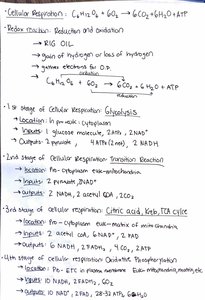
Stages of Cellular Respiration
1. Glycolysis: - Occurs in cytoplasm - Breaks down glucose into pyruvate - Produces 2 ATP, 2 NADH 2. Transition Reaction: - Converts pyruvate to acetyl-CoA - Produces NADH, CO2 3. Citric Acid Cycle (Krebs Cycle): - Occurs in mitochondrial matrix - Produces 2 ATP, 6 NADH, 2 FADH2, 4 CO2 4. Electron Transport Chain (ETC): - Occurs in inner mitochondrial membrane - Uses NADH and FADH2 to produce ATP - Oxygen is final electron acceptor 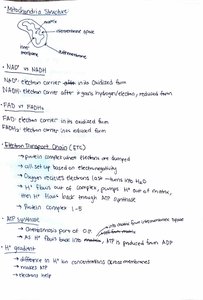
ATP Production
- Substrate-level phosphorylation: Direct transfer of phosphate to ADP - Oxidative phosphorylation: Uses ETC and chemiosmosis to produce ATP
Fermentation
Fermentation is an anaerobic process that allows glycolysis to continue in the absence of oxygen. - Types: Alcoholic (produces ethanol), Lactic acid (produces lactate)
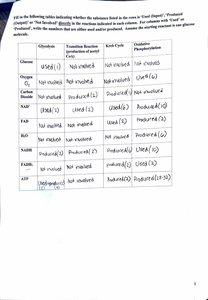
Summary Table: Cellular Respiration Products and Reactants
Substance | Glycolysis | Transition Reaction | Krebs Cycle | Oxidative Transport Chain |
|---|---|---|---|---|
Glucose | Used | Not involved | Not involved | Not involved |
Oxygen | Not involved | Not involved | Not involved | Used |
Carbon Dioxide | Not produced | Produced | Produced | Not produced |
ATP | Produced | Not produced | Produced | Produced |
NADH | Produced | Produced | Produced | Used |
FADH2 | Not produced | Not produced | Produced | Used |
Water | Not produced | Not produced | Not produced | Produced |
Metabolism and Energy
Catabolic and Anabolic Pathways
Metabolic pathways are classified as catabolic (breaking down molecules, releasing energy) or anabolic (building molecules, requiring energy). - Catabolic: Cellular respiration - Anabolic: Photosynthesis 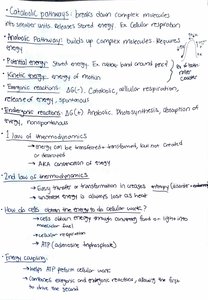
Energy Types and Laws
- Potential energy: Stored energy (e.g., chemical bonds) - Kinetic energy: Energy of motion - First Law of Thermodynamics: Energy cannot be created or destroyed - Second Law of Thermodynamics: Energy transformations increase entropy
Free Energy and Spontaneity
Free energy determines whether a reaction is spontaneous. - Gibbs Free Energy: - Negative indicates a spontaneous reaction 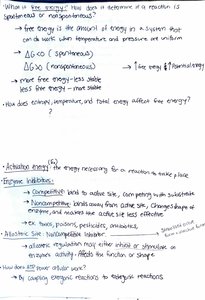
Enzymes and Catalysis
Enzymes are biological catalysts that lower activation energy, speeding up reactions. - Active site: Region where substrate binds - Enzyme inhibitors: Competitive (binds active site), Noncompetitive (binds elsewhere) - Factors affecting activity: Temperature, pH, substrate concentration 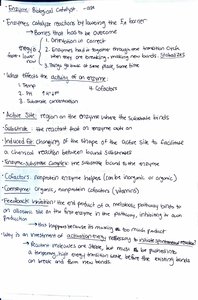
Energy Coupling
Cells couple exergonic and endergonic reactions to drive cellular processes, often using ATP as the energy currency.
Additional Info
- Photosystem I and II: Work together in light reactions to produce ATP and NADPH. - Primary electron acceptors: Accept electrons from excited chlorophyll molecules. - CAM and C4 plants: Adaptations to minimize water loss and photorespiration. - Denature: High heat or pH changes can denature enzymes, affecting their function. ----------------------------------------
