 Indietro
General Biology Study Notes: The Chemical Context of Life
Guida di studio - Note intelligenti
 Appunti personalizzati basati sui tuoi materiali, ampliati con definizioni chiave, esempi e contesto.
The Chemical Context of Life
Introduction to Chemistry in Biology
Chemistry forms the foundation of biological processes, as all living organisms are composed of matter and interact through chemical reactions. Understanding the chemical context of life is essential for grasping how biological molecules function and interact.
Concept 2.1: Matter, Elements, and Compounds
Definition and Properties
Matter: Anything that takes up space and has mass.
Element: A substance that cannot be broken down to other substances by chemical reactions.
Compound: A substance consisting of two or more elements in a fixed ratio. Compounds have emergent properties distinct from their constituent elements.
Example: Sodium (Na) and chlorine (Cl) are elements; when combined, they form sodium chloride (NaCl), a compound with properties different from either element.
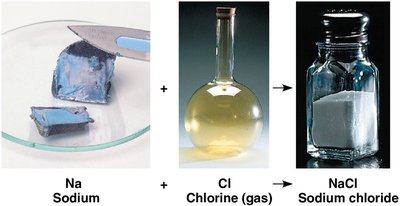
Emergent Properties of Compounds
Compounds exhibit new properties not found in their individual elements.
These properties arise from the specific arrangement and bonding of atoms.
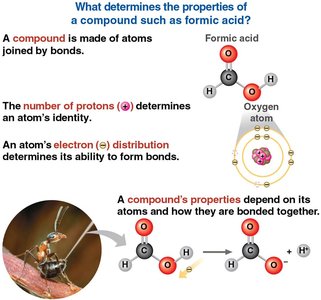
The Elements of Life
Essential Elements and Trace Elements
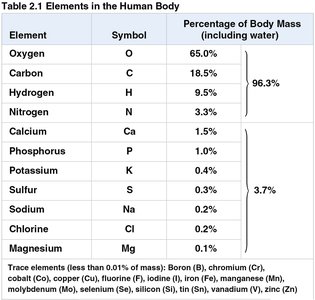
About 20–25% of the 92 natural elements are essential for life.
Four elements—carbon, hydrogen, oxygen, and nitrogen—make up 96% of living matter.
The remaining 4% includes calcium, phosphorus, potassium, and sulfur.
Trace elements are required in minute quantities (e.g., iron, zinc).
Element | Symbol | Percentage of Body Mass |
|---|---|---|
Oxygen | O | 65.0% |
Carbon | C | 18.5% |
Hydrogen | H | 9.5% |
Nitrogen | N | 3.3% |
Calcium | Ca | 1.5% |
Phosphorus | P | 1.0% |
Potassium | K | 0.4% |
Sulfur | S | 0.3% |
Sodium | Na | 0.2% |
Chlorine | Cl | 0.2% |
Magnesium | Mg | 0.1% |
Concept 2.2: Atomic Structure and Properties
Atoms and Subatomic Particles
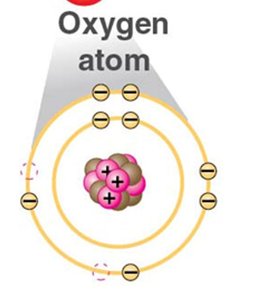
Atom: The smallest unit of matter retaining the properties of an element.
Subatomic particles: Protons (positive charge), Neutrons (no charge), Electrons (negative charge).
Protons and neutrons form the atomic nucleus; electrons form a cloud around the nucleus.
Atomic Number and Atomic Mass
Atomic number: Number of protons in the nucleus.
Mass number: Sum of protons and neutrons.
Atomic mass: Total mass of an atom, approximated by mass number.
Isotopes
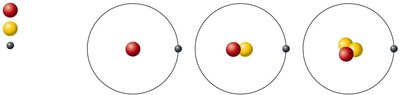
Atoms of the same element with different numbers of neutrons are called isotopes.
Radioactive isotopes decay spontaneously, emitting particles and energy.
Applications of Isotopes
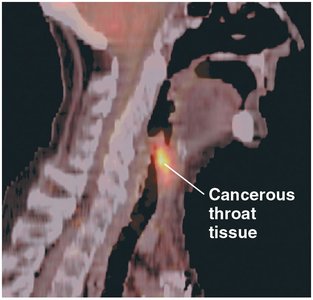
Radioactive tracers are used in medicine to track metabolic processes.
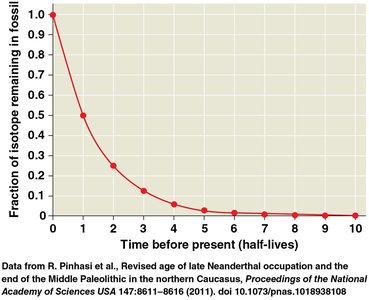
Radiometric dating uses the decay of isotopes to estimate the age of fossils and rocks.
Concept 2.2: Energy Levels of Electrons
Electron Shells and Potential Energy
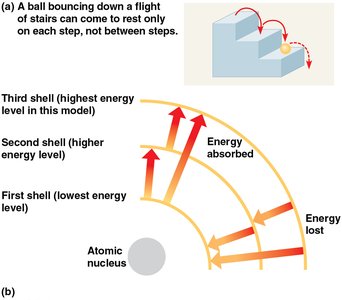
Energy: Capacity to cause change; potential energy depends on location or structure.
Electrons occupy shells with distinct energy levels; energy is absorbed or lost as electrons move between shells.
Electron Distribution and Chemical Properties
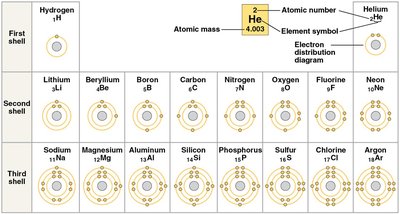
The distribution of electrons in shells determines an atom's chemical behavior.
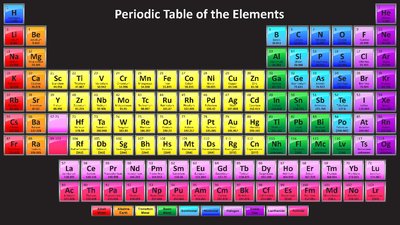
The periodic table reflects electron distribution for each element.
Valence Electrons and Orbitals
Valence electrons: Electrons in the outermost shell; determine chemical reactivity.
Orbitals: 3D spaces where electrons are found 90% of the time; each shell has a specific number of orbitals.
Concept 2.3: Chemical Bonding
Covalent Bonds
Covalent bond: Sharing of a pair of valence electrons between two atoms.
Single bond: One pair shared; double bond: Two pairs shared.
Electronegativity: Atom's ability to attract electrons in a covalent bond.
Nonpolar covalent bond: Electrons shared equally; polar covalent bond: Unequal sharing, resulting in partial charges.
Ionic Bonds
Atoms may transfer electrons, forming ions.
Cation: Positively charged ion; Anion: Negatively charged ion.
Ionic bond: Attraction between cation and anion.
Ionic compounds (salts) are stable when dry, but dissociate easily in water.
Weak Chemical Interactions
Weak bonds (hydrogen bonds, van der Waals interactions) stabilize large biological molecules.
Hydrogen bonds: Form when hydrogen covalently bonded to an electronegative atom is attracted to another electronegative atom.
Van der Waals interactions: Result from transient local partial charges.
Molecular Shape and Function
Molecular shape is determined by the positions of atom orbitals.
Shape is crucial for biological recognition and function (e.g., drug-receptor interactions).
Additional info:
Atoms interact to complete their valence shells, leading to the formation of molecules and compounds essential for life.
Emergent properties, such as those seen in compounds, are fundamental to understanding biological complexity.
