 Indietro
General Biology Unit 2 Study Guide – Step-by-Step Guidance
Guida di studio - Note intelligenti
 Appunti personalizzati basati sui tuoi materiali, ampliati con definizioni chiave, esempi e contesto.
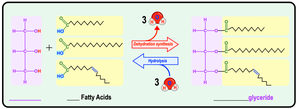
Q1. What are the building blocks of fats? Label them on this figure. Also label the ester linkages.
Background
Topic: Lipids – Structure and Formation
This question tests your understanding of the molecular structure of fats (triglycerides), including the components that make up fats and the type of bond formed during their synthesis.
Key Terms and Formulas
Glycerol: A three-carbon alcohol with a hydroxyl group attached to each carbon.
Fatty Acid: A long hydrocarbon chain with a carboxyl group at one end.
Ester Linkage: The bond formed between the hydroxyl group of glycerol and the carboxyl group of a fatty acid during dehydration synthesis.
Dehydration Synthesis: A chemical reaction that joins two molecules by removing a water molecule.
Step-by-Step Guidance
Examine the diagram: Identify the two types of molecules shown on the left side (glycerol and three fatty acids).
Recall that during fat synthesis, each fatty acid forms a bond with one of the hydroxyl groups on glycerol. This bond is called an ester linkage.
For each ester linkage formed, a water molecule is removed (dehydration synthesis). Count how many water molecules are produced when three fatty acids are attached to one glycerol.
Label the glycerol backbone, the fatty acid chains, and the ester linkages on the diagram. Make sure you can identify where the water molecules are removed.
Try solving on your own before revealing the answer!
Final Answer:
The building blocks of fats are glycerol and fatty acids. In the diagram, the left side shows one glycerol molecule (vertical, with three -OH groups) and three fatty acids (long chains with -COOH groups). The ester linkages are the bonds formed between the -OH of glycerol and the -COOH of each fatty acid. Three water molecules are removed in the process, one for each ester linkage formed. This process is called dehydration synthesis.
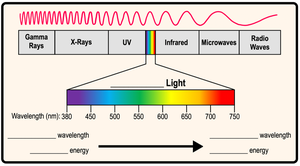
Q2. Glycolysis occurs __________ mitochondria, in the cell's __________.
Background
Topic: Cellular Respiration – Glycolysis
This question tests your knowledge of where glycolysis takes place within a eukaryotic cell and its relationship to the mitochondria.
Key Terms and Concepts
Glycolysis: The first step of cellular respiration, where glucose is broken down into two molecules of pyruvate.
Cytosol: The fluid portion of the cytoplasm where glycolysis occurs.
Mitochondria: The organelle where later steps of cellular respiration (pyruvate oxidation, citric acid cycle, electron transport chain) occur.
Step-by-Step Guidance
Recall the main steps of cellular respiration: glycolysis, pyruvate oxidation, citric acid cycle, and electron transport chain.
Identify which step occurs outside the mitochondria and which steps occur inside.
Think about the location of glycolysis in relation to the cell's organelles. Is it inside or outside the mitochondria?
Fill in the blanks with the correct terms for the location of glycolysis.
Try solving on your own before revealing the answer!
Final Answer:
Glycolysis occurs outside mitochondria, in the cell's cytosol (or cytoplasm). This is the first step of cellular respiration and does not require mitochondria or oxygen.
Q3. The 10 individual steps of glycolysis can be divided into two stages: energy investment and energy payoff. These steps are shown in the figure below. Label the figure, this will help you focus your study and memorize the energy flow in glycolysis.
Background
Topic: Glycolysis – Phases and Energy Flow
This question is about understanding the two main phases of glycolysis and the energy changes that occur during each phase.
Key Terms and Concepts
Energy Investment Phase: The first phase of glycolysis, where ATP is consumed to phosphorylate glucose and its intermediates.
Energy Payoff Phase: The second phase of glycolysis, where ATP and NADH are produced.
Net Products: The overall gain of ATP and NADH after accounting for what was used and produced.
Step-by-Step Guidance
Identify the two phases of glycolysis in the diagram: the energy investment phase and the energy payoff phase.
Recall how many ATP molecules are used in the investment phase and how many are produced in the payoff phase.
Determine the net gain of ATP and NADH from one molecule of glucose after both phases are complete.
Label the diagram with the correct number of ATP used, ATP produced, and NADH produced in each phase.
Try solving on your own before revealing the answer!
Final Answer:
In glycolysis, the energy investment phase uses 2 ATP molecules, and the energy payoff phase produces 4 ATP and 2 NADH molecules. The net products from one glucose molecule are 2 ATP (4 produced - 2 used) and 2 NADH.
Q4. Glycolysis results in 2 pyruvate molecules, which are then transported to the mitochondrial __________. Pyruvate Oxidation: 2nd step of cellular respiration that converts each pyruvate into a molecule of Acetyl-__________.
Background
Topic: Cellular Respiration – Pyruvate Oxidation
This question tests your understanding of the fate of pyruvate after glycolysis and the location and products of pyruvate oxidation.
Key Terms and Concepts
Pyruvate: The end product of glycolysis, a three-carbon molecule.
Mitochondrial Matrix: The compartment inside the mitochondria where pyruvate oxidation occurs.
Acetyl-CoA: The molecule formed from pyruvate during pyruvate oxidation, which enters the citric acid cycle.
Step-by-Step Guidance
Recall where pyruvate travels after being produced in glycolysis (from the cytosol to a specific part of the mitochondria).
Identify the name of the compartment inside the mitochondria where pyruvate oxidation takes place.
Remember the product of pyruvate oxidation that enters the citric acid cycle.
Fill in the blanks with the correct terms for the location and product of pyruvate oxidation.
Try solving on your own before revealing the answer!
Final Answer:
Glycolysis results in 2 pyruvate molecules, which are then transported to the mitochondrial matrix. Pyruvate oxidation converts each pyruvate into a molecule of Acetyl-CoA.
