 Indietro
General Chemistry for Biology: The Chemical Context of Life
Guida di studio - Note intelligenti
 Appunti personalizzati basati sui tuoi materiali, ampliati con definizioni chiave, esempi e contesto.
General Chemistry for Biology
The Chemical Context of Life
Chemistry forms the foundation for understanding biological processes. All living organisms are composed of matter, which is anything that occupies space and has mass. The study of matter and its interactions is essential for grasping the molecular basis of life.
Matter and Elements
Definitions and Properties
Matter: Anything that takes up space and has mass.
Mass: The measure of the amount of matter in an object, independent of gravity.
Weight: The measure of gravitational pull on an object; varies with location.
Element: A pure substance that cannot be broken down by ordinary chemical means. There are 92 naturally occurring elements, each with a unique symbol (1-2 letters).
Of the 92 elements, about 25 are essential for life. Six elements—Carbon (C), Hydrogen (H), Nitrogen (N), Oxygen (O), Phosphorus (P), and Sulfur (S)—make up 96-99% of living matter. These are often remembered by the acronym "CHNOPS." Trace elements such as iron, magnesium, calcium, and iodine are required in minute quantities but are vital for biological functions.
Atoms and Subatomic Particles
Energy - Often explained as the ability to do work.
While energy can take many forms like light, sound, heat, etc., what these forms have in common is the ability to effect change. This is often described as the ability to do work.
Structure of the Atom
An atom is the smallest unit of an element that retains its chemical properties. Atoms are composed of three types of subatomic particles:
Protons (p+): Positively charged, located in the nucleus, mass = 1 atomic mass unit (amu).
Neutrons (n): No charge, located in the nucleus, mass = 1 amu.
Electrons (e-): Negatively charged, orbit the nucleus in energy levels (shells), mass is negligible (1/2000 amu).
The elementary particles in an atom are protons, neutrons, and electrons. Protons carry positive charges and electrons carry negative charges. Neutrons, as their name suggests, are electrically neutral and add no charge to the atom. The protons and neutrons are clustered together inside the nucleus of the atom, while the electrons move around the outside of the nucleus in the electron cloud.
The atomic number is the number of protons in an atom and defines the element. The mass number is the sum of protons and neutrons. In a neutral atom, the number of protons equals the number of electrons. If an atom has a net negative charge, it must have more electrons than protons. Protons carry positive charges and electrons carry negative charges. Neutrons, as their name suggests, are electrically neutral and add no charge to the atom. For an atom to carry a net negative charge, the number of negative charges (electrons) must be greater than the number of positive charges (protons). Atoms that carry net charges are called ions; in particular, ions with negative charges are called anions, and ions with positive charges are called cations.
Electron Arrangement
Electrons occupy concentric energy levels (shells) around the nucleus.
The innermost shell holds up to 2 electrons; the second and third shells hold up to 8 electrons each.
Electrons fill the lowest available energy level first.
Isotopes and Ions
Isotopes
Isotopes are atoms of the same element with different numbers of neutrons, resulting in different mass numbers. Most elements have several isotopes, some of which are radioactive and decay over time, emitting radiation. Some elements have different isotopes, meaning they have differet numbers of neutrons in the nuclei of their atoms. For example, nitrogen always has a mass number of 7 (meaning 7 protons in its nucleus) but can have 7 or 8 neutrons. The name "nitrogen-14" indicates 7 protons + 7 neutrons = atomic mass of 14. The name "nitrogen-15" indicates 7 protons + 8 neutrons = atomic mass of 15. Atoms of the same element that have different numbers of neutrons are called Isotopes.
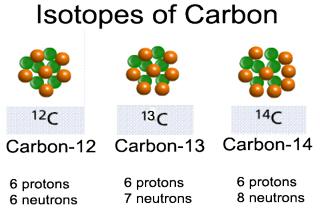
Radioactive isotopes are used in geological dating and as biological tracers in medicine and research.
Half-life: The time required for half of a radioactive sample to decay.
Ions
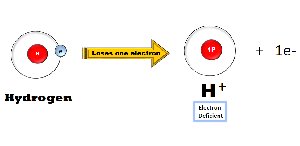
Ions are atoms or molecules that have gained or lost electrons, resulting in a net charge. Cations are positively charged (lost electrons), and anions are negatively charged (gained electrons). Standard Atom of Carbon is 12^C
Chemical Bonds
Ionic Bonds
An ionic bond forms when one atom donates an electron to another, resulting in oppositely charged ions that attract each other. Example: Sodium chloride (NaCl).
Stability is achieved when atoms have a complete outer shell of electrons (usually 8, known as the octet rule).
Covalent Bonds
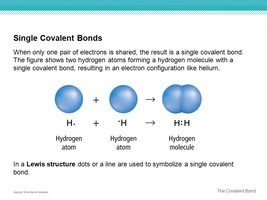
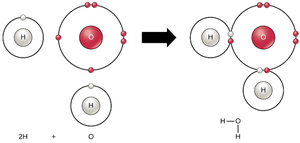
A covalent bond forms when two atoms share one or more pairs of electrons, allowing both to achieve a stable electron configuration. Covalent bonds are strong and form the backbone of biological molecules.
Water: Structure and Properties
Chemical Structure of Water
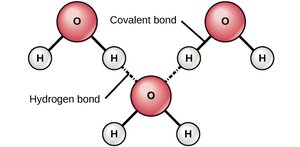
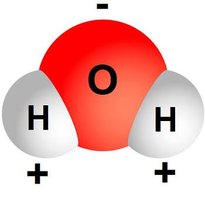
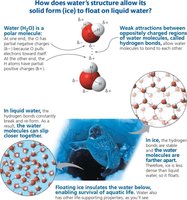
Water (H2O) is a polar molecule formed by covalent bonds between one oxygen and two hydrogen atoms. Oxygen is more electronegative, creating a partial negative charge near the oxygen and partial positive charges near the hydrogens.
Hydrogen Bonds
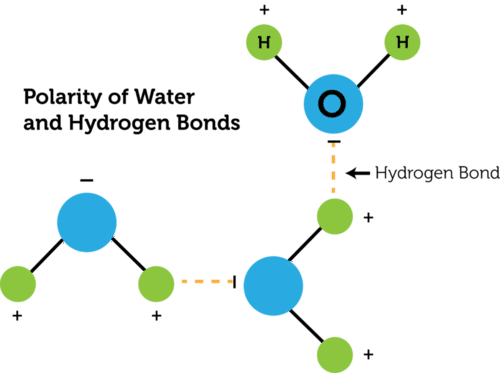
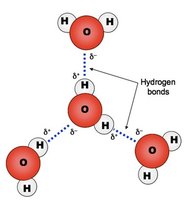
Hydrogen bonds are weak attractions between the slightly positive hydrogen atom of one water molecule and the slightly negative oxygen atom of another. Individually weak, these bonds are collectively strong and give water its unique properties.
Unique Properties of Water
Expansion upon freezing: Water expands as it freezes due to hydrogen bonds locking molecules in a lattice, making ice less dense than liquid water. This allows ice to float, insulating aquatic life in winter.
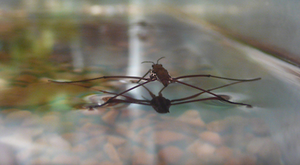
Cohesion and Surface Tension: Water molecules stick together (cohesion) due to hydrogen bonding, resulting in high surface tension. This allows small insects to walk on water.
Acids, Bases, and pH
Acids and Bases
Acid: A substance that increases the concentration of H+ ions in solution (proton donor).
Base: A substance that decreases the concentration of H+ ions, often by accepting them (proton acceptor).
pH Scale
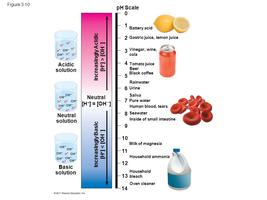
The pH scale measures the concentration of hydrogen ions in a solution, ranging from 0 (most acidic) to 14 (most basic). Each unit represents a tenfold change in H+ concentration.
Acid Rain and Environmental Impact
Normal rainwater is slightly acidic (pH 5.6) due to dissolved CO2 forming carbonic acid.
Industrial pollution can lower rainwater pH further, causing acid precipitation that harms ecosystems and accelerates soil erosion.
Soil formation depends on the gradual breakdown of rock by mildly acidic rainwater, which is essential for sustaining terrestrial life.
Environmental Chemistry: Ozone and Pollution
Ozone Layer and CFCs
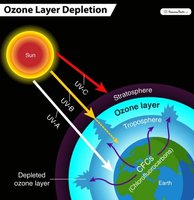
The ozone layer (O3) protects Earth from harmful ultraviolet (UV) radiation. Chlorofluorocarbons (CFCs), once used in aerosols, deplete ozone, increasing UV exposure and environmental risks.

Summary Table: Subatomic Particles
Subatomic Particle | Charge | Mass (amu) | Location |
|---|---|---|---|
Proton | +1 | 1 | Nucleus |
Neutron | 0 | 1 | Nucleus |
Electron | -1 | 1/2000 | Electron cloud (shells) |
Key Equations
Number of neutrons = Mass number – Atomic number
pH =
Additional info:
Radioactive isotopes are used in medicine for imaging and treatment, but require careful handling due to potential hazards.
Soil erosion and acidification are ongoing environmental concerns, emphasizing the importance of sustainable practices and pollution control.
Radioactive isotopes are atoms with unstable nuclei that emit radiation as they decay, making them detectable with specialized instruments.
Chemically, radioactive isotopes behave almost identically to their stable counterparts because they have the same number of electrons and thus the same chemical properties.
When introduced into the body, these isotopes participate in normal biological processes, just like stable isotopes would.
Their radioactivity allows medical professionals to track their movement and concentration within the body using imaging techniques, such as PET scans.
This combination of chemical similarity and detectability makes radioactive isotopes valuable as tracers in medical diagnostics, enabling visualization of physiological processes without altering them.
