 Indietro
Genetic Variation and Evolutionary Mechanisms in Populations Part 3: Week 1 Exam 2
Guida di studio - Note intelligenti
 Appunti personalizzati basati sui tuoi materiali, ampliati con definizioni chiave, esempi e contesto.
Genetic Variation at the Molecular Level
DNA Sequence Variation and Its Effects
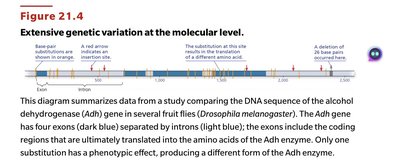
Genetic variation is a fundamental aspect of evolution, arising from differences in DNA sequences among individuals. The diagram below illustrates the molecular variation in the alcohol dehydrogenase (Adh) gene in fruit flies (Drosophila melanogaster), highlighting how mutations can occur in both exons and introns.
Exons: Coding regions (dark blue) that are translated into amino acids of the enzyme.
Introns: Non-coding regions (light blue) that separate exons.
Mutations: Substitutions, insertions, and deletions can occur at various points in the gene, sometimes affecting the phenotype.
Phenotypic Effect: Only certain mutations (e.g., a single substitution) may alter the enzyme's function.
Genetic Drift
Random Changes in Allele Frequencies
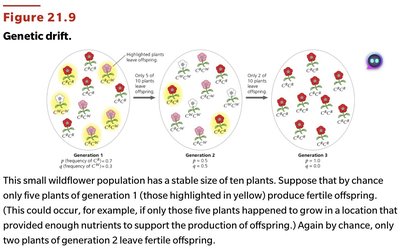
Genetic drift is a mechanism of evolution that involves random fluctuations in allele frequencies within a population, especially pronounced in small populations. The example below shows how chance events can lead to significant changes in genetic composition across generations.
Small Population Size: Drift is most impactful when populations are small.
Random Fertility: Only a subset of individuals may leave offspring, not necessarily those with advantageous traits.
Generational Change: Over successive generations, genetic drift can reduce genetic diversity and lead to fixation or loss of alleles.
Example: In a population of wildflowers, only a few individuals produce fertile offspring each generation, leading to random changes in flower color frequencies.
Modes of Selection
Types of Natural Selection
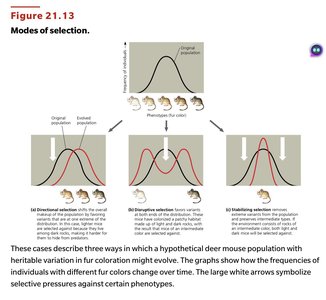
Natural selection acts on heritable variation in populations, shaping the distribution of phenotypes. The graphs below illustrate three primary modes of selection in a hypothetical deer mouse population with variable fur coloration.
Directional Selection: Favors one extreme phenotype, shifting the population's trait distribution in one direction.
Disruptive Selection: Favors both extreme phenotypes over intermediate ones, potentially leading to a bimodal distribution.
Stabilizing Selection: Favors intermediate phenotypes, reducing variation and maintaining the status quo.
Selective Pressures: Represented by arrows, these pressures act against certain phenotypes, influencing evolutionary outcomes.
Summary Table: Modes of Selection
Mode of Selection | Effect on Population | Example |
|---|---|---|
Directional | Shifts trait distribution toward one extreme | Darker fur favored in a soot-covered environment |
Disruptive | Favors extremes, reduces intermediates | Both very light and very dark fur favored |
Stabilizing | Favors intermediate traits, reduces extremes | Medium fur color favored in a mixed environment |
Key Equations
Allele Frequency:
Hardy-Weinberg Principle:
Additional info: These concepts are central to Chapter 21 (Genomes and Their Evolution) and Chapter 23 (The Evolution of Populations) in General Biology, providing foundational understanding for population genetics and evolutionary mechanisms.
