 Indietro
Genetic Variation in Sexual Life Cycles: Mechanisms and Evolutionary Significance Part 2
Guida di studio - Note intelligenti
 Appunti personalizzati basati sui tuoi materiali, ampliati con definizioni chiave, esempi e contesto.
Genetic Variation and Evolution
Introduction to Genetic Variation
Genetic variation is essential for evolution and is produced through several mechanisms in sexual life cycles. The original source of genetic diversity is mutation, which creates different versions of genes known as alleles. The reshuffling of alleles during sexual reproduction further increases genetic variation among offspring.
Mutation: A change in an organism’s DNA, creating new alleles.
Alleles: Different versions of the same gene.
Genetic Shuffling: The process of mixing alleles during sexual reproduction.
Origins of Genetic Variation Among Offspring
Mechanisms Contributing to Genetic Variation
Three primary mechanisms contribute to genetic variation in sexually reproducing organisms:
Independent assortment of chromosomes
Crossing over
Random fertilization
Independent Assortment of Chromosomes
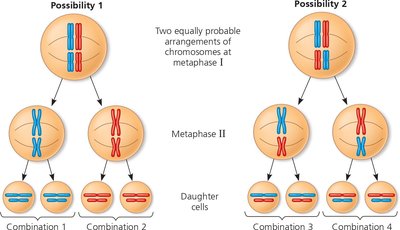
Random Orientation at Metaphase I
During meiosis I, homologous pairs of chromosomes align randomly at the metaphase plate. This random orientation determines how chromosomes are distributed into daughter cells, resulting in a mix of maternal and paternal chromosomes.
Equal Chance of Inheritance: Each homologous pair has a 50/50 chance of passing either the maternal or paternal chromosome to a daughter cell.
Independent Segregation: Each pair segregates independently, leading to diverse combinations.
Number of Possible Combinations
The number of possible combinations when chromosomes assort independently into gametes is given by , where n is the haploid number.
Example: For humans, , so possible combinations.
Crossing Over
Formation of Recombinant Chromosomes
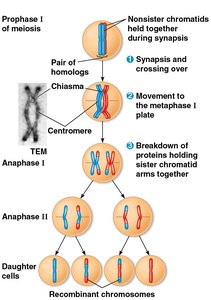
Crossing over occurs during meiosis and produces recombinant chromosomes, which combine genes inherited from each parent. This process is a major source of genetic diversity.
Crossover Events: In humans, 1 to 3 crossover events typically occur per chromosome pair.
Factors Affecting Crossover: Chromosome size and centromere position influence the number of crossovers.
Role of Crossing Over in Genetic Variation
Mechanism: Crossing over mixes DNA from both parents into a single chromosome.
Outcome: Increases genetic variation in offspring.
Independent Assortment at Metaphase II: Nonidentical sister chromatids are sorted independently, further increasing genetic diversity.
Random Fertilization
Contribution to Genetic Variation
Random fertilization refers to the process where any sperm can fuse with any egg, resulting in significant genetic variation.
Egg and Sperm Combinations: Each egg and sperm represents one of approximately 8.4 million possible chromosome combinations.
Genetic Possibilities in the Zygote: A fertilized egg (zygote) could have over 70 trillion possible diploid chromosome combinations ( million × million).
Additional Variation: Crossing over during meiosis introduces even more genetic variation.
Unique Genetic Identity: Each zygote has a unique genetic identity, even among siblings.
Summary Table: Mechanisms of Genetic Variation
Mechanism | Description | Contribution to Variation |
|---|---|---|
Mutation | Changes in DNA sequence | Creates new alleles |
Independent Assortment | Random distribution of chromosomes | Mixes maternal and paternal chromosomes |
Crossing Over | Exchange of genetic material between homologous chromosomes | Produces recombinant chromosomes |
Random Fertilization | Any sperm can fuse with any egg | Combines diverse gametes |
Sample Exam Questions
If n is the haploid number of chromosomes in an organism, how many combinations are possible when chromosomes assort independently into gametes? Answer:
Recombinant chromosomes are produced by: Answer: Crossing over
What are sources of genetic variation? Answer: Mutations and genetic shuffling
Different versions of the same gene are known as: Answer: Alleles
What is the evolutionary purpose of cells that undergo crossing over? Answer: To increase genetic diversity
What structures exchange genetic material during crossing over? Answer: Nonsister chromatids
Crossing over typically occurs between which of the following structures? Answer: Homologous chromosomes
Conclusion
The mechanisms of mutation, independent assortment, crossing over, and random fertilization collectively ensure that each offspring has a unique genetic makeup. This genetic diversity is fundamental to evolution and adaptation in populations. Additional info: The diagrams included visually reinforce the concepts of independent assortment and crossing over, which are central to understanding genetic variation in meiosis.
