 Indietro
Global Patterns in Climate and Ecology: Study Notes for General Biology
Guida di studio - Note intelligenti
 Appunti personalizzati basati sui tuoi materiali, ampliati con definizioni chiave, esempi e contesto.
Ecology: The Big Picture
Introduction to Ecology
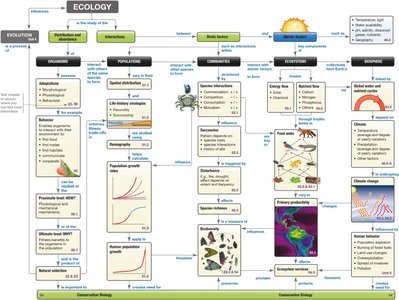
Ecology is the scientific study of interactions among organisms and their environment, encompassing both biotic (living) and abiotic (non-living) factors. Understanding ecological principles is essential for grasping how life is distributed and how environmental conditions shape biological communities.
Biotic factors: Interactions with living organisms, such as competition, predation, and symbiosis.
Abiotic factors: Non-living environmental components, including temperature, precipitation, sunlight, and geography.
Climate vs. Weather: Climate refers to prevailing, long-term weather conditions, while weather describes short-term atmospheric events.
Global Climate Patterns
Seasonality and Earth's Tilt
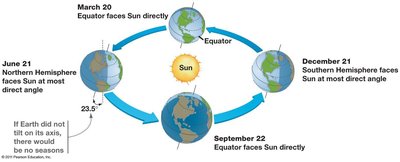
The Earth's seasons are caused by its 23.5º tilt on its axis, resulting in regular, annual fluctuations in temperature and precipitation. This tilt affects the angle at which sunlight strikes different regions, leading to variations in day length and temperature throughout the year.
High seasonality: Regions with significant variation in day length and temperature (e.g., temperate zones).
Low seasonality: Regions near the equator with minimal variation in day length and temperature.
Latitudinal Variation in Temperature
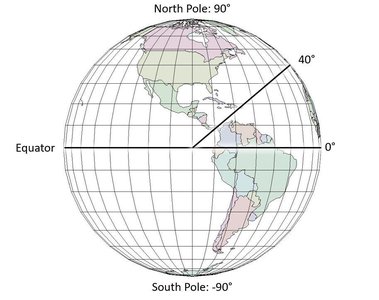
The tropics are warm and the poles are cold due to differences in the angle and intensity of incoming sunlight. Sunlight strikes the equator directly, delivering more energy per unit area, while at higher latitudes, sunlight arrives at a lower angle and is spread over a larger area, resulting in cooler temperatures.
Equator: Receives direct sunlight, leading to high temperatures.
Pole regions: Receive sunlight at a low angle, resulting in lower temperatures.
Atmospheric Circulation and Precipitation
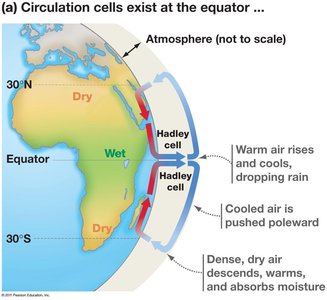
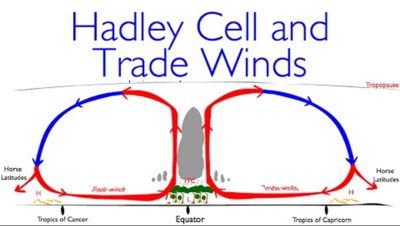
Global air circulation patterns, such as Hadley cells, drive the distribution of moisture and create distinct climate zones.
Hadley cell: A major cycle in global air circulation responsible for wet conditions at the equator and dry conditions at 30º N and 30º S.
Deserts: Typically found at 30º N and 30º S due to descending dry air.
Rainforests: Located near the equator where rising warm air cools and drops rain.
Wind Patterns and Climate Cycles
Wind patterns, including trade winds and westerlies, influence the distribution of precipitation and temperature. Cyclic events such as El Niño and La Niña further affect global climate by altering oceanic and atmospheric conditions.
El Niño: A climate pattern characterized by warming of the Pacific Ocean, leading to changes in weather worldwide.
La Niña: The opposite phase, with cooler Pacific Ocean temperatures and different global impacts.
Regional Climate Effects
Mountain Ranges and the Rain Shadow Effect
Physical features such as mountain ranges can produce extremes in precipitation through the rain shadow effect. Winds from the ocean cool and drop precipitation on one side of a mountain range, while the other side remains dry, often creating high deserts.
Rain shadow: The dry region on the leeward side of a mountain range.
Windward side: Receives high precipitation as moist air rises and cools.
Biomes and Species Distribution
Definition and Classification of Biomes
A biome is a major ecological community type, defined primarily by its climate, geography, and dominant vegetation. Temperature, precipitation, and geography determine the location and characteristics of biomes across the planet.
Examples of biomes: Tropical rainforest, desert, temperate forest, tundra.
Species richness: The number of different species present in a biome, influenced by both abiotic and biotic factors.
Summary Table: Climate Zones and Biome Distribution
Latitude | Climate | Biome Type | Precipitation |
|---|---|---|---|
Equator (0º) | Hot, Wet | Tropical Rainforest | High |
30º N/S | Hot, Dry | Desert | Low |
60º N/S | Cool, Wet | Temperate Forest | Moderate-High |
90º N/S (Poles) | Cold, Dry | Tundra | Low |
Key Terms and Concepts
Abiotic factors: Non-living environmental variables (temperature, precipitation, sunlight, geography).
Biotic factors: Living components of the environment (plants, animals, microbes).
Climate: Long-term patterns of temperature and precipitation.
Weather: Short-term atmospheric conditions.
Biome: Major ecological community defined by climate and vegetation.
Hadley cell: Atmospheric circulation pattern responsible for wet equatorial and dry subtropical regions.
Rain shadow: Dry area on the leeward side of a mountain range.
Equations and Academic Context
Solar Energy Distribution
The amount of solar energy received per unit area decreases with increasing latitude due to the angle of sunlight.
Solar energy per unit area: where is energy per unit area, is incoming solar radiation, and is the area over which it is distributed.
Atmospheric Circulation
Hadley cell circulation: Warm air rises at the equator, cools and drops rain, then descends as dry air at 30º N/S.
Additional info:
Some content was inferred from context and standard General Biology curriculum, especially regarding biomes and climate zones.
Images were included only when directly relevant to the explanation of global climate patterns, atmospheric circulation, and regional effects.
